The Use of Problem-Based Learning to Develop Awareness of Life and Death among Grade 12 Students
Abstract
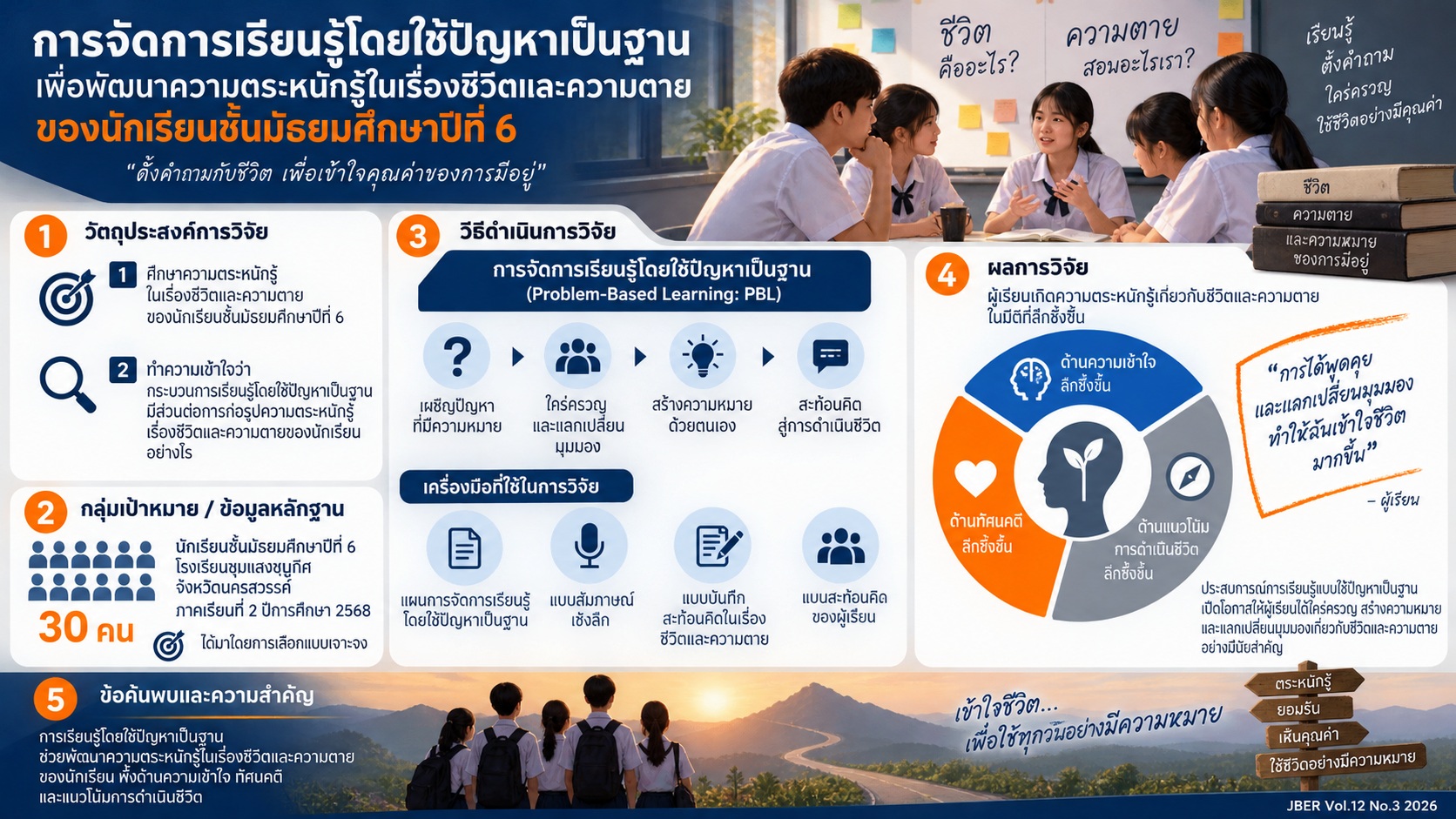
The independent study entitled “The Use of Problem-Based Learning to Develop Awareness of Life and Death among Grade 12 Students” aimed to (1) examine students’ awareness of life and death and (2) develop such awareness through Problem-Based Learning (PBL). The target group consisted of 30 Grade 12 students at Chumsaeng Chanuthit School, Nakhon Sawan Province, during the second semester of the 2025 academic year. The participants were selected through purposive sampling. The research instruments included PBL-based lesson plans, a life and death awareness scale, and student reflection forms.
The results revealed that after the learning activities, students demonstrated a higher level of awareness of life and death. They showed a better understanding of the nature of life and death, recognized the value of mindful living, and accepted the impermanence of life appropriately. Moreover, the PBL process enhanced students’ critical thinking, collaborative learning, and reflective thinking. In conclusion, Problem-Based Learning effectively developed students’ awareness of life and death.
Keyword: Problem-Based Learning, Life and Death Awareness, Death Education, High School Students
References
Barrows, H. S., & Tamblyn, R. M. (1980). Problem-based learning: An approach to medical education. Springer.
Braun, V., & Clarke, V. (2006). Using thematic analysis in psychology. Qualitative Research in Psychology, 3(2), 77–101. https://doi.org/10.1191/1478088706qp063oa
Cheng, F. K. (2017). Buddhist insights into life and death: Overcoming death anxiety. Athens Journal of Social Sciences, 4(1), 67–88. https://doi.org/10.30958/ajss.4-1-4
Creswell, J. W., & Poth, C. N. (2018). Qualitative inquiry and research design: Choosing among five approaches (4th ed.). SAGE Publications.
DeMaranville, J., Wongpakaran, T., Wongpakaran, N., & Wedding, D. (2025). Buddha image meditation is a potent predictor for mental health outcomes: A cross-sectional study among Thai high-school students. PLOS ONE, 20(6), e0326432. https://doi.org/10.1371/journal.pone.0326432
Dolmans, D. H. J. M., De Grave, W., Wolfhagen, I. H. A. P., & Van der Vleuten, C. P. M. (2005). Problem-based learning: Future challenges for educational practice and research. Medical Education, 39(7), 732–741. https://doi.org/10.1111/j.1365-2929.2005.02205.x
Hmelo-Silver, C. E. (2004). Problem-based learning: What and how do students learn? Educational Psychology Review, 16(3), 235–266. https://doi.org/10.1023/B:EDPR.0000034022.16470.f3
Kolb, D. A. (1984). Experiential learning: Experience as the source of learning and development. Prentice-Hall.
Lincoln, Y. S., & Guba, E. G. (1985). Naturalistic inquiry. SAGE Publications.
Miles, M. B., Huberman, A. M., & Saldaña, J. (2014). Qualitative data analysis: A methods sourcebook (3rd ed.). SAGE Publications.
Patton, M. Q. (2015). Qualitative research and evaluation methods (4th ed.). SAGE Publications.
Piaget, J. (1972). The psychology of the child. Basic Books.
Savery, J. R., & Duffy, T. M. (1995). Problem based learning: An instructional model and its constructivist framework. Educational Technology, 35(5), 31–38.
Vygotsky, L. S. (1978). Mind in society: The development of higher psychological processes. Harvard University Press.
กรมสุขภาพจิต. (2566). รายงานสถานการณ์สุขภาพจิตของประชากรไทย. https://dmh.go.th/report/
ตีรพัฒน์, น. (2562). การจัดกิจกรรมการเรียนรู้แบบใช้ปัญหาเป็นฐานในประเด็นประวัติศาสตร์ไทยสำหรับนักเรียนชั้นมัธยมศึกษาปีที่ 6 (วิทยานิพนธ์ปริญญาครุศาสตรมหาบัณฑิต). มหาวิทยาลัยราชภัฏร้อยเอ็ด.
นภาพร พรหมบุญ. (2563). ผลของการจัดการเรียนรู้มรณศึกษาที่มีต่อทัศนคติเรื่องความตายของนักเรียนชั้นมัธยมศึกษาตอนปลาย (วิทยานิพนธ์ปริญญาโท). มหาวิทยาลัยเชียงใหม่.
พุทธทาสภิกขุ. (2500). คู่มือมนุษย์. ธรรมสภา.
พันธ์สี, ป. (2561). ผลของการจัดการเรียนรู้แบบใช้ปัญหาเป็นฐานเรื่องปัญหาเศรษฐกิจในชุมชนต่อการคิดอย่างมีวิจารณญาณของนักเรียนชั้นมัธยมศึกษาปีที่ 5. สำนักวิชาการ มหาวิทยาลัยสุโขทัยธรรมาธิราช.
มูลทอง, ศ. (2563). ปัจจัยที่สัมพันธ์กับพฤติกรรมเสี่ยงต่อการฆ่าตัวตายในนักเรียนมัธยมศึกษา จังหวัดนครพนม. วารสารการพยาบาลตำรวจและการสาธารณสุข, 10(2), 45–58.
เหล่าพิเดช, อ., & ศิริสัมพันธ์, อ. (2560). ผลของการใช้ปัญหาเป็นฐานในการเรียนรู้เรื่องปัญหาสังคมไทยต่อความสามารถในการแก้ปัญหาอย่างสร้างสรรค์ของนักเรียนชั้นมัธยมศึกษาปีที่ 6. วารสารการศึกษาปัญหาและพัฒนาการ, 3(1), 101–115.
สมาคมจิตแพทย์แห่งประเทศไทย. (2562). ความชุกภาวะซึมเศร้าและความเสี่ยงต่อการฆ่าตัวตายในนักเรียนมัธยมศึกษา. วารสารสมาคมจิตแพทย์แห่งประเทศไทย, 63(1), 12–23.
ศิริพร วงศ์สายตา. (2562). ผลของการจัดการเรียนรู้แบบใช้ปัญหาเป็นฐานที่มีต่อความตระหนักในคุณค่าชีวิตของนักเรียนชั้นมัธยมศึกษาปีที่ 6 (วิทยานิพนธ์ปริญญาโท). มหาวิทยาลัยศรีนครินทรวิโรฒ.
Downloads
Published
How to Cite
Issue
Section
Categories
License
Copyright (c) 2026 Journal of Buddhist Education and Research (JBER)

This work is licensed under a Creative Commons Attribution-NonCommercial-NoDerivatives 4.0 International License.