Learning Management to Enhance Awareness of Chumsaeng Community Identity Through The Television Series Krong Kam
Keywords:
อัตลักษณ์ชุมชน, ละครโทรทัศน์, ความตระหนักรู้ทางวัฒนธรรมAbstract
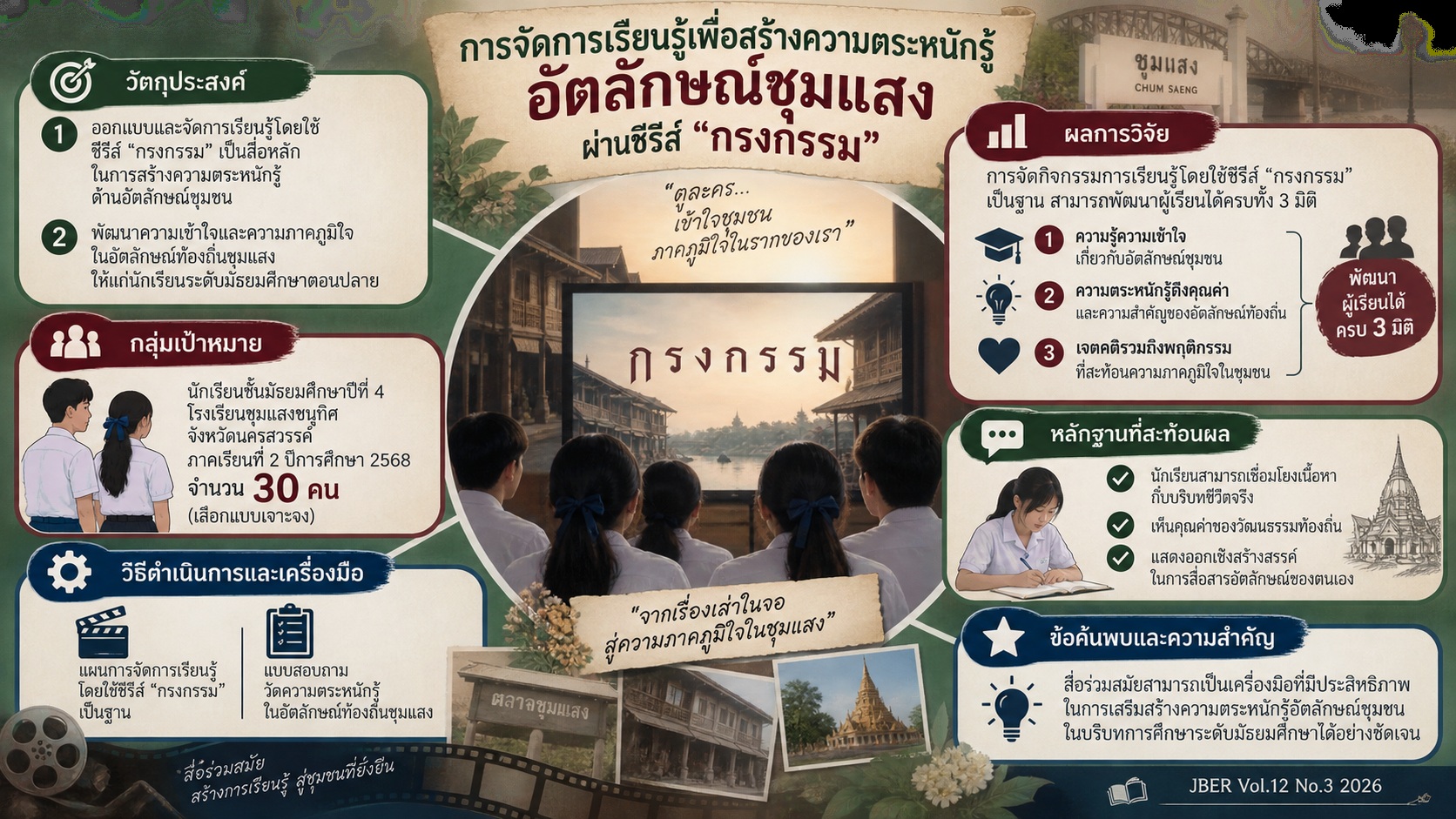
This independent study aimed to: (1) design and implement learning management using the television series Krong Kam as the primary instructional medium to enhance awareness of community identity, and (2) develop students’ understanding and pride in the local identity of Chum Saeng. The target group consisted of 30 Grade 10 students from Chumsaengchanutit School, Nakhon Sawan Province, during the second semester of the 2025 academic year, selected through purposive sampling. The research instruments included lesson plans based on the television series and a questionnaire measuring awareness of Chum Saeng’s local identity.
The findings revealed that learning activities based on the series effectively developed students in three dimensions: knowledge and understanding of community identity, awareness of the value and significance of local identity, and attitudes and behaviors reflecting pride in their community. Students were able to connect the content to their real-life context, recognize the value of local culture, and creatively communicate their community identity. The results indicate that contemporary media can serve as an effective pedagogical tool for enhancing community identity awareness in secondary social studies education.
References
Bandura, A. (1977). Social learning theory. Englewood Cliffs, NJ: Prentice Hall.
Buckingham, D. (2003). Media education: Literacy, learning and contemporary culture.
Cambridge: Polity Press.
Buckingham, D. (2007). Media education: Literacy, learning and contemporary culture.
Cambridge: Polity Press.
Burke, P. (2008). What is cultural history? (2nd ed.). Cambridge: Polity Press.
Dewey, J. (1938). Experience and education. New York: Macmillan.
Fisch, S. M. (2004). Children’s learning from television: Sesame Street and beyond.
Mahwah, NJ: Lawrence Erlbaum Associates.
Fogarty, R. (1991). The mindful school: How to integrate the curricula. Palatine, IL:
IRI/Skylight Publishing.
Jenkins, H. (2015). Cultural TV and community identity. Journal of Media Studies, 22(3),
–229.
Jenkins, K. (1991). Re-thinking history. London: Routledge.
Kolb, D. A. (1984). Experiential learning: Experience as the source of learning and
development. Englewood Cliffs, NJ: Prentice Hall.
Kemmis, S., & McTaggart, R. (1988). The action research planner. Geelong, Australia:
Deakin University Press.
Hall, S. (1997). Representation: Cultural representations and signifying practices.
London: Sage.
Mayer, R. E. (2009). Multimedia learning (2nd ed.). New York: Cambridge University
Press.
Lee, H., & Kim, J. (2015). K-drama as cultural learning tool in education. Seoul: Korean
Cultural Research.
Mayer, R. E. (2009). Multimedia learning (2nd ed.). New York: Cambridge University
Press.
Paivio, A. (1986). Mental representations: A dual coding approach. Oxford: Oxford
University Press.
Singhal, A., & Rogers, E. M. (1999). Entertainment-Education: A Communication Strategy
for Social Change. Mahwah, NJ: Lawrence Erlbaum Associates.
Singhal, A., Cody, M. J., Rogers, E. M., & Sabido, M. (2004). Entertainment-Education
and Social Change: History, Research, and Practice. Mahwah, NJ: Lawrence
Erlbaum Associates.
Slater, M. D., & Rouner, D. (2002). Entertainment-Education and elaboration likelihood:
Understanding the processing of narrative persuasion. Communication Theory,
(2), 173–191.
Seixas, P., & Morton, T. (2013). The big six historical thinking concepts. Toronto: Nelson
Education.
Smith, J. (2010). Film and community identity in Australia. Melbourne: Australian Cultural
Press.
Thompson, E. P. (1963). The making of the English working class. London: Victor
Gollancz.
Vygotsky, L. S. (1978). Mind in society: The development of higher psychological
processes. Cambridge, MA: Harvard University Press.
วิภาดา ศรีบุญเรือง. (2563). การใช้สื่อภาพยนตร์เป็นฐานในการจัดกิจกรรมการเรียนรู้เพื่อ
เสริมสร้างทักษะการคิดวิเคราะห์ของนักเรียนมัธยมศึกษาตอนปลาย. วารสารวิจัยและ
นวัตกรรมการเรียนรู้, 6(1), 101–118.
สมศักดิ์ เจียมธีรสกุล. (2545). บทนำว่าด้วยวิธีวิทยาประวัติศาสตร์. กรุงเทพฯ: สำนักพิมพ์
มหาวิทยาลัยธรรมศาสตร์.
สมศักดิ์ ศรีบริบูรณ์. (2563). การจัดการเรียนรู้ประวัติศาสตร์ท้องถิ่นแบบบูรณาการเพื่อส่งเสริมอัต
ลักษณ์ของผู้เรียน. วารสารครุศาสตร์, 48(2), 87–101.
สำนักงานคณะกรรมการการศึกษาขั้นพื้นฐาน. (2551). หลักสูตรแกนกลางการศึกษาขั้นพื้นฐาน
พุทธศักราช 2551. กรุงเทพฯ: กระทรวงศึกษาธิการ.
อังคณา สังข์ช่วย. (2563). การบูรณาการประวัติศาสตร์ท้องถิ่นกับกลุ่มสาระสังคมศึกษาเพื่อ
เสริมสร้างอัตลักษณ์ผู้เรียน. วารสารศึกษาศาสตร์ มหาวิทยาลัยเชียงใหม่, 11(2), 23–39.
Downloads
Published
How to Cite
Issue
Section
Categories
License
Copyright (c) 2026 Journal of Buddhist Education and Research (JBER)

This work is licensed under a Creative Commons Attribution-NonCommercial-NoDerivatives 4.0 International License.