Personnel Administration According to the Seven Sappurisa-Dhamma Principles of Educational Institution Administrators under the Mukdahan Primary Educational Service Area Office
Keywords:
Personnel Administration According, Seven Sappurisa-Dhamma Principles, Educational Institution AdministratorsAbstract
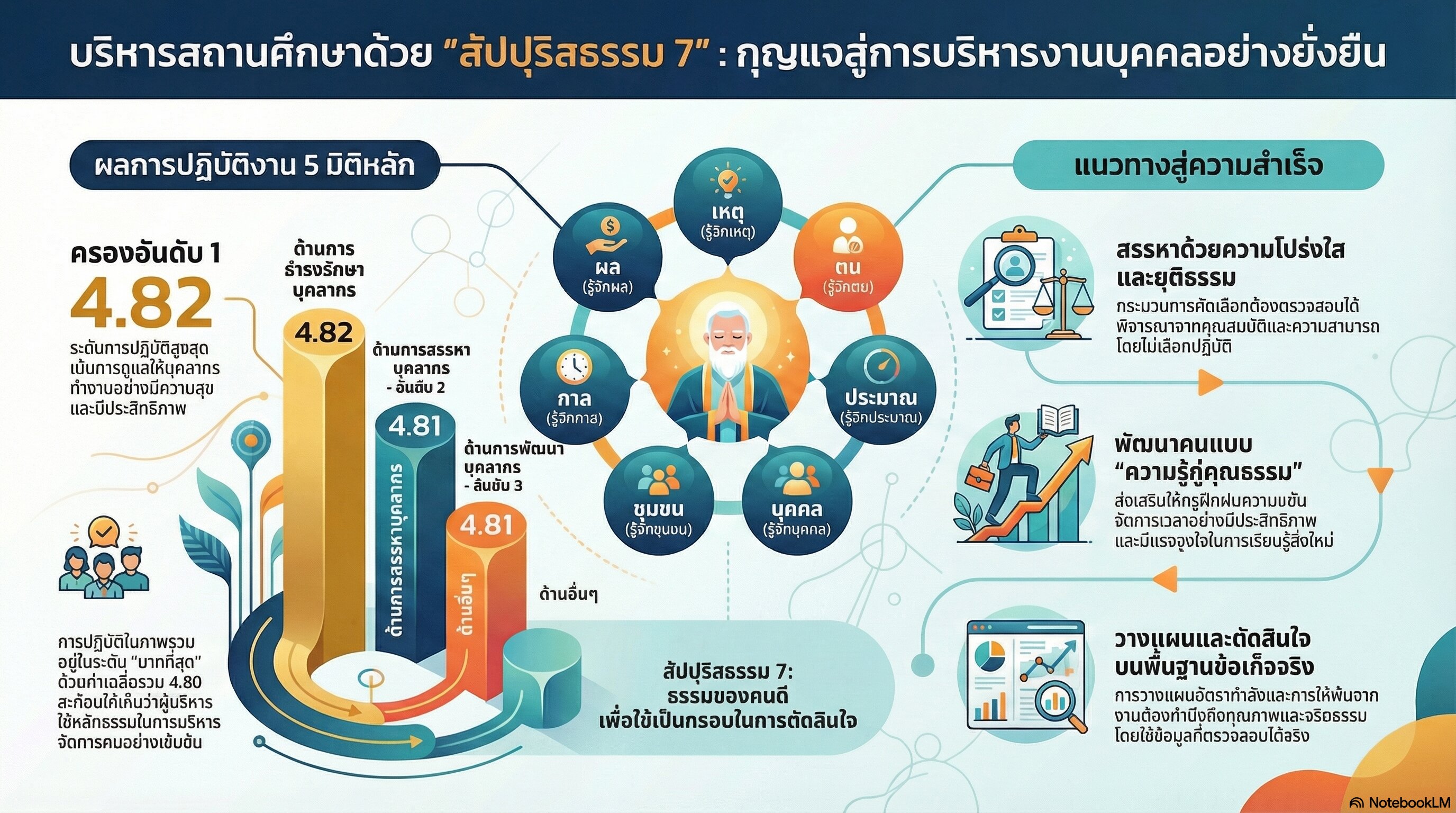
This research aimed to study the personnel administration based on the Seven Sappurisa-Dhamma Principles of educational institution administrators under the Mukdahan Primary Educational Service Area Office and to propose guidelines for developing school administration according to the Seven Sappurisa-Dhamma Principles in personnel management. A mixed-methods research design was employed, combining quantitative and qualitative approaches. The quantitative research utilized a questionnaire distributed to 322 respondents, while the qualitative research involved interviews with nine key informants. Quantitative data were analyzed using basic statistics, whereas qualitative data were analyzed using content analysis. The findings of the research were as follows: 1. The overall level of personnel administration based on the Seven Sappurisa-Dhamma Principles of educational institution administrators under the Mukdahan Primary Educational Service Area Office was found to be at the highest level. By aspect, from highest to lowest, they were as follows: personnel retention, personnel recruitment, personnel development, termination management, and manpower planning. 2. The guidelines for personnel administration based on the Seven Sappurisa-Dhamma Principles of educational institution administrators under the Mukdahan Primary Educational Service Area Office are as follows: Administrators should ensure that all selection procedures are transparent and verifiable, considering candidates’ qualifications fairly. Effective planning should not only focus on the number of personnel appropriate to the workload but also take into account the quality, knowledge, ability, and morality of each individual. Administrators should encourage teachers and staff to cultivate diligence and effective time management in their work. They should also motivate personnel to develop curiosity and self-improvement in all aspects to enhance academic knowledge and new skills, which can be effectively applied in managing people in accordance with the school context.
References
กรรณิการ์ นิยมศิลป์, และไพบูลย์ สุวรรณโพธิ์ศรี. (2531). การบริหารงานบุคคล (พิมพ์ครั้งที่ 5). โรงพิมพ์ชวนพิมพ์.
กระทรวงศึกษาธิการ. (2551). คู่มือการบริหารโรงเรียนขั้นพื้นฐานที่เป็นนิติบุคคล (พิมพ์ครั้งที่ 2). กระทรวงศึกษาธิการ.
กาญจน์เกล้า ถูประกัน. (2566). การบริหารงานบุคคลตามหลักสัปปุริสธรรม 7 ในสถานศึกษาขั้นพื้นฐาน สังกัดสำนักงานเขตพื้นที่การศึกษาประถมศึกษามหาสารคาม เขต 3. วารสารบัณฑิตศึกษามหาจุฬาขอนแก่น, 10(1), 238–251.
ธีระศักดิ์ บึงมุม, และพรพิพัฒน์ เพิ่มผล. (2560). การพัฒนาบุคลากรตามหลักสัปปุริสธรรม 7 ในสถานศึกษาขั้นพื้นฐาน สำนักงานเขตพื้นที่การศึกษาประถมศึกษาขอนแก่น เขต 4. วารสารวิชาการ มหาวิทยาลัยกรุงเทพธนบุรี, 6(1), 49–60.
เนติ์ มโนปัญญา. (2565). ภาวะผู้นำทางวิชาการของผู้บริหารโรงเรียนที่ส่งผลต่อประสิทธิผลการบริหารงานวิชาการของโรงเรียน สังกัดสำนักงานเขตพื้นที่การศึกษาประถมศึกษาสกลนคร เขต 1 (ครุศาสตรมหาบัณฑิต, มหาวิทยาลัยราชภัฏสกลนคร).
บุญชม ศรีสะอาด. (2554). การวิจัยเบื้องต้น. สุวีริยาสาส์น.
ปรีชญา รูปต่ำ. (2565). ภาวะผู้นำทางวิชาการของผู้บริหารสถานศึกษา สังกัดสำนักงานเขตพื้นที่การศึกษาประถมศึกษาขอนแก่น เขต 3 (ศึกษาศาสตรมหาบัณฑิต, มหาวิทยาลัยมหามกุฏราชวิทยาลัย).
พระครูพิศาลปริยัตยานุกูล (อนันต วฑฺฒโน). (2561). แนวทางการบริหารงานบุคคลตามหลักสัปปุริสธรรม 7 ของผู้บริหารโรงเรียนประถมศึกษาเขตบางขุนเทียน สังกัดกรุงเทพมหานคร (ครุศาสตรมหาบัณฑิต, มหาวิทยาลัยมหาจุฬาลงกรณราชวิทยาลัย).
พระครูวินัยธรวรวุฒิ เตชธมฺโม. (2564). รูปแบบการบริหารจัดการตามหลักสัปปุริสธรรม 7 ของโรงเรียนพระปริยัติธรรม แผนกสามัญศึกษา เขต 7 (ครุศาสตรดุษฎีบัณฑิต, มหาวิทยาลัยมหาจุฬาลงกรณราชวิทยาลัย).
พระครูวินัยธรวรวุฒิ เตชธมฺโม, และคณะ. (2566). การวิจัยแบบผสมผสานวิธีทางพุทธบริหารการศึกษา. วารสารครุศาสตร์ปัญญา, 2(2), 60–76.
พระจิณณ์วเรณย์ อคฺคธมฺโม. (2564). การบริหารงานบุคคลตามหลักสัปปุริสธรรม 7 ในโรงเรียนพระปริยัติธรรม แผนกสามัญศึกษา จังหวัดขอนแก่น (ครุศาสตรมหาบัณฑิต, มหาวิทยาลัยมหาจุฬาลงกรณราชวิทยาลัย).
พระธรรมโกศาจารย์ (ประยูร ธมฺมจิตฺโต). (2549). พุทธวิธีการบริหาร. โรงพิมพ์มหาจุฬาลงกรณราชวิทยาลัย.
พระมหาบุดดี สุธงษา. (2566). การบริหารงานบุคคลตามหลักสัปปุริสธรรม 7 ของผู้บริหารโรงเรียนพระปริยัติธรรม แผนกสามัญศึกษา สังกัดสำนักงานพระพุทธศาสนาแห่งชาติ จังหวัดเลย. วารสารศรีล้านช้างปริทรรศน์, 9(1), 105–120.
ภาวิณี วัฒนพรหม. (2565). แนวทางการพัฒนาภาวะผู้นำแบบยั่งยืนตามหลักสัปปุริสธรรม 7 ของผู้บริหารโรงเรียนเอกชน จังหวัดกำแพงเพชร. The Journal of Research and Academics, 5(3), 179–192.
พัฒนา ยอดสะอึ, สัมฤทธิ์ กางเพ็ง, และศิวกร อินภูษา. (2564). รูปแบบการวิจัยแบบผสมวิธีทางพุทธนวัตกรรมการบริหารการศึกษา. วารสารมจรอุบลปริทรรศน์, 9(1), 1817–1827.
ลัลณ์ลลิน พงษ์ศักดิ์ขจร, และสงวน อินทร์รักษ์. (2567). ภาวะผู้นำทางวิชาการของผู้บริหารโรงเรียนเทพมงคลรังษี จังหวัดกาญจนบุรี. วารสารธรรมเพื่อชีวิต, 30(1), 236–237.
สมบัติ บุตรแสนคม. (2564). การบริหารงานบุคคลในยุคฐานวิถีชีวิตใหม่ตามหลักสัปปุริสธรรม 7 ของผู้บริหารโรงเรียนประถมศึกษา อำเภอคลองหลวง จังหวัดปทุมธานี (ครุศาสตรมหาบัณฑิต, มหาวิทยาลัยมหาจุฬาลงกรณราชวิทยาลัย).
สุนทร สายคำ, และพระอธิการบุญช่วย โชติวํโส. (2560). ภาวะผู้นำของผู้บริหารในมุมมองของผู้ใต้บังคับบัญชา. วารสารสถาบันวิจัยพิมลธรรม, 4(2), 24.
สำนักงานเลขาธิการสภาการศึกษา. (2560). แผนการศึกษาแห่งชาติ พ.ศ. 2560–2579. บริษัทพริกหวานกราฟฟิค.
สำนักนายกรัฐมนตรี. (2553). พระราชบัญญัติการศึกษาแห่งชาติ พ.ศ. 2542 และที่แก้ไขเพิ่มเติม (ฉบับที่ 3) พ.ศ. 2553. สำนักงานคณะกรรมการการศึกษาแห่งชาติ.
Downloads
Published
How to Cite
Issue
Section
License
Copyright (c) 2026 Author(s)

This work is licensed under a Creative Commons Attribution-NonCommercial-NoDerivatives 4.0 International License.