Academic Leadership According to the Dutiyapāpaṇika Sutta Principles of Educational Institution Administrators under the Khon Kaen Secondary Educational Service Area Office
Keywords:
Academic Leadership, Dutiyapāpaṇika Sutta Principles, Educational Institution AdministratorsAbstract
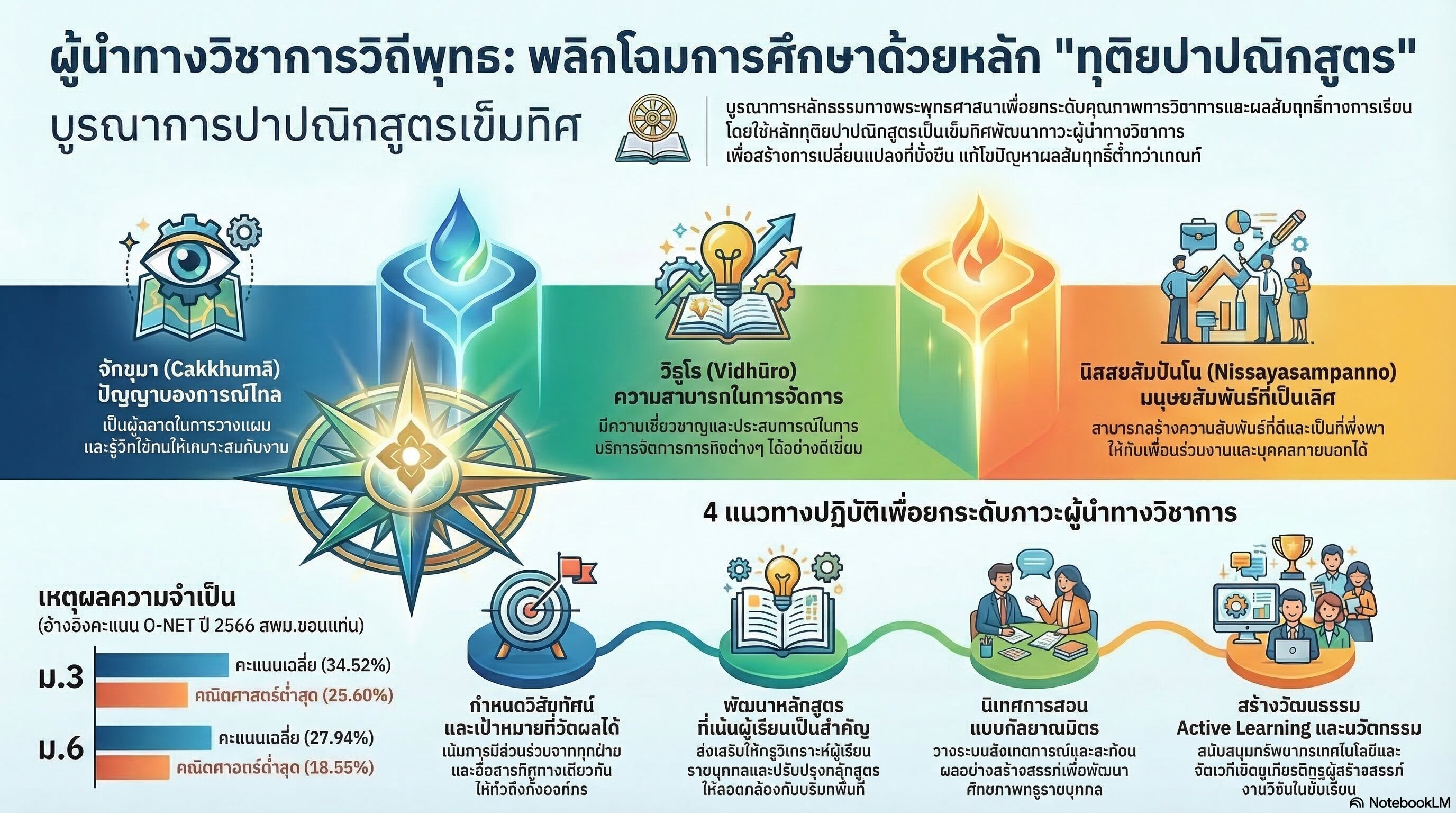
This research aimed (1) to study the conditions of academic leadership according to the Dutiyapāpaṇika Sutta Principles of educational institution administrators, and (2) to propose guidelines for developing academic leadership according to the Dutiyapāpaṇika Sutta Principles of educational institution administrators under the Khon Kaen Secondary Educational Service Area Office. A mixed-methods research design was employed, combining quantitative and qualitative approaches. For the quantitative phase, a questionnaire was used as the research instrument, with a reliability coefficient of 0.86. The sample consisted of 346 participants, including school administrators and teachers. Statistical methods employed included frequency, percentage, mean, and standard deviation. For the qualitative phase, interviews were conducted with nine key informants, who were experts in educational administration, selected through purposive sampling. The findings of the research were as follows: 1. The overall level of academic leadership according to the Dutiyapāpaṇika Sutta Principles of educational institution administrators under the Khon Kaen Secondary Educational Service Area Office was found to be at the highest level. The aspect with the highest mean score was defining vision, mission, and goals according to the Dutiyapāpaṇika Sutta Principles. 2. The guidelines for developing academic leadership according to the Dutiyapāpaṇika Sutta Principles of educational institution administrators emphasize participatory and holistic development. Administrators should promote collaboration in defining a shared vision, mission, and goals, ensuring effective communication that translates the vision into measurable operational standards while establishing cooperative networks and continuous evaluation for improvement. They should foster clear communication and understanding of curriculum implementation among all stakeholders, encourage teachers to analyze learners to create learner-centered curricula, and revise curricula to align with each school’s context. Furthermore, administrators should design a transparent and systematic internal supervision process through joint planning, observation, constructive feedback, and the use of data to develop personnel and enhance institutional quality. Finally, they should cultivate a collaborative working culture, provide resources to support active learning and classroom research, organize platforms for sharing and recognizing innovative works, and continuously promote educational innovation toward sustainable development.
References
ครรชิต ชัยกิจ, ละเอียด จงกลนี, และ จุฬาพรรณ ภรณ์ธนะแพทย์. (2563). ภาวะผู้นำทางวิชาการและพุทธวิธีในการจัดการศึกษา. วารสารวิชาการและการวิจัย มหาวิทยาลัยภาคตะวันออกเฉียงเหนือ, 10(2), 169.
เนติ์ มโนปัญญา. (2565). ภาวะผู้นำทางวิชาการของผู้บริหารโรงเรียนที่ส่งผลต่อประสิทธิผลการบริหารงานวิชาการของโรงเรียน สังกัดสำนักงานเขตพื้นที่การศึกษาประถมศึกษาสกลนคร เขต 1 (ครุศาสตรมหาบัณฑิต, สาขาวิชาการบริหารการศึกษา). มหาวิทยาลัยราชภัฏสกลนคร.
บุญชม ศรีสะอาด. (2554). การวิจัยเบื้องต้น. กรุงเทพมหานคร: สุวีริยาสาส์น.
ปรีชญา รูปต่ำ. (2565). ภาวะผู้นำทางวิชาการของผู้บริหารสถานศึกษา สังกัดสำนักงานเขตพื้นที่การศึกษาประถมศึกษาขอนแก่น เขต 3 (ศึกษาศาสตรมหาบัณฑิต, สาขาวิชาการบริหารการศึกษา). มหาวิทยาลัยมหามกุฏราชวิทยาลัย.
พรพิมล แก้วอ่อน. (2564). แนวทางการพัฒนาทักษะภาวะผู้นำในศตวรรษที่ 21 ตามหลักทุติยปาปณิกสูตรของผู้บริหารโรงเรียนในกลุ่มโรงเรียนฟ้าอุดม สังกัดสำนักงานเขตพื้นที่การศึกษาประถมศึกษานครสวรรค์ เขต 3 (ครุศาสตรมหาบัณฑิต, สาขาวิชาพุทธบริหารการศึกษา). มหาวิทยาลัยมหาจุฬาลงกรณราชวิทยาลัย.
พระธรรมโกศาจารย์ (ประยูร ธมฺมจิตฺโต). (2549). พุทธวิธีการบริหาร. กรุงเทพมหานคร: โรงพิมพ์มหาจุฬาลงกรณราชวิทยาลัย.
พัฒนา ยอดสะอึ, สัมฤทธิ์ กางเพ็ง, และ ศิวกร อินภูษา. (2564). รูปแบบการวิจัยแบบผสมวิธีทางพุทธนวัตกรรมการบริหารการศึกษา. วารสารมจรอุบลปริทรรศน์, 9(1), 1817–1827.
ภาณุพงศ์ อุณชาติ, และ เอกราช โฆษิตพิมาณเวช. (2566). ภาวะผู้นำทางวิชาการของผู้บริหารสถานศึกษาในยุคนิวนอร์มัล. วารสารพุทธปรัชญาวิวัฒน์, 7(1), 746.
ลัลณ์ลลิน พงษ์ศักดิ์ขจร, และ สงวน อินทร์รักษ์. (2567). ภาวะผู้นำทางวิชาการของผู้บริหารโรงเรียนเทพมงคลรังษี จังหวัดกาญจนบุรี. วารสารธรรมเพื่อชีวิต, 30(1), 236–237.
วนิดา เชื้อคมตา. (2566). ภาวะผู้นำทางวิชาการของผู้บริหารสถานศึกษาที่ส่งผลต่อชุมชนแห่งการเรียนรู้ทางวิชาชีพของโรงเรียน สังกัดสำนักงานเขตพื้นที่การศึกษาประถมศึกษาสกลนคร เขต 1 (ครุศาสตรมหาบัณฑิต, สาขาวิชาการบริหารการศึกษา). มหาวิทยาลัยราชภัฏสกลนคร.
สรวิชญ์ โสมดี, ทัศนีย์ บุญมาภิ, สังวาร วังแจ่ม, และ สุรศักดิ์ สุทธสิริ. (2567). ภาวะผู้นำทางวิชาการในยุคดิจิทัลของผู้บริหารสถานศึกษาในสหวิทยาเขตป่าสักชลสิทธิ์ สังกัดสำนักงานเขตพื้นที่การศึกษามัธยมศึกษาลพบุรี. วารสารมจรอุบลปริทรรศน์, 9(1), 837–848.
สำนักงานเขตพื้นที่การศึกษามัธยมศึกษาขอนแก่น. (2567). ข้อมูลสารสนเทศทางการศึกษา สำนักงานเขตพื้นที่การศึกษามัธยมศึกษาขอนแก่น ปีการศึกษา 2567. ขอนแก่น: สำนักงานเขตพื้นที่การศึกษามัธยมศึกษาขอนแก่น.
สำนักงานเลขาธิการสภาการศึกษา. (2560). แผนการศึกษาแห่งชาติ พ.ศ. 2560–2579. กรุงเทพมหานคร: บริษัทพริกหวานกราฟฟิค.
สำนักนายกรัฐมนตรี. (2553). พระราชบัญญัติการศึกษาแห่งชาติ พ.ศ. 2542 และที่แก้ไขเพิ่มเติม (ฉบับที่ 3) พ.ศ. 2553. กรุงเทพมหานคร: สำนักงานคณะกรรมการการศึกษาแห่งชาติ.
Downloads
Published
How to Cite
Issue
Section
License
Copyright (c) 2026 Authors

This work is licensed under a Creative Commons Attribution-NonCommercial-NoDerivatives 4.0 International License.