Influence of Work Engagement and Job Stress on Organizational Citizenship Behavior of University’s Academic Support Staff in a Public University
Keywords:
Work engagement, Job stress, Organizational citizenship behaviorAbstract
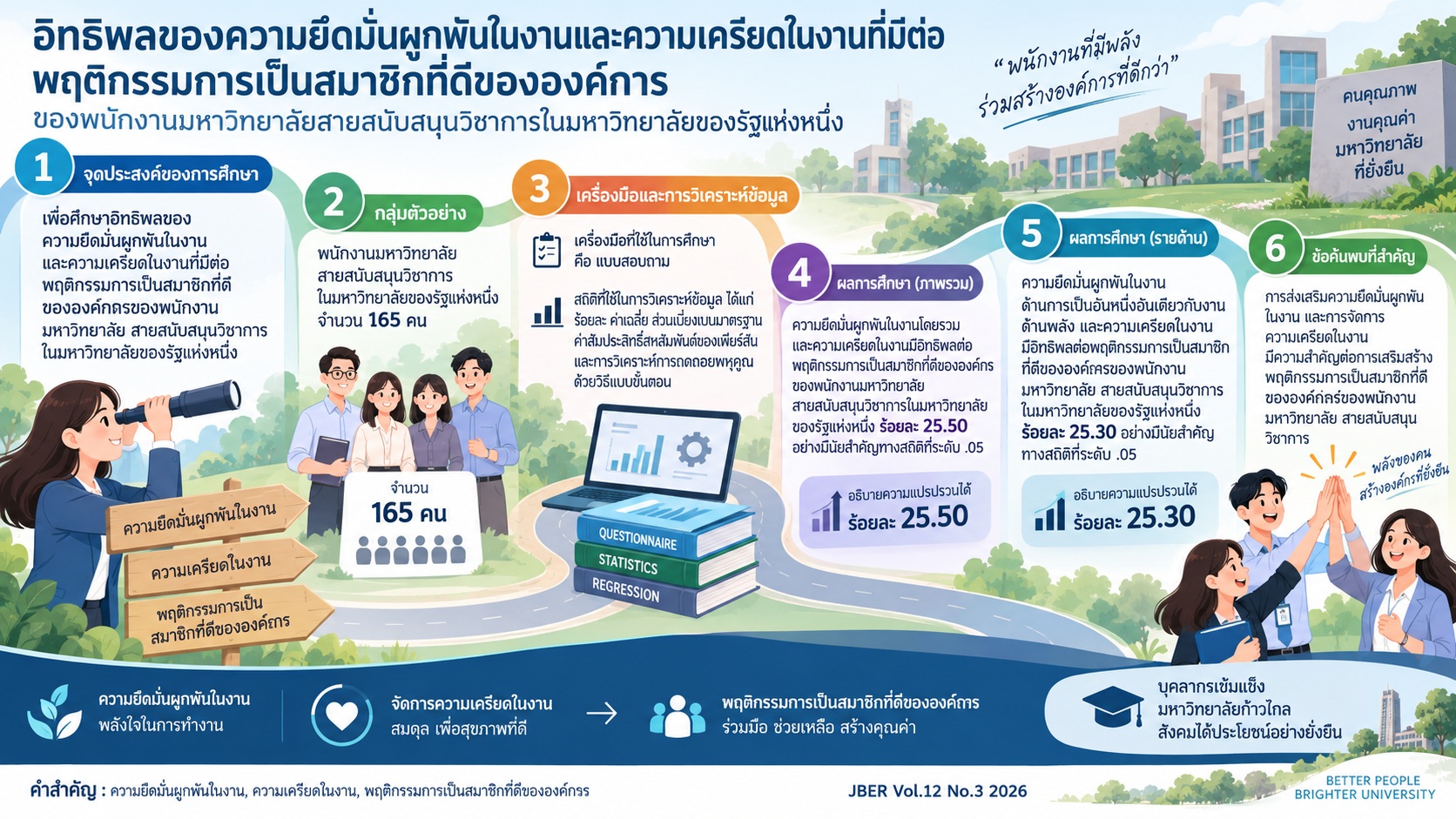
This objective of the study was to study the influence of work engagement and job stress on organizational citizenship behavior of University’s academic support staff in a public university. The samples of the study were 165 university’s academic support staff in a public university. Data were collected by questionnaires. Statistics used for data analysis were percentage, mean, standard deviation, Pearson’s product moment correlation coefficient,
and stepwise multiple regression analysis. This results of the study revealed that overall work engagement and job stress has influential effect on organizational citizenship behavior of university’s academic support staff in a public university around 25.50 percentage at .05 level of significance; and work engagement in terms of absorption, vigor and job stress has influential effect on organizational citizenship behavior of university’s academic support staff in a public university around 25.30 percentage at .05 level of significance.
References
กาญจนา ต่างแก้ว, & ทิพทินนา สมุทรานนท์. (2564). อิทธิพลของบุคลิกภาพห้าองค์ประกอบ คุณลักษณะ งาน การรับรู้ความสามารถของตนเองที่มีต่อพฤติกรรมการเป็นสมาชิกที่ดีขององค์การของพนักงาน ขายในบริษัทเกษตรอุตสาหกรรมแห่งหนึ่ง.วารสารศิลปศาสตร์ มหาวิทยาลัยแม่โจ้, 10(1), 265–285.
ชูศรี วงศ์รัตนะ. (2562). เทคนิคการใช้สถิติเพื่อการวิจัย.อมรการพิมพ์.
เพียงหทัย พงษ์สุวรรณ. (2566). หัวใจหลัก 3 ประการสําหรับการบริหารทรัพยากรมนุษย์ในยุคดิจิทัล. วารสารสหวิทยาการนวัตกรรมปริทรรศน์, 6(2), 74–88.
รัตติกรณ์ จงวิศาล. (2564). จิตวิทยาองค์การ(พิมพ์ครั้งที่ 4). สํานักพิมพ์แห่งจุฬาลงกรณ์มหาวิทยาลัย.
วริษฐา กองทรัพย์, ทิพทินนา สมุทรานนท์, & รัตติกรณ์ จงวิศาล. (2561). วัฒนธรรมองค์การ การสนับสนุน จากองค์การ ความยึดมั่นผูกพันในงานและพฤติกรรมการเป็นสมาชิกที่ดีขององค์การของพนักงาน ระดับปฏิบัติการเจนเนอเรชั่นวายของธนาคารแห่งหนึ่ง.วารสารศรีนครินทรวิโรฒวิจัยและพัฒนา (สาขามนุษยศาสตร์และสังคมศาสตร์), 10(19), 171–187.
ศิริลักษณ์ อัมพรประเสริฐ, & ทิพทินนา สมุทรานนท์. (2559). บุคลิกภาพห้าองค์ประกอบ ความยึดมั่นผูกพัน ต่อการปฏิบัติงาน ความยุติธรรมในองค์การและพฤติกรรมการเป็นสมาชิกที่ดีขององค์การของ พนักงานบริษัทผลิตเครื่องดื่ม.วารสาร มจร สังคมศาสตร์ปริทรรศน์, 5(2), 475–490.
สํานักงานเลขาธิการสภาผู้แทนราษฎร. (2568). สถานการณ์และแนวโน้มเศรษฐกิจการคลังต่อการกําหนด นโยบายภาครัฐ.สํานักงบประมาณของรัฐสภา.
สุชาติ ประสิทธิ์รัฐสินธุ์. (2555). ระเบียบวิธีการวิจัยทางสังคมศาสตร์.สํานักพิมพ์แห่งจุฬาลงกรณ์ มหาวิทยาลัย.
สุพานี สฤษฎ์วานิช. (2552). พฤติกรรมองค์การสมัยใหม่: แนวคิดและทฤษฎี(พิมพ์ครั้งที่ 2). โรงพิมพ์ มหาวิทยาลัยธรรมศาสตร์.
สุรเดช จองวรรณศิริ. (2562). การจัดการสู่องค์กรนวัตกรรม: Innovative organization book of knowledge.บริษัท ทริปเปิลว้าว คอร์ปอเรชั่น จํากัด.
สุรพล พยอมแย้ม. (2541). จิตวิทยาอุตสาหกรรม.โครงการส่งเสริมการผลิตตําราและเอกสารการสอน คณะ ศึกษาศาสตร์ มหาวิทยาลัยศิลปากร.
สุวิมล ติรกานันท์. (2553). การวิเคราะห์ตัวแปรพหุในงานวิจัยทางสังคมศาสตร์.โรงพิมพ์แห่งจุฬาลงกรณ์ มหาวิทยาลัย.
อภิญญา หิรัญวงษ์. (2562). เอกสารประกอบการสอนรายวิชา 01475511 สถิติประยุกต์ทางจิตวิทยา [เอกสารไม่ได้ตีพิมพ์]. คณะสังคมศาสตร์ มหาวิทยาลัยเกษตรศาสตร์.
Abdulla, S. M. M., & Hatamleh, I. M. (2022). The impact of job stress sources on organizational citizenship behavior. Journal of Statistics Applications & Probability, 11, 233–252.
Affandi, A. S., Patrisia, D., Syahrizal, & Abror. (2019). The effect of employee engagement and job satisfaction on organizational citizenship behavior. Advances in Economics, Business and Management Research, 64, 806–814. https://doi.org/10.2991/piceeba2- 18.2019.69
Bakker, A. B., & Demerouti, E. (2008). Towards a model of work engagement. Career Development International, 13(3), 209–223. https://doi.org/10.1108/13620430810870476
George, J. M., & Jones, G. R. (2008). Understanding and managing organizational behavior (5th ed.). Pearson Prentice Hall.
Giancaspro, M. L., Callea, A., & Manuti, A. (2022). A study on the relationship between psychological capital, work engagement and extra-role behavior. Sustainability, 14(4), Article 2022. https://doi.org/10.3390/su14042022
Hair, J. F., Black, W. C., Babin, B. J., & Anderson, R. E. (2019). Multivariate data analysis(8th ed.). Cengage Learning.
Kiat, E. S., Nordin, N. A., & Rahim, S. A. (2023). The influence of work engagement towards organisational citizenship behaviour among Malaysian police officers. International Journal of Scientific and Research Publications, 13(6), 243–247. https://doi.org/10.29322/IJSRP.13.06.2023.p13833
Page, S. E., & Kallapur, A. (2025). Replace, augment, disrupt: AI & organizational decision- making. Journal of Organization Design.https://doi.org/10.1007/s41469-025-00194-4
Rekha, S. S., & Sasmita, M. (2019). Impact of employee engagement on organizational citizenship behavior: An overview. Revista Espacios, 40(7), 17–23.
Riggio, R. E. (2017). Introduction to industrial/organizational psychology(7th ed.). Routledge.
Rovinelli, R. J., & Hambleton, R. K. (1977). On the use of content specialists in the assessment of criterion-referenced test item validity. Tijdschrift voor Onderwijsresearch, 2(2), 49–60.
Schaufeli, W. B., & Bakker, A. B. (2010). Defining and measuring work engagement: Bringing clarity to the concept. In A. B. Bakker & M. P. Leiter (Eds.), Work engagement: A handbook of essential theory and research(pp. 10–24). Psychology Press.
Siegrist, J., Starke, D., Chandola, T., Godin, I., Marmot, M., Niedhammer, I., & Peter, R. (2004). The measurement of effort–reward imbalance at work: European comparisons. Social Science & Medicine, 58(8), 1483–1499. https://doi.org/10.1016/S0277-9536(03)00351-4
Smithikrai, C. (2019). Antecedents and consequences of work engagement among Thai employees. The Journal of Behavioral Science, 14(3), 14–31.
Spreitzer, G. M., & Fritz, C. (2010). Engagement and human thriving: Complementary perspectives on energy and connections to work. In A. B. Bakker & M. P. Leiter (Eds.), Work engagement: A handbook of essential theory and research(pp. 132–146). Psychology Press.
Tabachnick, B. G., & Fidell, L. S. (2019). Using multivariate statistics(7th ed.). Pearson.
Taris, T. W., Schaufeli, W. B., & Shimazu, A. (2010). The push and pull of work: The differences between workaholism and work engagement. In A. B. Bakker & M. P. Leiter (Eds.), Work engagement: A handbook of essential theory and research(pp. 39–53). Psychology Press.
Tj, H. W., & Tecoalu, M. (2022). The effect of organizational culture, work stress, and organizational commitment on organizational citizenship behavior mediated by job satisfaction. Budapest International Research and Critics Institute-Journal, 5(2), 12659–12665. https://doi.org/10.33258/birci.v5i2.5110
Downloads
Published
How to Cite
License
Copyright (c) 2026 Journal of Buddhist Education and Research (JBER)

This work is licensed under a Creative Commons Attribution-NonCommercial-NoDerivatives 4.0 International License.