Constructing a Fundamental Violin Exercise Book for Beginner Violin Students in Linyi City, Shandong Province
คำสำคัญ:
The Violin, , Learning methods, Eexercise book, Beginnerบทคัดย่อ
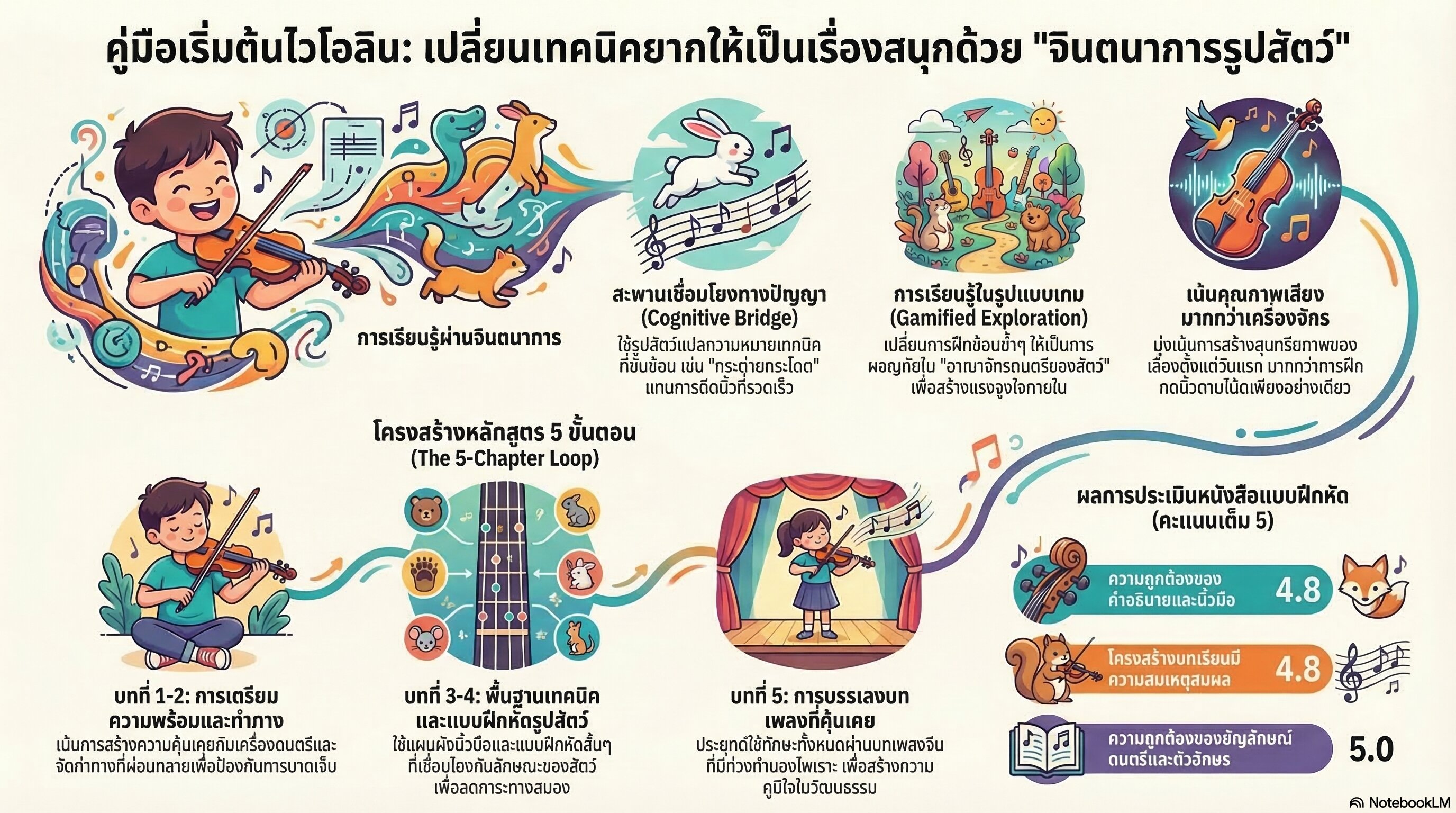
This study aims to 1) Study the Violin learning methods needs of primary school students in violin education and develop a training exercise book using animal-based music symbols. 2) To construct fundamental violin exercise book for violin beginner at Linyi city, Shandong province. This research adopts a qualitative research approach. The primary data collection tool is a structured interview form designed to gather in-depth insights from violin instructors who teach in primary schools in Linyi City. These participants were selected based on their active engagement in early-stage violin education and their familiarity with using innovative methods, including animal imagery, in classroom instruction. The results show that based on the above findings, this study established a design philosophy centered on “student cognition and psychology” rather than “technical items” and extracted the following core solutions: “Information translation” and “chunking” are essential. Abstract symbols cannot be taught directly; instead, a “mediating system” that seamlessly connects with children’s existing life experiences must be found. Animal imagery was chosen as the ideal cognitive bridge. It directly translates the “short, flexible” technical requirements into the vivid image of “a bunny hop,” which children can instantly understand and imitate, packaging complex instructions into an easily accessible “cognitive chunk.” Reconstructing ‘Practice’ as ‘Gamified Exploration.’ The core driving force for young children’s persistence is interest, not lofty goals. The practice process itself must be full of discovery and enjoyment. Constructing a coherent narrative of the “Animal Music Kingdom.” Each lesson is no longer an isolated technical point but an adventure story or role challenge within the kingdom. This imbues repetitive practice with meaning and context, thereby stimulating intrinsic motivation. as follows: Chapter 1: Understanding the Violin and Its Structure. Chapter 2: Establishing Correct Playing Posture. Chapter 3: Structured Training of Scales and Arpeggios. Chapter 4: Elementary Etudes Incorporating Animal Imagery, and Chapter 5: Musical Practice Centered on Familiar Chinese Repertoire in classroom instruction.
เอกสารอ้างอิง
Bennett, E. (2015). The violin lesson: A manual for teaching and self-teaching. Edition Peters.
Renping, Q. (2021). Research on the development of contemporary Chinese violin music. Central Conservatory of Music Press.
Rosand, D. (2016). The violin: The Cambridge companion to the instrument. Cambridge University Press.
Xingci, L. (2018). A violin’s chronicle of China: A brief history of violin at the Shanghai Conservatory of Music.
Yuejian, C. (2020). Selected Chinese-style violin teaching pieces and teaching guide. People’s Music Publishing House.
Zhinuo, D. (2015). 60 tips for basic violin skills. Shanghai Music Publishing House.
Zili, L. (2020). Children’s violin tutorial. Shanghai Music Publishing House.
ดาวน์โหลด
เผยแพร่แล้ว
รูปแบบการอ้างอิง
ฉบับ
ประเภทบทความ
หมวดหมู่
สัญญาอนุญาต
ลิขสิทธิ์ (c) 2026 Journal of Buddhist Education and Research (JBER)

อนุญาตภายใต้เงื่อนไข Creative Commons Attribution-NonCommercial-NoDerivatives 4.0 International License.