ความสัมพันธ์ระหว่างการมองโลกในแง่ดี ความฉลาดทางอารมณ์กับความสามารถในการเผชิญปัญหาและฟันฝ่าอุปสรรคของนักเรียน ชั้นมัธยมศึกษาตอนปลาย ในเขตพื้นที่การศึกษามัธยมศึกษา กรุงเทพมหานครเขต 2 กรุงเทพมหานคร
บทคัดย่อ
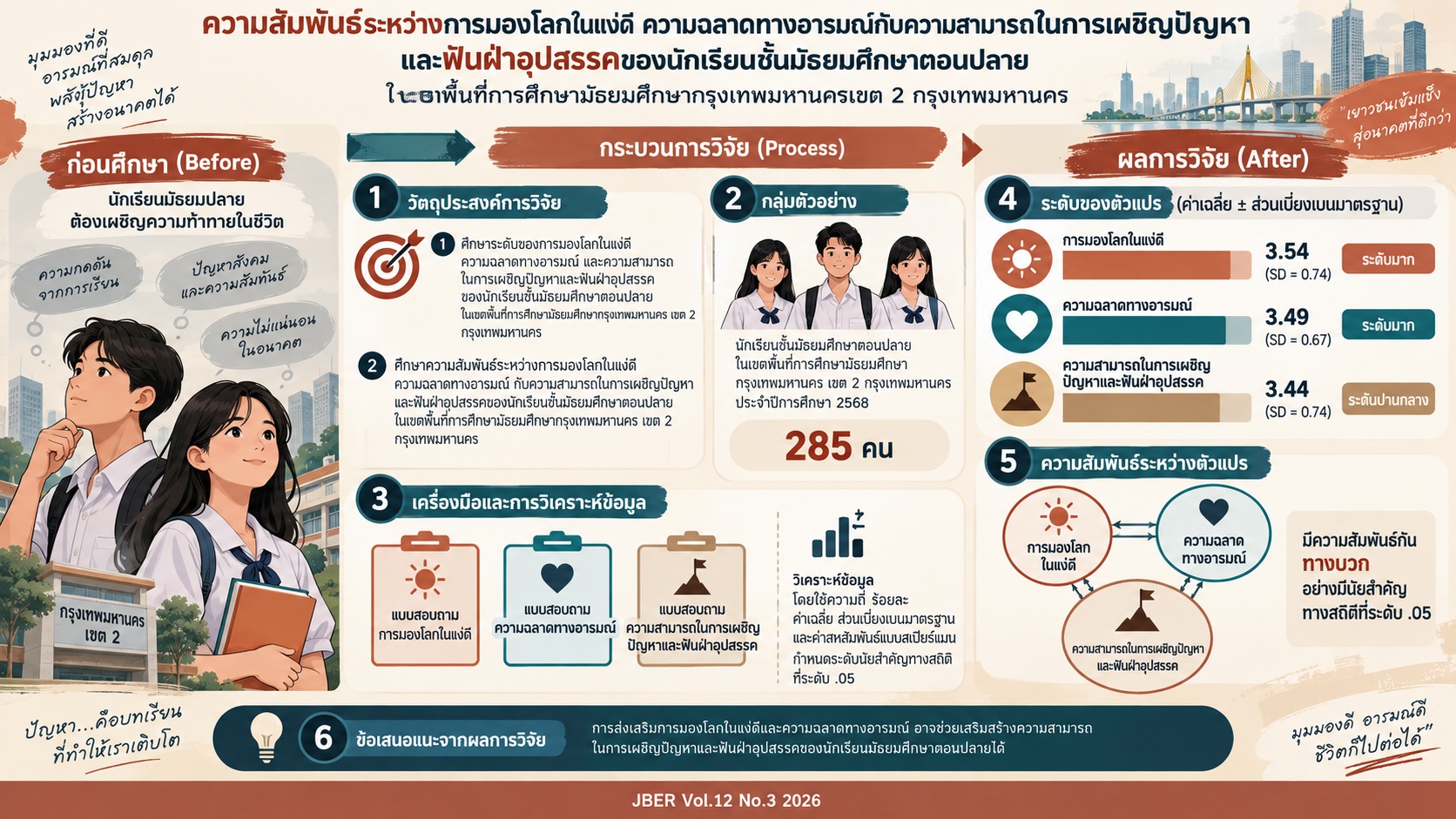
การศึกษาวิจัยระดับนี้เพื่อมองโลกในแง่ดีฉลาดทางอารมณ์ กับการตรวจสอบปัญหาและฟันฝ่าอุปสรรคของนักเรียนชั้นมัธยมศึกษาตอนปลาย ในส่วนของการศึกษาระดับมัธยมศึกษากรุงเทพมหานครเขต 2 กรุงเทพมหานครและ 2) การศึกษาระหว่างการมองโลกกีฬาดีฉลาดทางอารมณ์ กับปัญหาการศึกษาและฟันฝ่าฟันของนักเรียนชั้นมัธยมศึกษาตอนปลาย ในพื้นที่ศึกษามัธยมศึกษาเขต 2 กรุงเทพมหานครศึกษากลุ่มตัวอย่างคือการศึกษาชั้นมัธยมศึกษาตอนปลายในเขตพื้นที่การศึกษามัธยมศึกษาเขต 2 กรุงเทพมหานคร 2568 จำนวน 285 คนที่สามารถสุ่มตัวอย่างแบบชั้นภูมิได้เป็นจำนวนมากการวิจัยประกอบด้วยองค์ประกอบการมองโลกมัลติฟังก์ชั่นดีในเรื่องความชาญฉลาดทางอารมณ์และสรรพคุณที่ก่อให้เกิดปัญหาและฟันฝ่าความกระหาย สถิติความเข้มข้นของข้อมูลรวมถึงความเข้มข้นของปริมาณข้อมูลที่สามารถวิเคราะห์ได้เป็นหลักและ
ค่าสหสัมพันธ์แบบสเปียร์แมนโดยกำหนดระดับนัยสำคัญทางสถิติที่ระดับ .05
ผลการศึกษาวิจัยพบว่า 1) นักเรียนชั้นมัธยมศึกษาตอนปลายในเขตการศึกษาระดับมัธยมศึกษากรุงเทพมหานครเขต กรุงเทพมหานคร 2 มีระดับฝ่าการมองโลกทัศน์ดี (X̄ = 3.54, SD = 0.74) เทคโนโลยีฉลาดทางอารมณ์ (X̄ = 3.49, SD = 0.67) ตรวจมากและตรวจสุขภาพปัญหาและฟันต่อเนื่อง (X̄ = 3.44, SD = 0.74) ผู้บริหารปานกลาง และ 2) การมองโลกให้ดี ฉลาดทางอารมณ์กับการตรวจจับปัญหาและฟันฝ่าอุปสรรคของนักเรียนชั้นมัธยมศึกษาตอนปลายในพื้นที่การศึกษามัธยมศึกษากรุงเทพมหานครเขต 2 กรุงเทพมหานครและทางบวกสถิติทางสถิติที่ระดับ .05
คำสำคัญ:การมองโลกในแง่ดี, ฉลาดทางอารมณ์, ความโหดร้ายที่ปัญหาและฟันฝ่าความผิด
เอกสารอ้างอิง
กรมกิจการเด็กและเยาวชน. (2565). รายงานสถานการณ์เด็กและเยาวชนของประเทศไทย พ.ศ. 2565.
กระทรวงการพัฒนาสังคมและความมั่นคงของมนุษย์.
https://opendata.nesdc.go.th/dataset/126d22f2-0e39-4792-a213-
d8023251d183/resource/c4a11fd3-8e41-421f-af65-915fa07f3348/download/28-2565.pdf
พรรณปพร ลีวิโรจน์ และ ทัศนีย์ นิลสูงเนิน. (2565). การศึกษาความฉลาดทางอารมณ์ของนักเรียนที่ใช้สาร
เสพติดในจังหวัดสมุทรปราการ. วารสารสังคมศาสตร์วิจัย, 13(1), 36–53.
พิมพ์รัตน์ ธรรมรักษา และ อาภาพร เผ่าวัฒนา. (2562). ความฉลาดทางอารมณ์กับพฤติกรรมเสี่ยงใน
วัยรุ่น. วารสารวิจัยสุขภาพและการพยาบาล, 35(3), 212–221.
สรีวัน ศุภฤกษ์ชาติกุล, สกล วรเจริญศรี และ มณฑิรา จารุเพ็ง. (2564). การเสริมสร้างการมองโลกในแง่ดี
ของนักเรียนวัยรุ่นโดยกิจกรรมแนะแนว. ศึกษาศาสตร์ มมร, 9(2), 241–252. https://so04.tci-
thaijo.org/index.php/edj/article/view/253590
Hfocus. (2567, 5 ธันวาคม). เด็กไทยเผชิญสารพัดปัจจัยเสี่ยง เฉพาะ ก.ย. 67 พบข่าวเยาวชน 97 กรณี
ถูกกระทำอนาจาร 16.49%. https://www.hfocus.org/content/2024/12/32422
American Psychological Association, Teachers of Psychology in Secondary Schools. (2022).
Positive psychology: A seven-lesson unit plan for high school psychology teachers.
Anju, J., & Sahoo, J. (2023). Adversity quotient: A review of related literature. International
Journal of Scientific Research in Modern Science and Technology, 2(10), 26–32.
https://doi.org/10.59828/ijsrmst.v2i10.156
Apriliyanti, A. B., & Ahkam, M. A. (2021). Hubungan antara optimisme dengan adversity quotient
(AQ) pada siswa sekolah menengah atas yang mengikuti ekstrakurikuler. Pinisi Journal of
Art, Humanity and Social Studies, 1(1), 18–25.
Cejudo, J., Rodrigo-Ruiz, D., López-Delgado, M. L., & Losada, L. (2018). Emotional intelligence
and its relationship with levels of social anxiety and stress in adolescents. International
Journal of Environmental Research and Public Health, 15(6), 1073.
https://doi.org/10.3390/ijerph15061073
Chusnah, L., & Maryam, S. (2025). Optimism and mindfulness as predictors of psychological
well-being among adolescents. Journal of Educational, Health and Community
Psychology,14(1), 45–56.
Glassie, S. L., & Schutte, N. S. (2024). The relationship between emotional intelligence and
optimism: A meta-analysis. International Journal of Psychology, 59(3), 353–367.
https://doi.org/10.1002/ijop.13108
Handayani, P. G., Wiyono, B. B., Muslihati, M., & Hambali, I. M. (2023). A synthesis of adversity
quotient in student victims of bullying. Pegem Journal of Education and Instruction, 13(3),
–175. https://doi.org/10.47750/pegegog.13.03.18
Hinz, A., Friedrich, M., Glaesmer, H., Brendel, B., Nesterko, Y., & Ernst, J. (2024). Temporal
stability of optimism and pessimism (LOT-R) over 6 years in the general population.
Frontiers in Psychology, 15, Article 1379651. https://doi.org/10.3389/fpsyg.2024.1379651
Kaur, H., & Billing, D. (2022). Adversity quotient among secondary school students in relation to
gender and locality. International Journal of Research in Social Sciences, 12(4), 78–84.
Kwansumran, W., Dallas, J. C., Wonginjun, S., & Sangsai, N. (2025). Factors related to adversity
quotient in junior high school students. Frontiers of Nursing, 12(1), 19–26.
https://doi.org/10.2478/fon-2025-0003
Lee, K., & Cha, H. (2025). Factors affecting the emotional intelligence of adolescents during the
COVID-19 pandemic: A descriptive study in South Korea. Child Health Nursing Research,
(3), 176–186. https://doi.org/10.4094/chnr.2025.016
Matore, M. E. E. M., & Khairani, A. Z. (2016). The relationship between emotional intelligence
and adversity quotient among polytechnic students. Indian Journal of Science and
Technology, 9(47), 1–7.
Mulyasari, A., & Maryam, S. (2023). The relationship between emotional intelligence and
adversity quotient in working students. Psikologia: Jurnal Psikologi, 8(2), 111–118.
Oberle, E., Guhn, M., Gadermann, A. M., Thomson, K., & Schonert-Reichl, K. A. (2018). Positive
mental health and supportive school environments: A population-level longitudinal study of
dispositional optimism and school relationships in early adolescence. Social Science &
Medicine, 214, 154–161. https://doi.org/10.1016/j.socscimed.2018.06.041
Rahmadina, D. P., Jamain, R. R., & Novitawati, N. (2023). A contribution of optimism and social
support to adversity quotient. KONSELOR, 12(3), 119–125.
https://doi.org/10.24036/020231235-0-86
Rincón Uribe, F. A., Neira Espejo, C. A., & Pedroso, J. S. (2020). Role of optimism in adolescent
mental health: A protocol for a systematic review. BMJ Open, 10(7), Article e036177.
https://doi.org/10.1136/bmjopen-2019-036177
Stoltz, P. G. (2000). Adversity quotient: Turning obstacles into opportunities (2nd ed.). Pocket
Books.
The Nation Thailand. (2024, November 24). Thai children in crisis, threatening nation's future.
https://www.nationthailand.com/blogs/news/general/40043570
UNICEF Thailand. (2025). Impact report 2024: From promise to progress.
https://www.unicef.org/thailand/reports/impact-report-2024
World Health Organization. (2024). Mental health of adolescents. https://www.who.int/news-
room/fact-sheets/detail/adolescent-mental-health
Zamri, S. N. A. S., & Khairani, A. Z. (2020). Psychometric properties of the adversity quotient
instrument among technical and vocational education and training (TVET) students using
the Rasch model. International Journal of Evaluation and Research in Education, 9(2),
ดาวน์โหลด
เผยแพร่แล้ว
รูปแบบการอ้างอิง
ฉบับ
ประเภทบทความ
หมวดหมู่
สัญญาอนุญาต
ลิขสิทธิ์ (c) 2026 Journal of Buddhist Education and Research (JBER)

อนุญาตภายใต้เงื่อนไข Creative Commons Attribution-NonCommercial-NoDerivatives 4.0 International License.