การพัฒนาชุดกิจกรรรม Kids สร้างเมือง BKK ปฏิบัติการร่วมมือรวมพลังเด็กปฐมวัยเพื่อส่งเสริมทักษะร่วมมือรวมพลังเด็กปฐมวัย
คำสำคัญ:
ชุดกิจกรรม, ทักษะร่วมมือรวมพลัง, เด็กปฐมวัยบทคัดย่อ
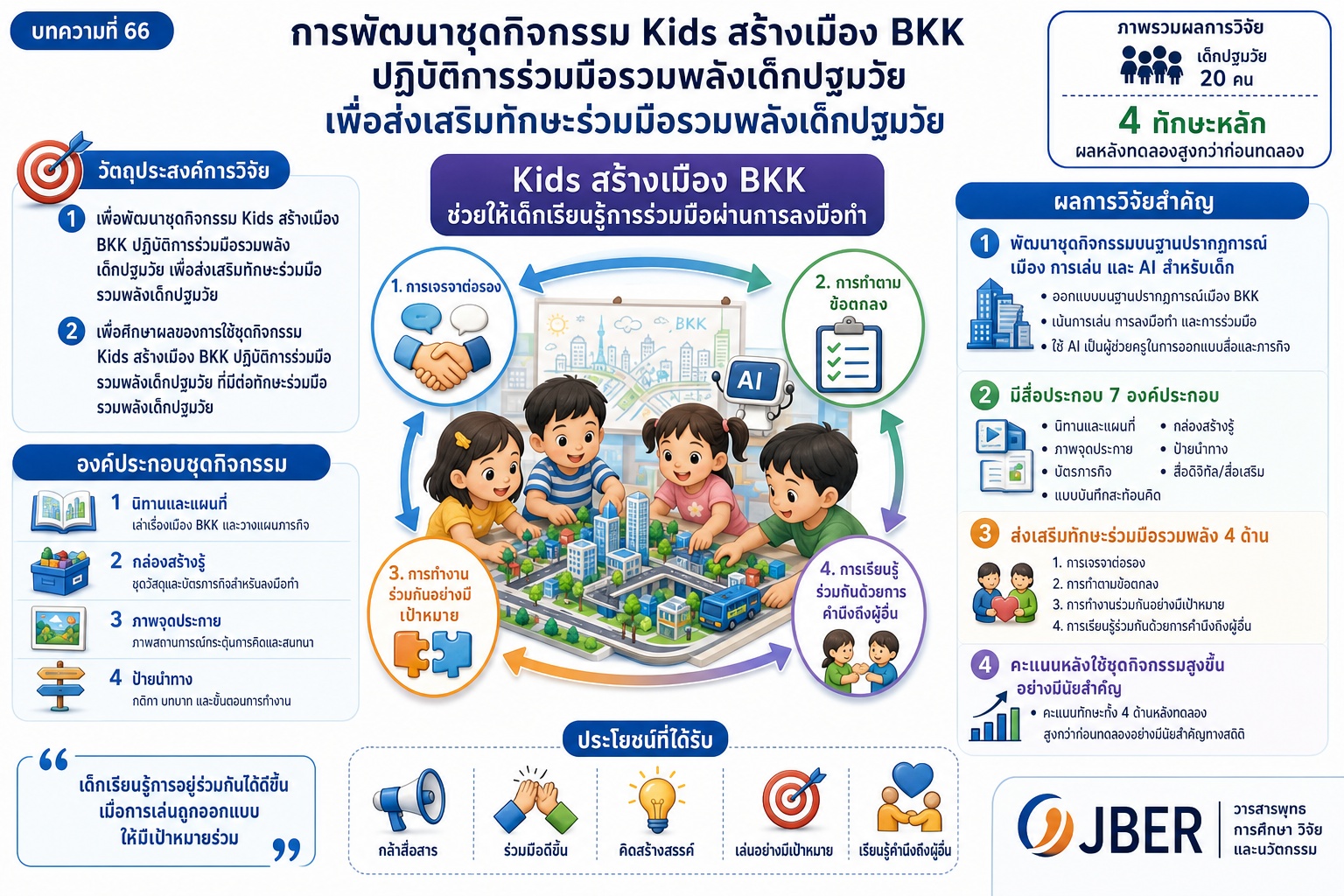
การวิจัยครั้งนี้มีวัตถุประสงค์เพื่อพัฒนาชุดกิจกรรม Kids สร้างเมือง BKK ปฏิบัติการร่วมมือรวมพลังเด็กปฐมวัยเพื่อส่งเสริมทักษะร่วมมือรวมพลังเด็กปฐมวัย และเพื่อศึกษาผลการใช้ชุดกิจกรรม Kids สร้างเมือง BKK ปฏิบัติการร่วมมือรวมพลังเด็กปฐมวัยเพื่อส่งเสริมทักษะร่วมมือรวมพลังเด็กปฐมวัย กลุ่มตัวอย่างที่ใช้ในการวิจัยประกอบด้วย เด็กปฐมวัยในระดับชั้นอนุบาลศึกษาชั้นปีที่ 1 อายุ 3 – 4 ปี โรงเรียนสามเสนนอก(ประชาราษฎร์อนุกูล) ภาคเรียนที่ 2 ปีการศึกษา 2568 จำนวน 20 คน จากการสุ่มแบบเจาะจง โดยการวิจัยแบ่งออกเป็น 3 ระยะคือ ระยะที่ 1 ศึกษาแนวทางพัฒนาชุดกิจกรรม ระยะที่ 2 ออกแบบแนวทางการจัดกิจกรรมการเรียนรู้ที่ส่งเสริมการใช้ชุดกิจกรรม ระยะที่ 3 ศึกษาเงื่อนไขความสำเร็จของชุดกิจกรรม เครื่องมือที่ใช้ในการวิจัย ได้แก่ 1) ชุดกิจกรรม Kids สร้างเมือง BKK ปฏิบัติการร่วมมือรวมพลังเด็กปฐมวัยเพื่อส่งเสริมทักษะร่วมมือรวมพลังเด็กปฐมวัย 2) แบบประเมินทักษะร่วมมือรวมพลังของเด็กปฐมวัย ผลการวิจัยพบว่า 1) ชุดกิจกรรมที่พัฒนาขึ้นสามารถส่งเสริมให้เด็กปฐมวัยสร้างองค์ความรู้ร่วมกัน จากการพัฒนาขั้นตอนการใช้ชุดกิจกรรมใช้ปรากฏการณ์เป็นฐาน องค์ประกอบของความเป็นเมือง การเรียนรู้ผ่านการเล่น การใช้ปัญญาประดิษฐ์สำหรับเด็กปฐมวัย ผสานกับการเล่นสร้างด้วยวัสดุปลายเปิด โดยมีเนื้อหาครอบคลุมทักษะร่วมมือรวมพลัง 4 ด้าน ได้แก่ การเจรจาต่อรอง การทำตามข้อตกลง การทำงานร่วมกันอย่างมีเป้าหมาย และการเรียนรู้ร่วมกันด้วยการคำนึงถึงผู้อื่น โดยมีสื่อประกอบชุดกิจกรรม ประกอบด้วย 7 องค์ประกอบย่อย (หนังสือนิทาน, แผนที่ชุมชนจำลอง, แผนที่ BKK จำลอง, แผ่นวางแผน, กล่องสร้างรู้, ภาพจุดประกาย, ป้ายนำทาง) 2) ผลการทดลองใช้ชุดกิจกรรมพบว่า เด็กปฐมวัยที่ได้รับการจัดกิจกรรมจากชุดกิจกรรมนี้มีคะแนนเฉลี่ยของทักษะร่วมมือรวมพลังสูงกว่าก่อนการทดลองโดยรวม และรายด้านประกอบด้วย การเจรจาต่อรอง การทำตามข้อตกลง การทำงานร่วมกันอย่างมีเป้าหมาย และการเรียนรู้ร่วมกันด้วยการคำนึงถึงผู้อื่น อย่างมีนัยสำคัญทางสถิติที่ 0.05
เอกสารอ้างอิง
กมลทิพย์ ทองเทพ, อรพรรณ บุตรกตัญญู, ปัทมาวดี เล่ห์มงคล, & พงศธร มหาวิจิตร. (2565). การศึกษาการจัดประสบการณ์การเรียนรู้แบบโครงการโดยใช้ปรากฏการณ์เป็นฐานเพื่อพัฒนาทักษะการทำงานร่วมกันของเด็กปฐมวัย. วารสารศึกษาศาสตร์ มหาวิทยาลัยสงขลานครินทร์ วิทยาเขตปัตตานี, 33(3), 151–167. https://so02.tci-thaijo.org/index.php/edupsu/article/view/249024
กันต์ฌพัชญ์ อยู่อำไพ. (2567). ลูสพาร์ทส์เพลย์กับการศึกษาปฐมวัย: จากยุค 1970 สู่ความนิยมในศตวรรษที่ 21. วารสารการจัดการทางการศึกษาปฐมวัย, 3(2), 55–64. https://so02.tci-thaijo.org/index.php/ECEM/article/view/254819
สำนักงานสภาพัฒนาการเศรษฐกิจและสังคมแห่งชาติ. (2568). แผนพัฒนาเศรษฐกิจและสังคมแห่งชาติ ฉบับที่ 13 พ.ศ. 2566–2570. https://www.nesdc.go.th/the-national-economic-and-social-development-plan/the-thirteenth-plan-2023-2027/
หัสวนัส เพ็งสันเทียะ, มนตา ตุลย์เมธาการ, & อิทธิพัทธ์ สุวทันพรกูล. (2564). ผลการจัดการเรียนรู้โดยใช้ปรากฏการณ์เป็นฐานที่มีต่อการคิดอย่างมีวิจารณญาณและการคิดสร้างสรรค์ของนักเรียนชั้นมัธยมศึกษาปีที่ 6. วารสารศิลปากรศึกษาศาสตร์วิจัย, 13(2), 240–257. https://so05.tci-thaijo.org/index.php/suedureasearchjournal/article/view/251771
Alalade, O., & Olusola, E. (2025). Effect of collaborative learning strategies on junior students' environmental knowledge and attitude towards social studies. Twist, 20, 488–496. https://doi.org/10.5281/zenodo.10049652
Amin, R. (2021). The benefits of construction play. RARE Early Childhood Support Services. https://rare.support/wp-content/uploads/2022/04/construction-play.pdf
Arnerich, M. (2021). Constructive play: What is it and how do I encourage it? https://www.famly.co/blog/encouraging-constructive-play
Bakır, V. (2024). Artificial intelligence-assisted early childhood development: Effectiveness, challenges, and ethical issues. Journal of Psychology and Technology, 1(1), 1–15. https://jpsytech.com/index.php/jpsytech/article/view/1
Beck, K., & Kaune, M. (2025). Early childhood development and cities. Urban95 Academy Working Paper. LSE Cities & Van Leer Foundation. https://urban95academy.org
Casey, T., & Robertson, J. (2017). Resources for playing: Providing loose parts to support children's play. Play Australia. https://www.playaustralia.org.au/sites/default/files/LibraryDownloads/loose-parts-toolkit.pdf
Caven, M. (2022). Prioritizing play: The importance of play-based learning in early education. Institute of Education Sciences. https://ies.ed.gov/learn/blog/prioritizing-play-importance-play-based-learning-early-education
Daehler, K., & Folsom, J. (2016). Making sense of science: Phenomena-based learning. WestEd. https://mss.wested.org/wp-content/uploads/2021/01/mss_pbl.pdf
Dong, C. (2025). Artificial intelligence in early childhood education: Opportunities and challenges. Global Journal of Human-Social Science: Linguistics & Education, 25(2), 53–59. https://doi.org/10.55737/qjss.135537445
Duncan, S., Martin, J., & Haughey, S. (2018). Through a child's eyes: How classroom design inspires learning and wonder. Gryphon House.
Ekeh, M. C. (2023). Developing early graders' collaborative skills through group-work, play-based pedagogy. International Journal of Learning, Teaching and Educational Research, 22(4). https://doi.org/10.26803/ijlter.22.4.10
Hedges, H., Robertson, J., & Hedges, C. (2019). Developing negotiation capital: Influence and imagination in three- and four-year-old triadic collaborative play in nursery. European Early Childhood Education Research Journal, 27(1), 15–27. https://doi.org/10.1080/1350293X.2019.1539432
Islakhiyah, K., Sutopo, S., & Yulianti, L. (2018). Scientific explanation of light through phenomenon-based learning for junior high school students. In Proceedings of the 1st Annual International Conference on Mathematics, Science, and Education (ICoMSE 2017) (pp. 141–153). https://doi.org/10.2991/icomse-17.2018.31
Johnson, D. W., & Johnson, R. T. (2018). Cooperative learning: The foundation for active learning. In Active learning (pp. 1–12). IntechOpen. https://doi.org/10.5772/intechopen.80854
Katsavounidou, G. (2021). Child, play, and urban space: A historical overview and a holistic paradigm for child-centered urbanism. Journal of Urbanism. https://doi.org/10.1080/17549175.2021.2005120
Luong, D. (2024). Educating collaborative skills for 3–4-year-olds through construction play in some preschools in Yen Son District, Tuyen Quang Province. International Journal of Multidisciplinary Research and Growth Evaluation, 5, 49–53. https://doi.org/10.54660/IJMRGE.2024.5.3.49-53
Mawson, B. (2010). Environmental influences on independent collaborative play. International Research in Early Childhood Education, 1(2), 2–12.
McIlroy, T. (2024). Everything you need to know about symbolic play and why it matters. Empowered Parents. https://empoweredparents.co/symbolic-play/
Mona, M. (2024). Urban elements design: Shaping modern cities. INJ Architects. https://injarch.com/urban-elements-design/
Nicholson, S. (1971). How not to cheat children: The theory of loose parts. Landscape Architecture, 62, 30–35. https://creativestarlearning.co.uk/early-years-outdoors/simon-nicholson-and-the-theory-of-loose-parts-1-million-thanks/
Ronnie's Preschool. (2021). A guide and inventory of loose parts. https://www.childdev.com/Media/Edmonton/Documents/Loose_Parts_Guide_ebook-1.pdf
Scott, H. K., & Cogburn, M. (2026). Peer play. In StatPearls. StatPearls Publishing. https://www.ncbi.nlm.nih.gov/books/NBK513223/
Suzanna, L., & Morgan, L. S. (2015). Loose parts manual. Alberta Council for Environmental Education. https://www.popupadventureplay.org/wp-content/uploads/2019/08/Loose-Parts-Manual.pdf
UNESCO. (2024). AI competency framework for teachers. https://doi.org/10.54675/ZJTE2084
Wang, X. C., Proctor, C., Cai, Z., & Bhatt, V. (2025). AI literacies for young children: A conceptual framework. University at Buffalo, State University of New York. https://www.nsf.gov/awardsearch/showAward?AWD_ID=2334829
ดาวน์โหลด
เผยแพร่แล้ว
รูปแบบการอ้างอิง
ฉบับ
ประเภทบทความ
หมวดหมู่
สัญญาอนุญาต
ลิขสิทธิ์ (c) 2026 Journal of Buddhist Education and Research (JBER)

อนุญาตภายใต้เงื่อนไข Creative Commons Attribution-NonCommercial-NoDerivatives 4.0 International License.