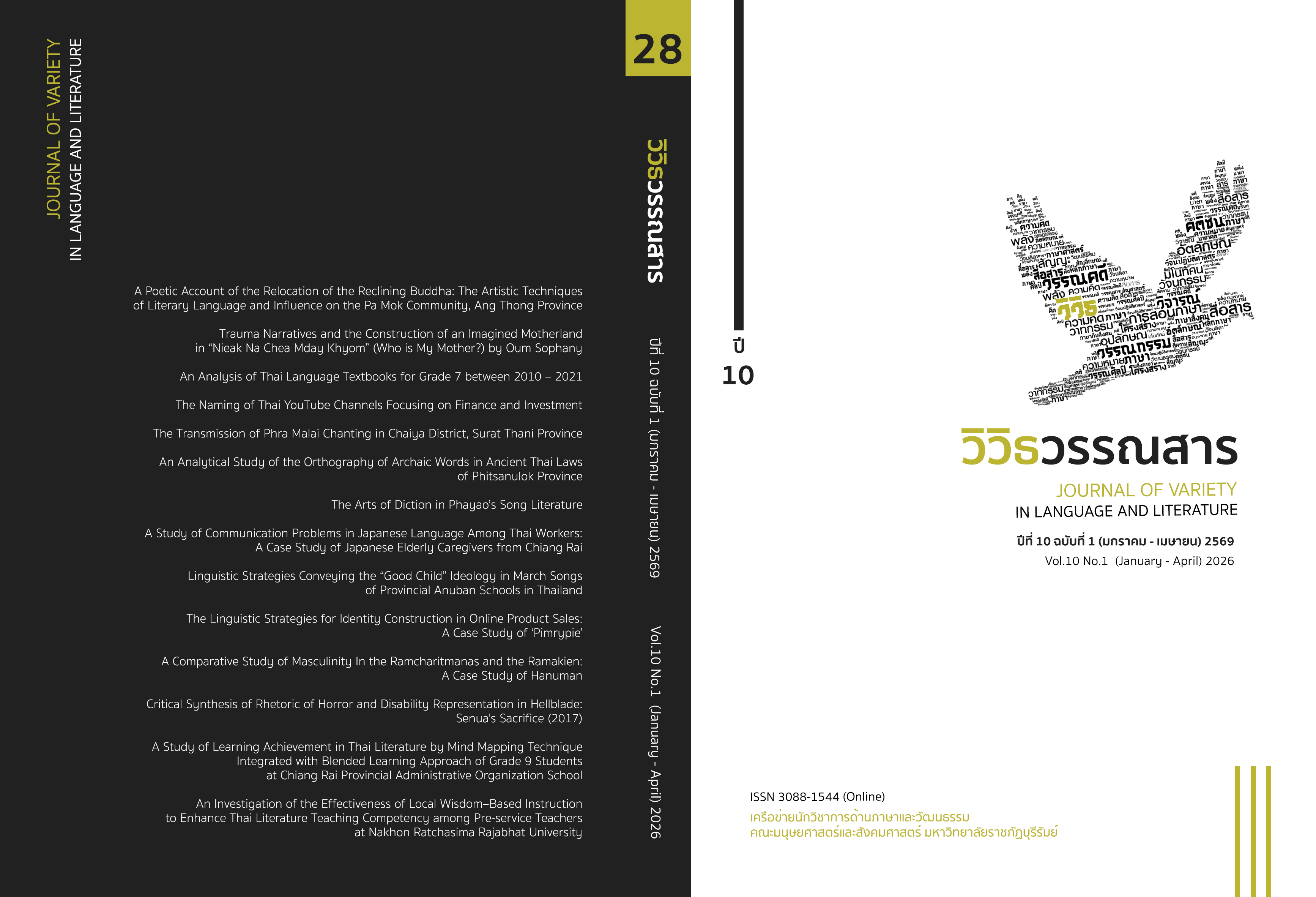
The Process of Identity Construction in Online Product Sales: A Case Study of ‘Pimrypie’
Article Sidebar
Main Article Content
Abstract
This research article aims to analyze the linguistic strategies employed by the Thai online seller “Pimrypie” in constructing a self-made entrepreneurial identity on digital platforms. Drawing on perspectives from language use and identity construction, the study analyzes nine popular livestream videos broadcast between January and September 2024. The data were analyzed using a qualitative descriptive-analytical approach.
The findings reveal two main aspects. First, nine types of linguistic strategies are identified in the livestream discourse: lexical choices, narrative strategies, speech acts, comparison, intertextuality, referencing, emphatic structures, stance expressions, and presupposition. These strategies are used to communicate and reinforce five core identity themes: diligence, a difficult life background, affordable product pricing, social contribution, and filial gratitude. Second, the findings highlight the social contexts that support these identity themes. The construction of Pimrypie’s identity reflects a dynamic process of digital identity formation in online media spaces, where the seller’s role evolves from an ordinary vendor to a socially influential online entrepreneur in Thai society. In particular, the use of direct, intense, and informal language plays a significant role in fostering emotional closeness and shared understanding with consumers. Such linguistic practices align with the culture of digital commerce platforms, which value authenticity and personal branding. Furthermore, this process of identity construction can be interpreted through Goffman’s dramaturgical perspective, which explains how individuals adjust their roles and self-presentation according to audiences and social contexts to manage impressions and construct desired identities in public online spaces.
Article Details

This work is licensed under a Creative Commons Attribution-NonCommercial-NoDerivatives 4.0 International License.
Copyright is that of the journal any reproduction must be permitted by the editor of journal
References
AlMamoory, M., & Khazaali, T. W. (2024). Linguistic strategy in online digital communication: A pragmatic study. Journal of Media and Communication Culture, 4 (3), 10–21. https://doi.org/10.55529/jmcc.43.10.21
Anantachat, S. (2012). Advertising and consumer culture. Chulalongkorn University Press. (In Thai)
Julphongsathorn, M. (2001). Creative strategies and information content in Thai magazine advertising [Master’s thesis]. Chulalongkorn University. https://doi.org/10.14457/CU.the.2001.20 (In Thai)
Kittiwatthanakul, S. (2004). The portrayal of women roles in magazine advertisement and creative personnel’s attitude [Master’s thesis]. Chulalongkorn University]. (In Thai)
Kivisto, P., & Pittman, D. (2007). Goffman’s dramaturgical sociology. In P. Kivisto (Ed.), Illuminating social life: Classical and contemporary theory revisited (pp. 271–290). Sage Publications.Komolvanich, M. (2013). Brand personality communication through perfume packaging [Master’s thesis]. Chulalongkorn University. https://doi.org/10.58837/CHULA.THE.2013.394 (In Thai)
Limkulakom, S. (1991). Strategies of word use in Thai in television and magazine advertising [Master’s thesis]. Chulalongkorn University. https://doi.org/10.58837/CHULA.THE.1991.843 (In Thai)
Liu, K. (2022). Identity construction online: Identities and ideologies in reader comments in online news fora [Doctoral dissertation]. Victoria University of Wellington. https://doi.org/10.26686/wgtn.19119728
Panlee, P. (2002). Weight loss process of women: A discourse of identity construction in consumer culture [Master’s thesis]. Chulalongkorn University. (In Thai)
Panphothong, N. (2013). Critical discourse analysis from a linguistic perspective: Concepts and applications to Thai discourse. Academic Publication Dissemination Project, Faculty of Arts, Chulalongkorn University. (In Thai)
Phakdeephasook, S. (2018). The relationship between language and identity and approaches to studying Thai language. Faculty of Arts, Chulalongkorn University. (In Thai)
Phanphitphat, T., & Asawadechsakul, W. (2015). Identity design of fashion brand for M generation men. Journal of Fine and Applied Arts, Chulalongkorn University, 2 (1), 117–130. (In Thai)
Rosana, A., & Fauzi, I. (2024). The role of digital identity in the age of social media: Literature analysis on self-identity construction and online social interaction. Journal of Social Science, 1 (4), 477–489. https://doi.org/10.59613/a8yyff42
Ruangdechsakul, J. (2006). Advertising media and the identity of contemporary Thai middle-class men [Master’s thesis]. Chulalongkorn University. https://doi.org/10.14457/CU.the.2006.160 (In Thai)
Sasanapatchoti, P. (2008). Analysis of brand positioning and personality in print advertisements [Master’s thesis]. Chulalongkorn University. https://doi.org/10.58837/CHULA.THE.2008.415 (In Thai)
Shaivya, S. (2024). Voices in the virtual: Constructing linguistic identity in digital spaces. International Journal for Multidisciplinary Research, 6(3). https://doi.org/10.36948/ijfmr.2024.v06i03.21117
Suksom, U. (2007). Identity formation of youth through fashionable clothings: A case study of Siam Square [Master’s thesis]. Chulalongkorn University. https://doi.org/10.58837/CHULA.THE.2007.805 (In Thai)
Suwannachang, N. (2010). Language of persuasion in health magazine advertisements [Master’s thesis]. Chulalongkorn University. https://doi.org/10.58837/CHULA.THE.2010.2123 (In Thai)
Turkle, S. (1997). Multiple subjectivity and virtual community at the end of the Freudian century. Sociological Inquiry, 67 (1), 72–84.
