Improving Chinese Calligraphic Stroke Order through Active Recall Techniques Using Multimedia on an Interactive Smart Display within the Buddhist Art and Architectural Context of Leng Nei Yi Temple 2 for Lower Secondary Novice Students
Keywords:
Chinese Calligraphy Stroke Order, Active Recall, Multimedia on an Interactive Smart Display, Buddhist Art and Architecture on Leng Nei Yi Temple 2Abstract
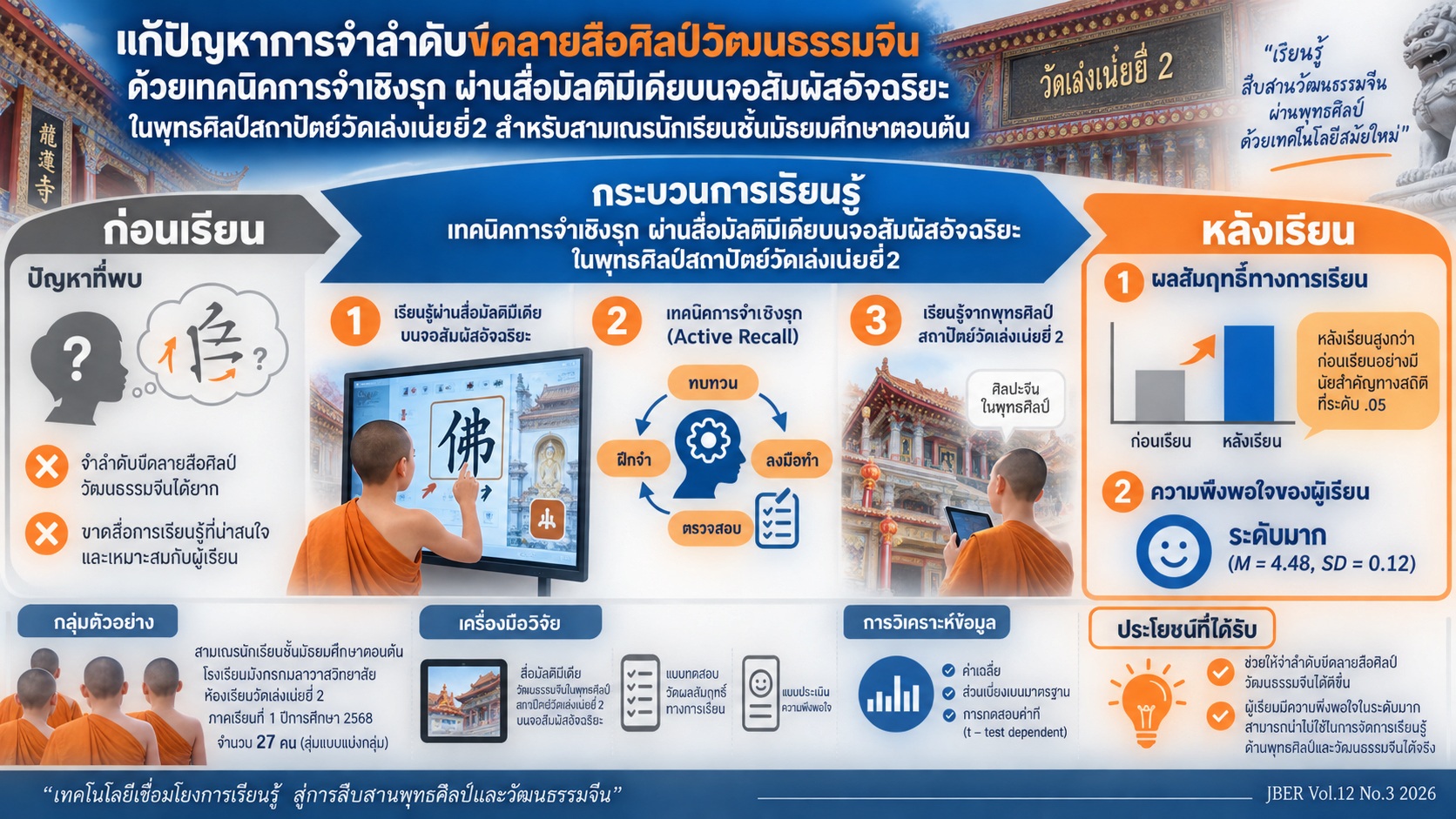
This study aimed 1) to compare lower secondary novice students’ learning achievement in memorizing the stroke order of Chinese calligraphic cultural arts before and after instruction delivered through active recall techniques using multimedia on an interactive smart display within the Buddhist art and architectural context of Leng Nei Yi Temple 2, and 2) to examine the students’ satisfaction with the learning management based on active recall techniques using multimedia on an interactive smart display in the same context. The sample consisted of 27 lower secondary novice students enrolled in Semester 1 of the 2025 academic year at Mungkorn Kamalavas Wittayalai School, Leng Nei Yi Temple 2. The sample was selected through Cluster (Area) Random Sampling. The research instruments consisted of learning management plans, multimedia on an interactive smart display, an achievement test, and a satisfaction questionnaire. Data were analyzed using mean, standard deviation, and a dependent t-test. The results showed that 1) the post-learning achievement in memorizing the stroke order of Chinese calligraphic cultural arts among lower secondary novice students who received instruction through active recall techniques using multimedia on an interactive smart display within the Buddhist art and architectural context of Leng Nei Yi Temple 2 was significantly higher than their pre-learning achievement at the .05 level, and 2) the students’ satisfaction with the learning management based on active recall techniques using multimedia on an interactive smart display was at the high level (M = 4.48, SD = 0.12).
Keywords: Chinese Calligraphy Stroke Order, Active Recall, Multimedia on an Interactive Smart Display, Buddhist Art and Architecture on Leng Nei Yi Temple 2
References
สำนักงานเลขาธิการสภาการศึกษา. (2552–2559 (2553)) แผนการศึกษาแห่งชาติ ฉบับปรับปรุง, (น.39). กรุงเทพฯ: บริษัท พริกหวานกราฟฟิค จำกัด
ชัยวัฒน์ สุทธิรัตน์, (2561) การพัฒนารูปแบบการศึกษาชั้นเรียนแบบเรียนรู้ร่วมกันที่ส่งเสริมความสามารถในการจัดการเรียนรู้ของนักศึกษาครู, (น. 484). กำแพงเพชร: วารสารมนุษยศาสตร์และสังคมศาสตร์ ราชภัฏกําแพงเพชร
คณะสงฆ์จีนนิกายรังสรรค์, (2551) อนุสรณ์มโภชเปิดวัดบรมราชากาญจนาภิเษกอนุสรณ์, (น.14-15). กรุงเทพฯ: บริษัท คอมม่าดีไซน์แอนด์พริ้นท์ จํากัด
กระทรวงศึกษาธิการ (2551) หลักสูตรแกนกลางการศึกษาขั้นพื้นฐาน พุทธศักราช 2551, กรุงเทพฯ: โรงพิมพ์ ชุมนุมสหกรณ์การเกษตรแห่งประเทศไทย จำกัด
สหัสวรรษ สุวรรณไตรย์ และคณะ (2567) การพัฒนาทักษะการเขียนอักษรจีนตามลำดับขีด โดยใช้แบบฝึกทักษะการเขียนตัวอักษรจีน, ร้อยเอ็ด: วารสารมหาวิทยาลัยมหามกุฎราชวิทยาลัย วิทยาเขตร้อยเอ็ด
Chen Tingyou. (2003) Chinese Calligraphy. Wuzhou Communication Publishing House, 12-13.
Boakye, A. A., Essel, H. B., Appiah, E., & Anane-Antwi, E. (2024). Effectiveness Of Interactive Multimedia-Based Learning in Teaching Art History as A Component of General Knowledge in Art for Senior High School Students. Journal of the University of Science and Technology, 42(2), 140–156.
Jegou, J. (2017). Comment mémoriser les caractères chinois de manière efficace. 37.
Burrows, G. (2006). Ubiquitous Interactive Art Displays: Are they wanted, are they intuitive? Department of Information Science University of Otago. 6.
Downloads
Published
How to Cite
Issue
Section
Categories
License
Copyright (c) 2026 Journal of Buddhist Education and Research (JBER)

This work is licensed under a Creative Commons Attribution-NonCommercial-NoDerivatives 4.0 International License.