A Study of Transformational Leadership Based on the Four Iddhipāda Principles of School Administrators under the Udon Thani Primary Educational Service Area Office 1
Keywords:
Change Leadership SkillsAbstract
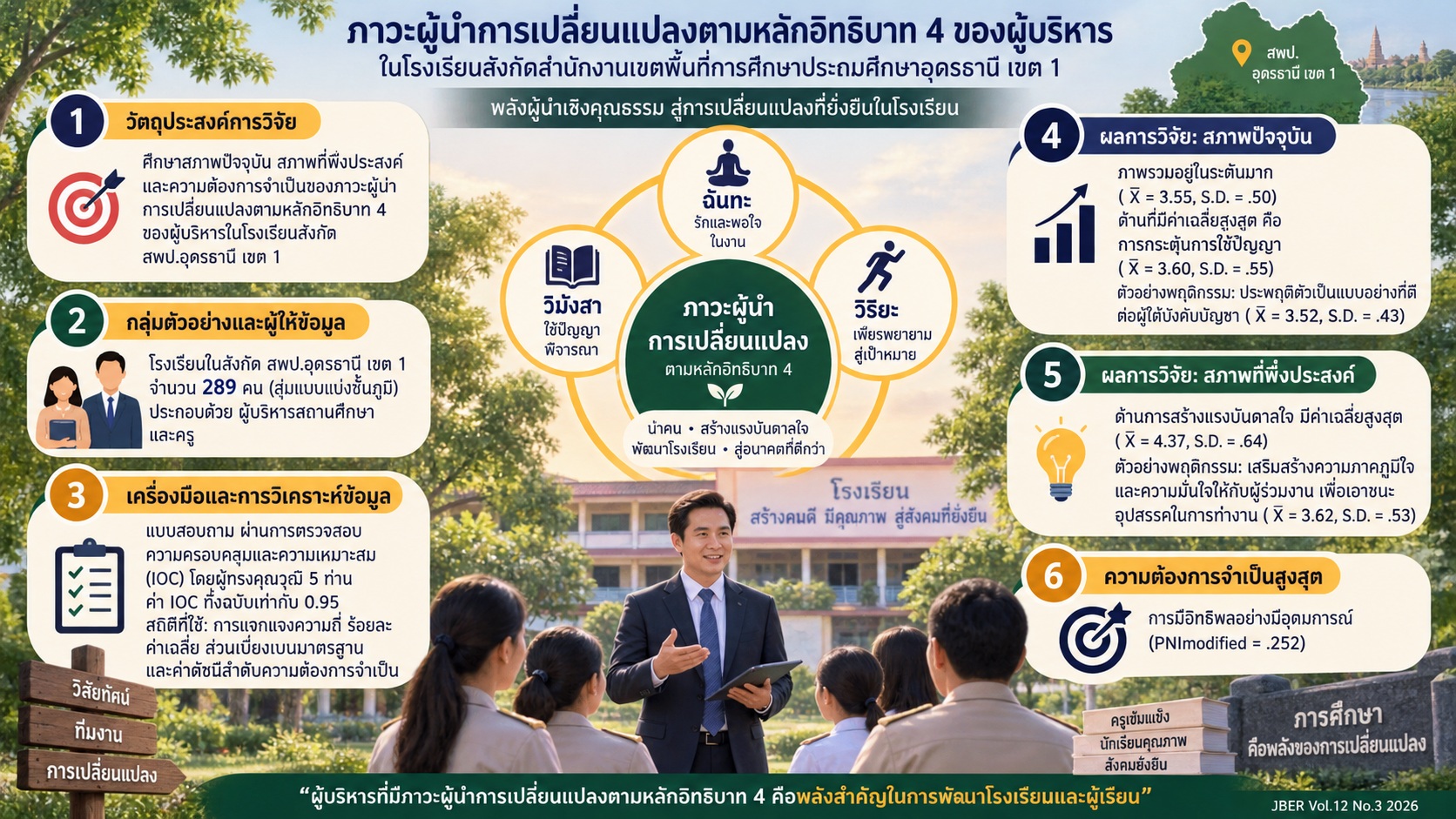
The objectives of this study were to examine the current and desirable conditions, as well as the priority needs, regarding transformational leadership based on the principle of the Four Iddhipada (Pathways to Accomplishment) among school administrators under the Office of Udon Thani Primary Educational Service Area 1. The sample consisted of 289 participants, drawn from schools under the jurisdiction of this office, selected through stratified random sampling. The informants included school administrators and teachers. The research instrument was a questionnaire validated for content coverage and appropriateness by five experts, with an Index of Item-Objective Congruence (IOC) of 0.95. Data were analyzed using frequency distribution, percentage, mean, standard deviation, and the Modified Priority Needs Index PNI modified. The findings revealed that, overall, the current state of transformational leadership based on the Four Iddhipada among school administrators was at a high level (x̄ = 3.55, S.D. = .50). When examined by dimension, the highest mean score for the current state was found in intellectual stimulation (x̄ = 3.60, S.D. = .55), with the specific item “acting as a good role model for subordinates” receiving a high mean score (x̄ = 3.52, S.D. = .43). Regarding the desirable state, the highest mean score was in inspirational motivation (x̄ = 4.37, S.D. = .64), particularly the item “fostering pride and confidence among colleagues to overcome obstacles at work” (x̄ = 3.62, S.D. = .53). The highest priority need was identified in the dimension of idealized influence (PNImodified = .252).
References
ณฐวัฒน์ พระงาม. (2562). ภาวะผู้นําการเปลี่ยนแปลงของผู้บริหารโรงเรียนขนาดเล็กสังกัดสํานักงานเขตพื้นที่ การศึกษาประถมศึกษาพิษณุโลก เขต 3. วารสารการวิจัยการบริหารการพัฒนา, 8(2), 13–23.
ธนภัทร พึ่งพงษ์. (2564). ความคิดเห็นของครูที่มีต่อภาวะผู้นําการเปลี่ยนแปลงของผู้บริหารสถานศึกษาในสังกัด สํานักงานเขตพื้นที่การศึกษามัธยมศึกษา เขต 1 กลุ่ม 2 กรุงเทพมหานคร.Journal of Roi Kaensarn Academi, 6(2), 72–85.
บุญชม ศรีสะอาด. (2556). การวิจัยเบื้องต้น(พิมพ์ครั้งที่ 9). สุวีริยาสาส์น.
พนิดา ตระหง่าน, และคณะ. (2565). ภาวะผู้นําการเปลี่ยนแปลงของผู้บริหารสถานศึกษา อําเภอเมืองปทุมธานี สังกัดสํานักงานเขตพื้นที่การศึกษาประถมศึกษาปทุมธานี เขต 1. Journal of Roi Kaensarn Academi, 7(2), 197.
พระมหาวิจิตร อินฺทธมฺโม (พิศเพ็ง). (2561). แนวทางการพัฒนาคุณลักษณะนักเรียนตามหลักกุศลกรรมบถ 10 สําหรับโรงเรียนประถมศึกษา อําเภอเมือง จังหวัดนนทบุรี.วารสารบวรสหการศึกษาและมนุษย สังคมศาสตร์, 4(2), 54–65.
ภวัต มิสดีย์. (2562). การพัฒนาโปรแกรมเสริมสร้างภาวะผู้นําการเปลี่ยนแปลงของผู้บริหารระดับต้น มหาวิทยาลัยราชภัฏ[วิทยานิพนธ์ปริญญาดุษฎีบัณฑิต, มหาวิทยาลัยมหาสารคาม].
ภัทรสุดา รักกล่อง. (2568). ภาวะผู้นําการเปลี่ยนแปลงของผู้บริหารสถานศึกษาสังกัดสํานักงานเขตพื้นที่การศึกษา ประถมศึกษาสุพรรณบุรี เขต 1. วารสารวิจยวิชาการ, 8(5), 211.
สุภารัตน์ ชนะสงคราม. (2563). การศึกษาภาวะผู้นําการเปลี่ยนแปลงของผู้บริหารสถานศึกษาโรงเรียนขนาดเล็ก กลุ่มโรงเรียนบ้านดุง สังกัดสํานักงานเขตพื้นที่การศึกษาประถมศึกษาอุดรธานี เขต 3[วิทยานิพนธ์ระดับ บัณฑิตศึกษา, มหาวิทยาลัยราชธานี].
สุวิมล ว่องวานิช. (2542). การสังเคราะห์เทคนิคที่ใช้ในการประเมินความต้องการจําเป็นในนิสิตคณะครุศาสตร์ จุฬาลงกรณ์มหาวิทยาลัย[วิทยานิพนธ์ปริญญาดุษฎีบัณฑิต, จุฬาลงกรณ์มหาวิทยาลัย].
สํานักงานเขตพื้นที่การศึกษาประถมศึกษาอุดรธานี เขต 1. (2568). คู่มือแนวทางการขับเคลื่อนนโยบายพัฒนา คุณภาพการศึกษา วิถีใหม่ วิถีคุณภาพ “เด็กอุดร 1 เป็นที่ 1” ปีการศึกษา 2568.สํานักงานเขตพื้นที่ การศึกษาประถมศึกษาอุดรธานี เขต 1.
Covey, S. R. (2004). The 8th habit: From effectiveness to greatness.Free Press.
Den Hartog, D. N., & Koopman, P. L. (2001). Leadership in organizations. In N. Anderson, D. S. Ones, H. K. Sinangil, & C. Viswesvaran (Eds.), Handbook of industrial, work & organizational psychology: Volume 2. Organizational psychology(pp. 166–187). SAGE Publications.
Gibson, J. L., Ivancevich, J. M., & Donnelly, J. H., Jr. (2000). Organizations: Behavior, structure, processes(10th ed.). McGraw-Hill.
Spears, L. C., & Lawrence, M. (Eds.). (2002). Focus on leadership: Servant-leadership for the twenty-first century.John Wiley & Sons.
Ward, K. (2002). A vision for tomorrow: Transformational nursing leaders. Nursing Outlook, 50(3), 121–126.
Wong, P. T. P., & Davey, M. A. (2007). Best practices in servant leadership.Paper presented at the Servant Leadership Research Roundtable, Regent University.
Downloads
Published
How to Cite
Issue
Section
Categories
License
Copyright (c) 2026 Journal of Buddhist Education and Research (JBER)

This work is licensed under a Creative Commons Attribution-NonCommercial-NoDerivatives 4.0 International License.