The Academic Administration Based on the Four Iddhipāda Principles of Private School Administrators in Khon Kaen Province
Keywords:
Academic Administration, Four Iddhipāda Principles, Educational Institution AdministratorsAbstract
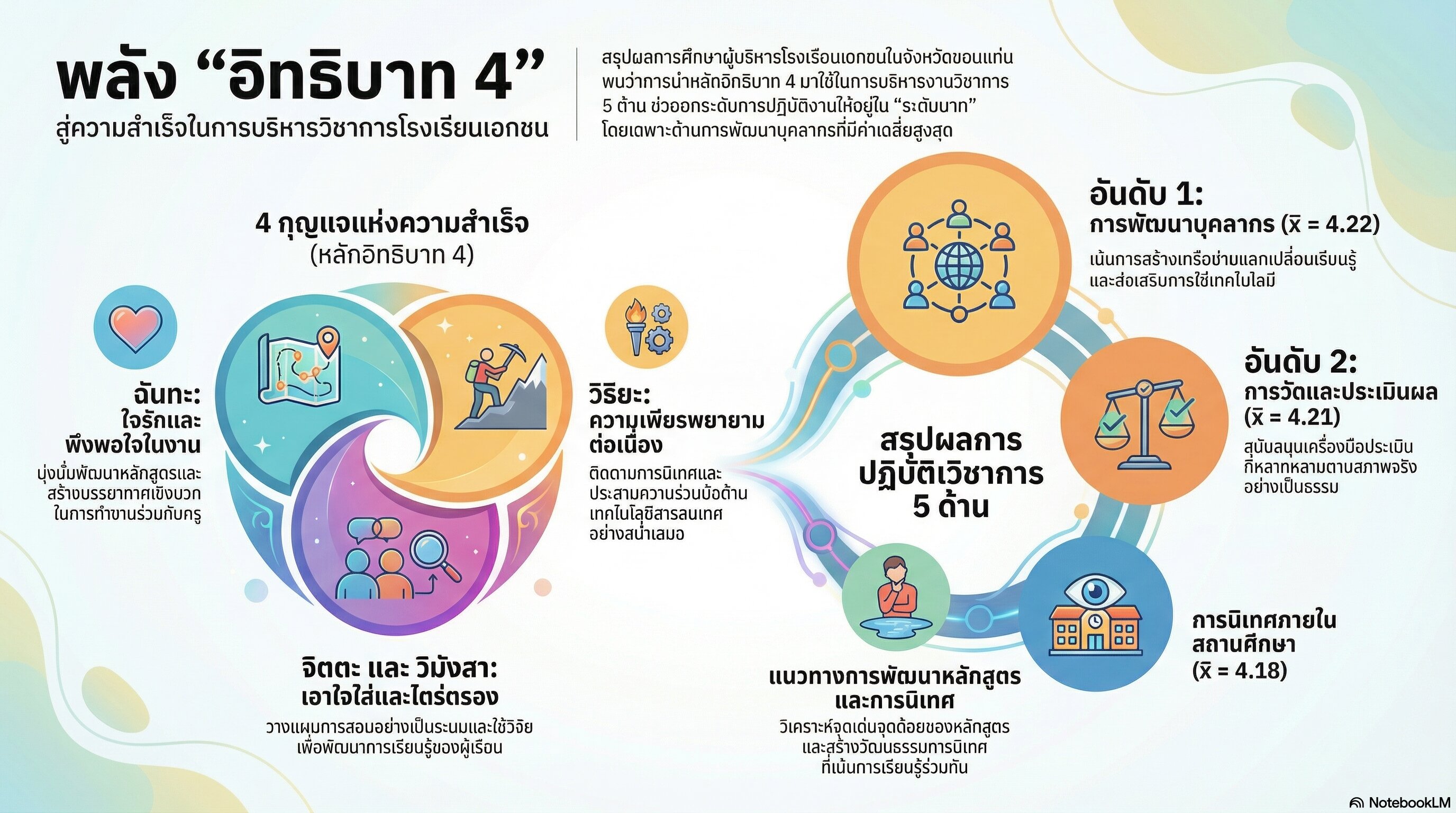
This research aimed to (1) study the academic administration situation according to the Four Bases of Influence among administrators of private schools in Khon Kaen Province, and (2) propose guidelines for academic administration according to the Four Bases of Influence among administrators of private schools in Khon Kaen Province. A quantitative research methodology was used. The sample consisted of 333 school administrators and academic department heads. The research instrument used was a questionnaire with a reliability coefficient of 1, and an interview form. Statistics used included frequency, percentage, mean, and standard deviation. The results revealed: 1. Overall, the level of implementation was high. When classified by area, the level of implementation was high in all areas, ranked by average as follows: Academic personnel development according to the Four Bases of Influence, followed by measurement and evaluation according to the Four Bases of Influence, teaching and learning according to the Four Bases of Influence, and curriculum administration according to the Four Bases of Influence. The area with the highest level of implementation was: Internal Supervision in Educational Institutions Based on the Four Bases of Iddhipāda 2. Guidelines for Academic Administration Based on the Four Bases of Iddhipāda for Private School Administrators in Khon Kaen Province: 1) Create satisfaction with the development of clear measurement and evaluation tools. 2) Understand, consider, and analyze the strengths and weaknesses of the curriculum to develop it in line with the changing conditions of today's society.
References
บุญชม ศรีสะอาด. (2544). การวิจัยเบื้องต้น (พิมพ์ครั้งที่ 6). สุวีริยาสาสน์.
ประยูร อาษานาม. (2551). คู่มือวิจัยทางการศึกษา (พิมพ์ครั้งที่ 2). มหาวิทยาลัยขอนแก่น.
สำนักงานเลขาธิการสภาการศึกษา. (2560). แผนการศึกษาแห่งชาติ พ.ศ. 2560–2579. พริกหวานกราฟฟิค.
สุทธิรักษ์ หงสะมัด. (2551). ก้าวนำพัฒนา. ทีมงานจาบโฆษณาเฉลิมทองคำ.
สมนึก ภัททิยธนี. (2551). การวัดผลการศึกษา (พิมพ์ครั้งที่ 4). ประสานการพิมพ์.
อุทัย บุญประเสริฐ. (2538). การวางแผนและจัดระบบแผนงานในโรงเรียน. โรงพิมพ์เอสดีเพล.
Downloads
Published
How to Cite
Issue
Section
License
Copyright (c) 2026 Authors

This work is licensed under a Creative Commons Attribution-NonCommercial-NoDerivatives 4.0 International License.