The Development Guidelines for the School Administrators’ Technological Leadership Administrators under Khon Kaen Primary Educational Service Area Office 2
Keywords:
Approach, technological Leadership, Current Situation, Desired SituationAbstract
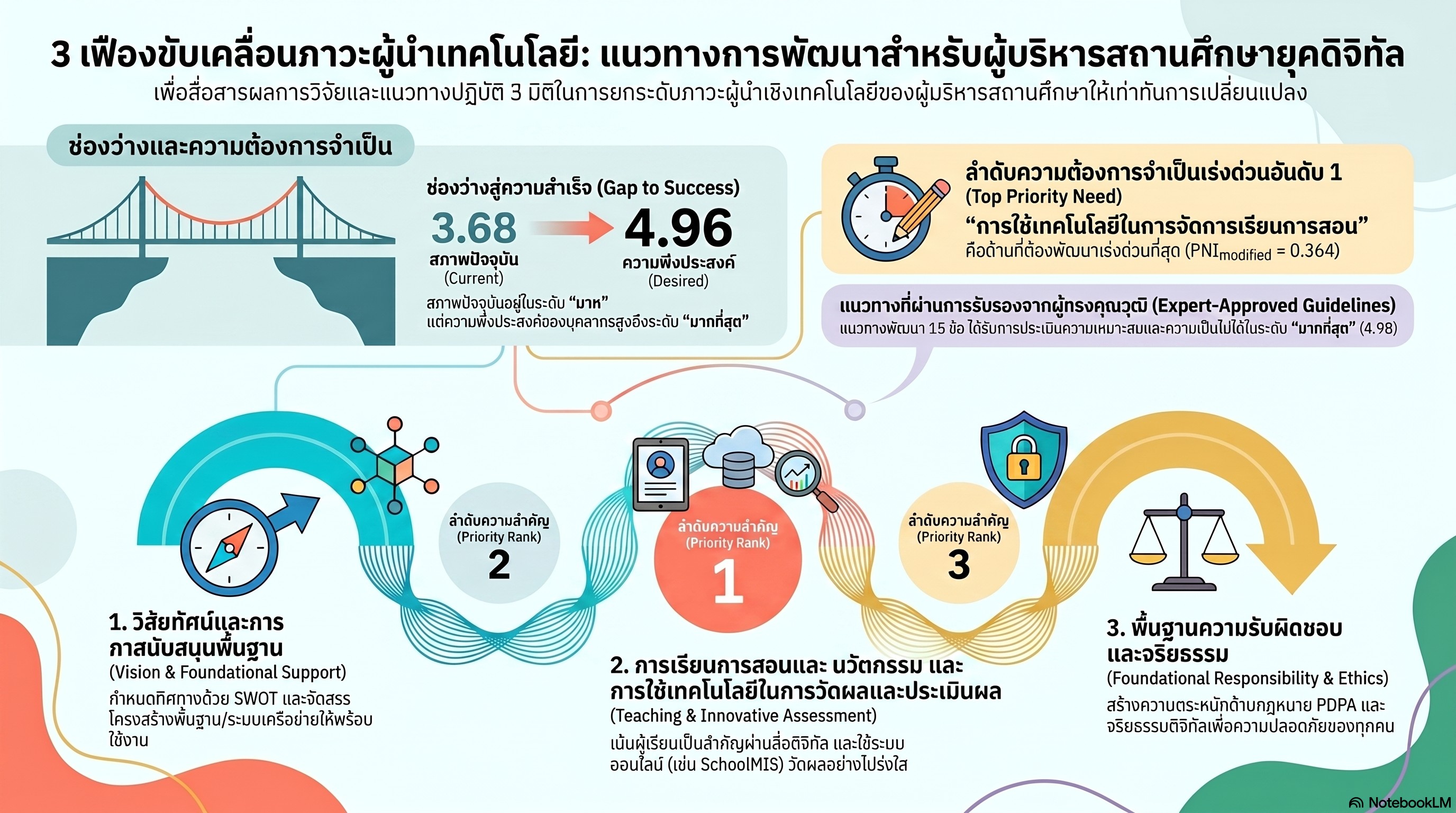
The purposes of this research were: (1) to study the current conditions, desirable conditions, and priority needs of technological leadership among school administrators under the Office of Khon Kaen Primary Educational Service Area 2; and (2) to develop guidelines for enhancing technological leadership among school administrators under the same office. This study employed a mixed-methods research design conducted in two phases. In Phase 1, data on current conditions, desirable conditions, and priority needs were collected from 303 school administrators and teachers selected through stratified random sampling and simple random sampling based on the Krejcie and Morgan table. The research instrument was a five-point rating scale questionnaire with IOC values ranging from 0.67 to 1.00 and reliability coefficients of 0.973 and 0.961 for the current and desirable condition scales, respectively. In Phase 2, seven experts were interviewed, and nine experts evaluated the proposed guidelines. The research instruments included a semi-structured interview form and an evaluation form for appropriateness and feasibility. Data were analyzed using frequency, percentage, mean, standard deviation, content analysis, and the Modified Priority Needs Index (PNImodified).
The findings revealed that the overall current level of technological leadership was high (x̄ = 3.68, S.D. = 0.76), while the overall desirable level was at the highest level (x̄ = 4.96, S.D. = 0.33). Among the current conditions, ethical, social, and legal use of technology received the highest mean score (x̄ = 3.77), followed by technology-supported management and operations, technology-based assessment, technological leadership and vision, and technology integration in teaching and learning. Regarding priority needs, technology integration in teaching and learning ranked first (PNImodified = 0.364), followed by technological leadership and vision (PNImodified = 0.359), technology-based assessment (PNImodified = 0.358), technology-supported management and operations (PNImodified = 0.347), and ethical, social, and legal use of technology (PNImodified = 0.315). The proposed development guidelines consisted of five dimensions with a total of fifteen guidelines: technology integration in teaching and learning, technological leadership and vision, technology-based assessment, technology-supported management and operations, and ethical, social, and legal use of technology. The evaluation results indicated that the proposed guidelines were highly appropriate (x̄ = 4.98) and highly feasible (x̄ = 4.97).
References
กระทรวงศึกษาธิการ. (2553). พระราชบัญญัติการศึกษาแห่งชาติ พ.ศ. 2542 และที่แก้ไขเพิ่มเติม (ฉบับที่ 2) พ.ศ. 2545 และ (ฉบับที่ 3) พ.ศ. 2553. สำนักงานคณะกรรมการการศึกษาแห่งชาติ.
จันทิมา ชิ้นปิ่นเกลียว, และคณะ. (2567). แนวทางการพัฒนาภาวะผู้นำเชิงเทคโนโลยีของผู้บริหารสถานศึกษาของโรงเรียนในสังกัดสำนักงานเขตพื้นที่การศึกษาประถมศึกษาขอนแก่น เขต 3. วารสารพุทธปรัชญาวิวัฒน์, 8(2).
จิรวัฒน์ รักปัญญาสุทธิกุล, & ชยากานต์ เรืองสุวรรณ. (2565). แนวทางการพัฒนาภาวะผู้นำเชิงเทคโนโลยีของผู้บริหารสถานศึกษา สังกัดสำนักงานอาชีวศึกษาจังหวัดร้อยเอ็ด. วารสารการบริหารการปกครองและนวัตกรรมท้องถิ่น, 7(2), 241–256.
เจนจิรา จุ้ยประโคน. (2566). ภาวะผู้นำทางเทคโนโลยีการศึกษาของผู้บริหารสถานศึกษาสังกัดสำนักงานเขตพื้นที่การศึกษาประถมศึกษาบุรีรัมย์ เขต 2. วารสารอิเล็กทรอนิกส์ทางการศึกษา, 3(2), 397–412.
ชัยนาม บุญนิตย์. (2563). ภาวะผู้นำทางเทคโนโลยีและนวัตกรรมของผู้บริหารสถานศึกษา สังกัดสำนักงานเขตพื้นที่การศึกษาประถมศึกษาสุโขทัย เขต 2 (วิทยานิพนธ์ครุศาสตรมหาบัณฑิต). มหาวิทยาลัยราชภัฏอุตรดิตถ์.
ชูพงศ์ อยู่ภักดี. (2564). แนวทางการพัฒนาภาวะผู้นำเชิงเทคโนโลยีของผู้บริหารสถานศึกษา สังกัดสำนักงานเขตพื้นที่การศึกษาประถมศึกษาชัยภูมิ เขต 1 (วิทยานิพนธ์ครุศาสตรมหาบัณฑิต). มหาวิทยาลัยราชภัฏมหาสารคาม.
ทิศนา แขมมณี. (2561). ศาสตร์การสอน: องค์ความรู้เพื่อการจัดกระบวนการเรียนรู้ที่มีประสิทธิภาพ (พิมพ์ครั้งที่ 22). สำนักพิมพ์แห่งจุฬาลงกรณ์มหาวิทยาลัย.
บุญชม ศรีสะอาด. (2560). การวิจัยเบื้องต้น (พิมพ์ครั้งที่ 10). สุวีริยาสาส์น.
ปรัชญา สาริพัฒน์. (2564). แนวทางการพัฒนาภาวะผู้นำเชิงเทคโนโลยีของผู้บริหารสถานศึกษา สังกัดสำนักงานคณะกรรมการส่งเสริมการศึกษาเอกชน จังหวัดสุราษฎร์ธานี (วิทยานิพนธ์ปริญญามหาบัณฑิต). มหาวิทยาลัยสุโขทัยธรรมาธิราช.
รัชนี สุทธิประภา. (2566). ภาวะผู้นำเชิงเทคโนโลยีของผู้บริหารสถานศึกษา สังกัดสำนักงานเขตพื้นที่การศึกษาประถมศึกษาเชียงราย เขต 3 (วิทยานิพนธ์ปริญญามหาบัณฑิต). มหาวิทยาลัยพะเยา.
สมนึก ภัททิยธนี. (2551). การวัดผลการศึกษา (พิมพ์ครั้งที่ 6). ประสานการพิมพ์.
สุจริต แสงสุวรรณ์. (2566). แนวทางการพัฒนาภาวะผู้นำเชิงเทคโนโลยีของผู้บริหารสถานศึกษา สังกัดสำนักงานเขตพื้นที่การศึกษาประถมศึกษาหนองคาย (วิทยานิพนธ์ครุศาสตรมหาบัณฑิต). มหาวิทยาลัยราชภัฏอุดรธานี.
อดิศักดิ์ ดงสิงห์. (2560). แนวทางการพัฒนาภาวะผู้นำเชิงเทคโนโลยีของผู้บริหารสถานศึกษา สังกัดสำนักงานเขตพื้นที่การศึกษามัธยมศึกษา เขต 1 (การศึกษาค้นคว้าด้วยตนเอง, ครุศาสตรมหาบัณฑิต). มหาวิทยาลัยสุโขทัยธรรมาธิราช.
อัสนี โปราณานนท์. (2564). แนวทางการพัฒนาภาวะผู้นำเชิงเทคโนโลยีของผู้บริหารสถานศึกษา สังกัดสำนักงานเขตพื้นที่การศึกษาประถมศึกษาพะเยา เขต 1 (การศึกษาค้นคว้าด้วยตนเอง, การศึกษามหาบัณฑิต). มหาวิทยาลัยพะเยา.
American Institutes for Research. (2009). Evaluation of the school technology leadership initiative: Report 2. Author.
Apsorn, A., Sisan, B., & Tungkunanan, P. (2019). Information and communication technology leadership of school administrators in Thailand. International Journal of Instruction, 12(2), 639–650. https://eric.ed.gov/?id=EJ1210977
Burke, R., & Cooper, C. (2004). Leading in turbulent times: Managing in the new world of work. Blackwell Publishing. https://www.semanticscholar.org/paper/Leading-in-turbulent-times
Chuanaphaisan, J. (2020). Guidelines for developing technology leadership of school administrators in Thawarawadee consortium schools under the Secondary Educational Service Area Office Suphanburi (Independent study, Master of Education). Silpakorn University.
Coatney, S. (2010). The many faces of school library leadership. ABC-CLIO.
Consortium for School Networking. (2004). Leadership and community involvement dramatically impact education technology budgets. Fratelli Group.
Cronbach, L. J. (1951). Coefficient alpha and the internal structure of tests. Psychometrika, 16(3), 297–334. https://doi.org/10.1007/BF02310555
International Society for Technology in Education. (2016). Five reasons why the 2016 ISTE standards for students matter. https://www.iste.org/explore/ISTE-Standards-in-Action/Five-reasons-why-the-2016-ISTE-Standards-for-Students-matter
International Society for Technology in Education. (2018). ISTE standards for education leaders. https://www.iste.org/standards/iste-standards-for-education-leaders
Krejcie, R. V., & Morgan, D. W. (1970). Determining sample size for research activities. Educational and Psychological Measurement, 30(3), 607–610. https://doi.org/10.1177/001316447003000308
Downloads
Published
How to Cite
Issue
Section
Categories
License
Copyright (c) 2026 Journal of Buddhist Education and Research (JBER)

This work is licensed under a Creative Commons Attribution-NonCommercial-NoDerivatives 4.0 International License.