Guidelines for Developing Transformational Leadership of School Administrators under Khon Kaen Primary Educational Service Area Office 2
Keywords:
Approach, transformational leadership, Current Situation, Desired SituationAbstract
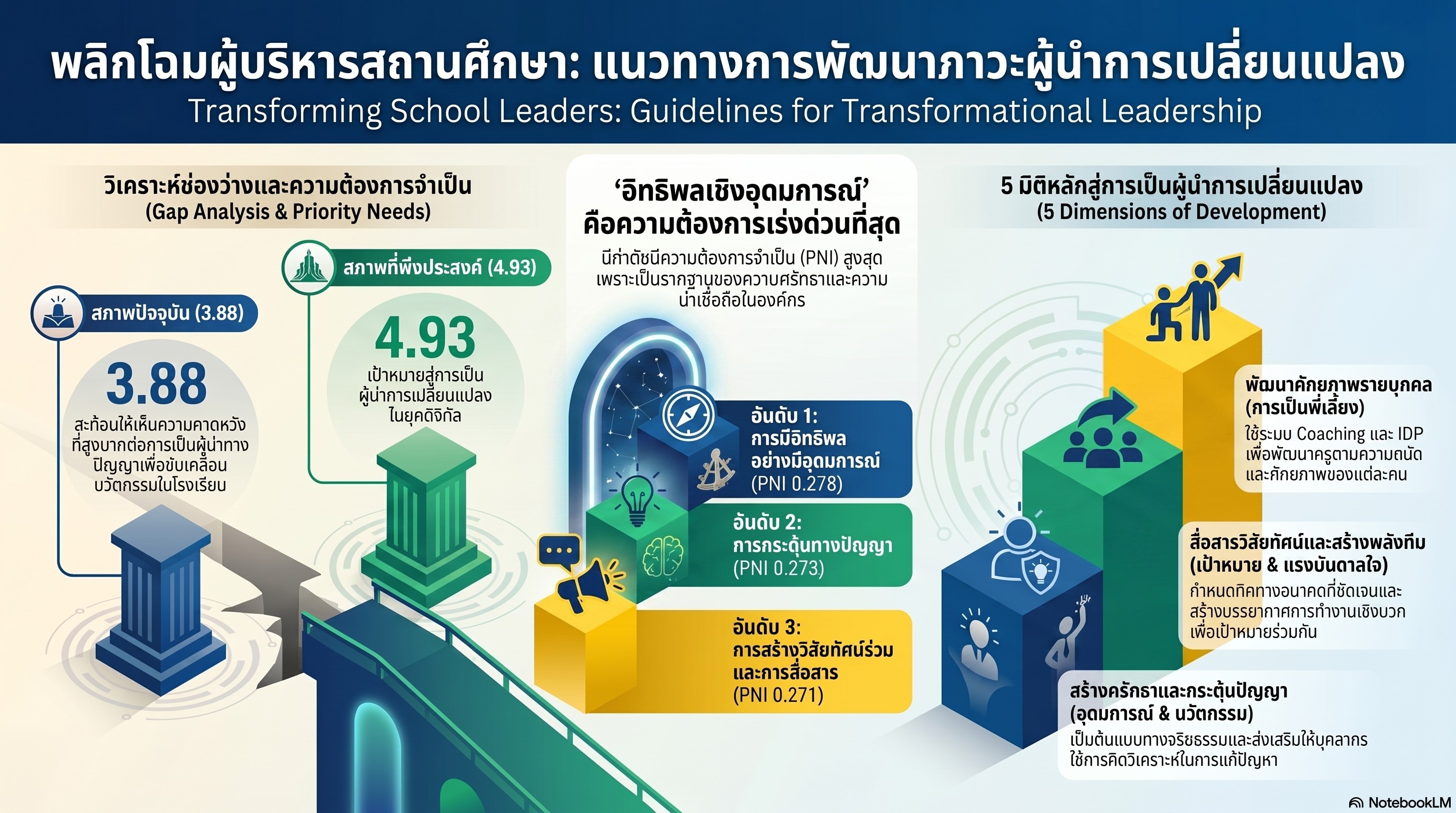
The objectives of this research were: 1) to study the current state, the desirable state, and the priority needs of transformational leadership of school administrators under the Office of Khon Kaen Primary Educational Service Area 2; and 2) to study guidelines for developing transformational leadership of school administrators under the Office of Khon Kaen Primary Educational Service Area 2. The study employed a mixed-methods research design divided into two phases. Phase 1 studied the current state, the desirable state, and priority needs. The sample group consisted of 303 school administrators and teachers, determined using Krejcie and Morgan’s table and selected via stratified random sampling. The research instrument was a transformational leadership questionnaire with an Item-Objective Congruence (IOC) index between 0.80 and 1.00. The analysis results showed that for the current state, the item discrimination power ranged from 0.469 to 0.839, with an overall reliability of 0.976. For the desirable state, the item discrimination power ranged from 0.418 to 0.881, with an overall reliability of 0.979. Phase 2 investigated guidelines for developing transformational leadership of school administrators under the Office of Khon Kaen Primary Educational Service Area 2 by interviewing 7 experts and assessing the guidelines with 9 experts, selected through purposive sampling. The research instruments included a semi-structured interview form and a suitability and feasibility assessment form. Data were analyzed using frequency, percentage, mean, standard deviation, and the Modified Priority Needs Index (PNImodified) to prioritize needs. Research Findings: (1) The current state of transformational Leadership of School Administrators under the Office of Khon Kaen Primary Educational Service Area 2 was at a high level (x̄ = 3.88, S.D. = 0.279). Considering each aspect, all were at a high level. The highest mean was found in individualized consideration (x̄ = 3.89, S.D. = 0.32), followed by inspirational motivation (x̄ = 3.88, S.D. = 0.33), intellectual stimulation (x̄ = 3.88, S.D. = 0.34), shared vision and communication (x̄ = 3.88, S.D. = 0.34), and idealized influence (x̄ = 3.86, S.D. = 0.35), respectively. The desirable state of transformational Leadership of School Administrators under the Office of Khon Kaen Primary Educational Service Area 2 was at the highest level overall (x̄ = 4.93, S.D. = 0.242). When considering each aspect, the highest mean was found in intellectual stimulation (x̄ = 4.94, S.D. = 0.29), followed by idealized influence (x̄ = 4.94, S.D. = 0.28), inspirational motivation (x̄ = 4.93, S.D. = 0.29), individualized consideration (x̄ = 4.93, S.D. = 0.30), and shared vision and communication (x̄ = 4.93, S.D. = 0.30), respectively. The Modified Priority Needs Index (PNImodified) for transformational Leadership of School Administrators under the Office of Khon Kaen Primary Educational Service Area 2 as a whole was 0.272. When classified by aspect, the highest need was found in idealized influence (PNImodified = 0.278), followed by intellectual stimulation (PNImodified = 0.273), shared vision and communication (PNImodified = 0.271), inspirational motivation (PNImodified = 0.270), and individualized consideration (PNImodified = 0.267), respectively. (2) The guidelines for developing transformational leadership of school administrators under the Office of the Primary Educational Service Area, Khon Kaen Area 2 consist of 5 aspects: 1) Influence with ideology, 3 approaches; 2) Intellectual stimulation, 3 approaches; 3) Creating a shared vision and communication, 3 approaches; 4) Creating inspiration, 3 approaches; 5) Taking into account the individual, 3 approaches. In total, 15 approaches were found. Overall, the most appropriate (x̄ = 4.98) and the most feasible (x̄ = 4.98).
References
เกศสุดา วรรณสินธ์. (2562). ภาวะผู้นำการเปลี่ยนแปลงของผู้บริหารสถานศึกษา สังกัดสำนักงานเขตพื้นที่การศึกษามัธยมศึกษา เขต 27 (วิทยานิพนธ์ปริญญามหาบัณฑิต). มหาวิทยาลัยราชภัฏมหาสารคาม.
ธนพล จูมแพง. (2566). ภาวะผู้นำการเปลี่ยนแปลงของผู้บริหารสถานศึกษาที่ส่งผลต่อการบริหารโรงเรียนคุณภาพ สังกัดสำนักงานเขตพื้นที่การศึกษาประถมศึกษาอุดรธานี (วิทยานิพนธ์ปริญญามหาบัณฑิต). มหาวิทยาลัยราชภัฏอุดรธานี.
ธิดา เมฆวะทัต. (2562). กลยุทธ์การพัฒนาภาวะผู้นำการเปลี่ยนแปลงของผู้บริหารสถานศึกษาระดับมัธยมศึกษาสังกัดสำนักงานศึกษาธิการภาค 9 (วิทยานิพนธ์ปริญญาดุษฎีบัณฑิต). มหาวิทยาลัยนอร์ทกรุงเทพ.
เนตรชนก แก้วกรม. (2563). การศึกษาภาวะผู้นำดิจิทัลและแนวทางการพัฒนาภาวะผู้นำดิจิทัลของผู้บริหารสถานศึกษา สังกัดสำนักงานเขตพื้นที่การศึกษาพิษณุโลก เขต 3 (วิทยานิพนธ์ปริญญามหาบัณฑิต). มหาวิทยาลัยนเรศวร.
ประชา โสภัณนา. (2563). การพัฒนาแนวทางการเสริมสร้างภาวะผู้นำการเปลี่ยนแปลงของผู้บริหารสถานศึกษา สังกัดสำนักงานเขตพื้นที่การศึกษามัธยมศึกษา เขต 27 (วิทยานิพนธ์ปริญญามหาบัณฑิต). มหาวิทยาลัยมหาสารคาม.
ปิยวัฒน์ บุตรน้ำเพ็ชร์ และสุรชัย สิกขาบัณฑิต. (2562). ภาวะผู้นำการเปลี่ยนแปลงของผู้บริหารโรงเรียนตามความคิดเห็นของครู สังกัดสำนักงานเขตพื้นที่การศึกษาประถมศึกษานครนายก (วิทยานิพนธ์ปริญญามหาบัณฑิต). มหาวิทยาลัยอีสเทิร์นเอเชีย.
พณิชา สีเข้ม. (2563). แนวทางการพัฒนาภาวะผู้นำการเปลี่ยนแปลงของผู้บริหารโรงเรียนเอกชน สังกัดสำนักงานคณะกรรมการส่งเสริมการศึกษาเอกชน จังหวัดอุทัยธานี (วิทยานิพนธ์ปริญญามหาบัณฑิต). มหาวิทยาลัยราชภัฏนครสวรรค์.
ภัคชัญญา นีระพันธ์. (2567). การพัฒนาภาวะผู้นำการเปลี่ยนแปลงของผู้บริหารสถานศึกษา. มหาวิทยาลัยขอนแก่น.
วันวิสา เสียงสนั่น. (2567). ภาวะผู้นำการเปลี่ยนแปลงของผู้บริหารสถานศึกษา สังกัดสำนักงานเขตพื้นที่การศึกษาประถมศึกษาสุรินทร์ เขต 1. วารสารเสียงธรรมจากมหายาน, 10(1), 110-124.
Bass, B. M., & Avolio, B. J. (1994). Improving organizational effectiveness through transformational leadership. SAGE Publications.
Cronbach, L. J. (1951). Coefficient alpha and the internal structure of tests. Psychometrika, 16(3), 297–334.
Fullan, M. (2016). The new meaning of educational change (5th ed.). Teachers College Press.
Gillespie, N. A., & Mann, L. (2004). Transformational leadership and shared values: The building blocks of trust. Journal of Managerial Psychology, 19(6), 588–607.
Goleman, D. (2002). The new leaders. Time Warner Books.
Hoy, W. K., & Miskel, C. G. (2012). Educational administration: Theory, research, and practice (9th ed.). McGraw-Hill.
Leithwood, K., & Jantzi, D. (2005). Transformational leadership. In B. Davies (Ed.), The essentials of school leadership (pp. 31–43). SAGE Publications.
Muchinsky, P. M. (1997). Psychology applied to work: An introduction to industrial and organizational psychology (5th ed.). Brooks/Cole.
Northouse, P. G. (2013). Leadership: Theory and practice (6th ed.). SAGE Publications.
Office of the Education Council. (2017). Education in Thailand 2017. Ministry of Education.
Podsakoff, P. M., MacKenzie, S. B., Moorman, R. H., & Fetter, R. (1990). Transformational leader behaviors and their effects on followers' trust in leader, satisfaction, and organizational citizenship behaviors. The Leadership Quarterly, 1(2), 107–142.
Trilling, B., & Fadel, C. (2009). 21st century skills: Learning for life in our times. Jossey-Bass.
Schieltz, M. (2019). The importance of transformational leadership in education. Chron.
United Nations. (2015). Transforming our world: The 2030 agenda for sustainable development. United Nations.
Downloads
Published
How to Cite
Issue
Section
Categories
License
Copyright (c) 2026 Journal of Buddhist Education and Research (JBER)

This work is licensed under a Creative Commons Attribution-NonCommercial-NoDerivatives 4.0 International License.