From Nationalization to Regionality: A Thematic Review of Chinese Landscape Oil Painting Studies
Keywords:
Chinese Landscape Oil Painting, Nationalization, Expressive Aesthetics, Regionality, Thematic Literature ReviewAbstract
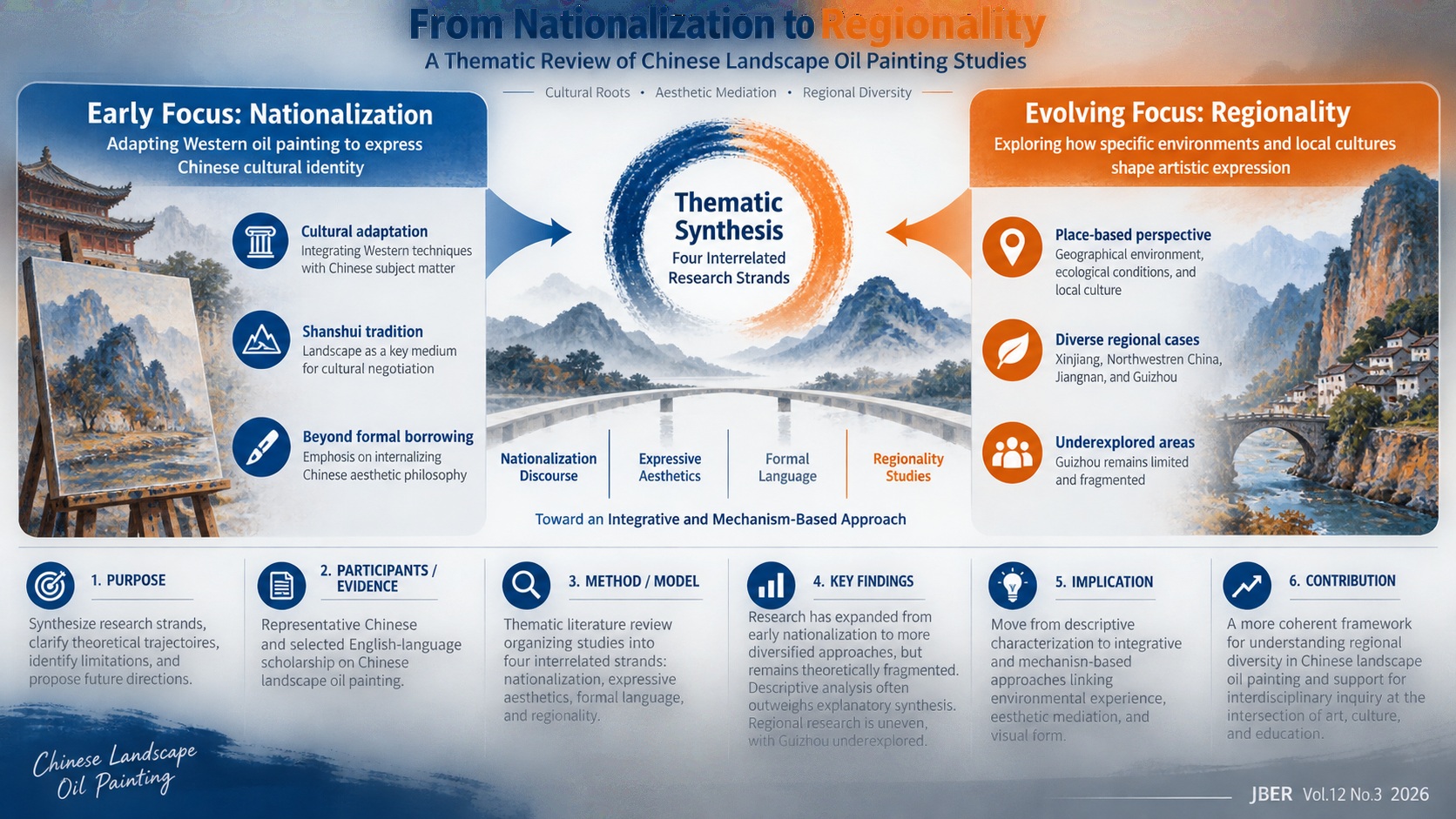
Landscape oil painting has played a significant role in the development of modern Chinese art, serving as an important site for negotiating cultural identity, aesthetic values, and spatial experience. Over the past decades, scholarly research on Chinese landscape oil painting has expanded from early discussions of nationalization to more diversified approaches focusing on expressive aesthetics, formal language, and regionality. However, existing studies remain theoretically fragmented, with descriptive analysis often outweighing explanatory synthesis. This article presents a thematic literature review of research on Chinese landscape oil painting. Drawing on representative Chinese and selected English-language scholarship, the review organizes existing studies into four interrelated research strands: nationalization discourse, expressive aesthetics and artistic conception, formal language and technical strategies, and regionality studies. Through critical synthesis, the article traces the evolution of theoretical perspectives and identifies persistent limitations, including the lack of mechanism-oriented analysis and the uneven distribution of regional research. Special attention is given to studies on Guizhou landscape oil painting as an underexplored research area. The limited and fragmented nature of existing scholarship on Guizhou highlights broader structural issues within regional landscape oil painting studies in China. Based on this analysis, the article argues for a shift from descriptive characterization toward integrative and mechanism-based approaches that link environmental experience, aesthetic mediation, and visual form. By clarifying theoretical trajectories and proposing future research directions, this review aims to contribute to a more coherent framework for understanding regional diversity in Chinese landscape oil painting and to support further interdisciplinary inquiry at the intersection of art, culture, and education.
Keywords: Chinese Landscape Oil Painting, Nationalization, Expressive Aesthetics, Regionality, Thematic Literature Review
References
Andrews, J. F. (1994). Painters and politics in the People’s Republic of China, 1949–1979. University of California Press.
Cai, X. (2008). Formal structure in Wu Guanzhong’s landscape oil painting. Literature and Art Review, 5, 72–76.
Cosgrove, D. (1984). Social formation and symbolic landscape. University of Wisconsin Press.
Grant, M. J., & Booth, A. (2009). A typology of reviews: An analysis of 14 review types and associated methodologies. Health Information & Libraries Journal, 26(2), 91–108. https://doi.org/10.1111/j.1471-1842.2009.00848.x
Gu, P., & Gu, X. (2020). Kong Yang as a singer of Guizhou landscape. Contemporary Guizhou, 6, 78–82.
Li, W. (2023). Four dimensions of Xinjiang landscape oil painting shaped by regional geography. Art Research, 4, 104–112.
Li, X. (2017). Landscape spirit in oil painting. Art Observation, 9, 56–59.
Li, Y. (2019). Spatial composition in landscape oil painting. Art Observation, 6, 83–86.
Li, Z. (2010). The aesthetic spirit of Chinese art and modern painting. China Academy of Art Press.
Liu, J. (2017). Resilience and bitter lyricism: Guizhou spirit in landscape oil painting. Art Appraisal, 10, 44–47.
Luo, W. (2016). Reflections on painting karst landscapes in Guizhou. Art Observation, 12, 90–93.
Mitchell, W. J. T. (2002). Landscape and power (2nd ed.). University of Chicago Press.
Qi, X. (2021). Aesthetic perception and qiyun shengdong in oil landscape painting. Art Observation, 10, 58–61.
Ren, J. (2015). The foundations and directions of nationalization in Chinese landscape oil painting. Art Observation, 5, 42–45.
Shi, G. (2010). Color and artistic conception in landscape oil painting. Art of the Masses, 4, 112–116.
Snyder, H. (2019). Literature review as a research methodology: An overview and guidelines. Journal of Business Research, 104, 333–339. https://doi.org/10.1016/j.jbusres.2019.07.039
Sullivan, M. (1973). The arts of China (3rd ed.). University of California Press.
Sullivan, M. (1996). Art and artists of twentieth-century China. University of California Press.
Wang, H. (2017). Regional diversity and cultural localization in contemporary Chinese oil painting. Art Observation, 9, 50–55.
Wu, G. (1999). Encounters between oil landscape painting and Chinese shanshui. Art Magazine, 3, 6–11.
Xiang, K. (2005). Artistic conception and emotion in oil landscape painting. Zhuangshi, 9, 98–100.
Yi, Y. (2015). Northwestern landscape and oil painting expression. Art Research, 2, 92–97.
Zhan, J. (1998). Contemporary Chinese landscape and oil painting. Art, 6, 4–6.
Zhang, H. (2023). Poetic imagination in expressive landscape oil painting. Art Observation, 4, 66–69.
Zhao, S. (2012). The path of imagery in Chinese landscape oil painting. Journal of Nanjing University of the Arts (Fine Arts & Design), 3, 78–84.
Downloads
Published
How to Cite
License
Copyright (c) 2026 Journal of Buddhist Education and Research (JBER)

This work is licensed under a Creative Commons Attribution-NonCommercial-NoDerivatives 4.0 International License.