Behavior of Willingness to Travel by Unmanned Aircraft: A Study of Bangkok and the Metropolitan Region
Keywords:
Behavior of travel, Unmanned Aircraft travelling, Unmanned AircraftAbstract
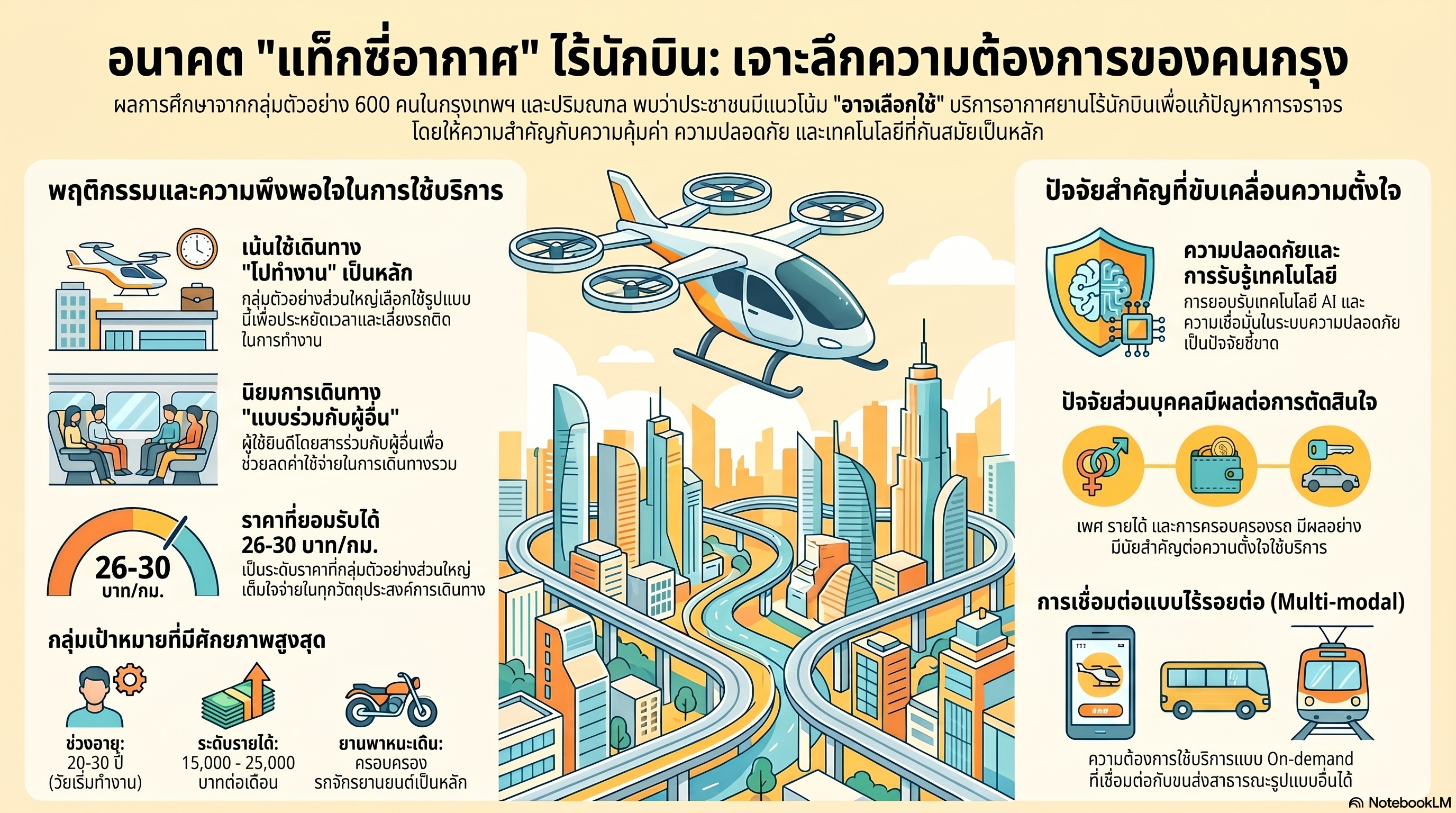
The objective of this research studied the behavior of willingness to travel by a Fully Autonomous Unmanned Aircraft: a study of Bangkok and metropolitan region. The sample consisted of 600 participants selected through cluster sampling. The analysis using inferential statistics aims to analyze the intention behaviors of travel by UAs with 2 scenarios: traveling for work, and traveling for other purposes. The findings indicate that most respondents tend to prefer this mode of transportation for commuting to work. They were willing to travel together with others and pay a fare of 26-30 baht per kilometer for all travel purposes, as shared travel can help reduce overall transportation costs. The comparison and relationship between personal factors and travel behavior according to the travel purposes of the sample group showed that, in general, there were no significant difference and they are correlated significant relationship at the .05 level. This may be attributed to the awareness of new technologies, benefits to be gained, safety, willingness, and satisfaction that will be used in the future to meet the demand and willingness of new travel mode by an Unmanned Aircraft.
References
Charoensook, C., Jirathammawat, N., Yuenchon, B., Ratanabutchai, V., & Monthong, S. (2025). Expectations of people in Bangkok regarding using drones for goods delivery. Journal of Buddhist Education and Research (JBER), 11(2), 721–729.
Ahmed, S., Fountas, G., Eker, U., Still, S. E., & Anastasopoulos, P. C. (2021). An exploratory empirical analysis of willingness to hire and pay for flying taxis and shared flying car services. Journal of Air Transport Management, 90, 101963. https://doi.org/10.1016/j.jairtraman.2020.101963
Ajzen, I. (1991). The theory of planned behavior. Organizational Behavior and Human Decision Processes, 50(2), 179–211. https://doi.org/10.1016/0749-5978(91)90020-T
Ajzen, I. (2020). The theory of planned behavior: Frequently asked questions. Human Behavior and Emerging Technologies, 2(4), 314–324. https://doi.org/10.1002/hbe2.195
Anwari, N., Ahmed, M. T., Islam, M. R., Hadiuzzaman, M., & Amin, S. (2021). Exploring the travel behavior changes caused by the COVID-19 crisis: A case study for a developing country. Transportation Research Interdisciplinary Perspectives, 9, 100334. https://doi.org/10.1016/j.trip.2021.100334
Bloom, B. S. (1975). Taxonomy of educational objectives. David McKay.
Das, S., Boruah, A., Banerjee, A., Raoniar, R., Nama, S., & Maurya, A. K. (2021). Impact of COVID-19: A radical modal shift from public to private transport mode. Transport Policy, 109, 1–11. https://doi.org/10.1016/j.tranpol.2021.05.005
Davis, F. D. (1989). Perceived usefulness, perceived ease of use, and user acceptance of information technology. MIS Quarterly, 13(3), 319–340. https://doi.org/10.2307/249008
International Civil Aviation Organization. (2015). Manual on remotely piloted aircraft systems (RPAS) (Doc 10019/AN/507) (1st ed.). ICAO.
Mouratidis, K., Ettema, D., & Næss, P. (2019). Urban form, travel behavior, and travel satisfaction. Transportation Research Part A: Policy and Practice, 129, 306–320. https://doi.org/10.1016/j.tra.2019.09.002
National Aeronautics and Space Administration. (2019). Urban air mobility grand challenge. https://www.nasa.gov/uamgc
Park, S. W. (2021). Social acceptability of urban air mobility by aircraft category and autonomous phases (Doctoral dissertation). KDI School.
Rajendran, S., & Srinivas, S. (2020). Air taxi service for urban mobility: A critical review of recent developments, future challenges, and opportunities. Transportation Research Part E: Logistics and Transportation Review, 143, 102090. https://doi.org/10.1016/j.tre.2020.102090
Rajendran, S., Srinivas, S., & Grimshaw, T. (2021). Predicting demand for air taxi urban aviation services using machine learning algorithms. Journal of Air Transport Management, 92, 102020. https://doi.org/10.1016/j.jairtraman.2021.102020
Rice, S., Winter, S. R., Mehta, R., & Ragbir, N. K. (2019). What factors predict the type of person who is willing to fly in an autonomous commercial airplane? Journal of Air Transport Management, 75, 131–138. https://doi.org/10.1016/j.jairtraman.2018.12.008
Rice, S., Winter, S. R., Capps, J., Trombley, J., Robbins, J., Milner, M. N., & Lamb, T. (2020). The creation of two valid scales: Willingness to fly in an aircraft and willingness to pilot an aircraft. The International Journal of Aviation, Aeronautics, and Aerospace, 7(1), Article 5. https://doi.org/10.15394/ijaaa.2020.1462
Straubinger, A., Verhoef, E. T., & de Groot, H. L. F. (2021). Will urban air mobility fly? The efficiency and distributional impacts of UAM in different urban spatial structures. Transportation Research Part C: Emerging Technologies, 127, 103124. https://doi.org/10.1016/j.trc.2021.103124
Uber Elevate. (2018). Fast-forwarding to the future of on-demand urban air transportation. https://www.uber.com/info/elevate/
Venkatesh, V., Morris, M. G., Davis, G. B., & Davis, F. D. (2003). User acceptance of information technology: Toward a unified view. MIS Quarterly, 27(3), 425–478. https://doi.org/10.2307/30036540
Wickens, C. D., & Hollands, J. G. (2000). Engineering psychology and human performance (3rd ed.). Prentice Hall.
Williams, K., Jenks, M., & Burton, E. (2000). Achieving sustainable urban form. Taylor & Francis.
Winter, S. R., Rice, S., & Lamb, T. L. (2020). A prediction model of consumers’ willingness to fly in autonomous air taxis. Journal of Air Transport Management, 89, 101926. https://doi.org/10.1016/j.jairtraman.2020.101926
Yamane, T. (1967). Statistics: An introductory analysis (2nd ed.). Harper & Row.
Zhang, X., Guan, H., Zhu, H., & Zhu, J. (2019). Analysis of travel mode choice behavior considering the indifference threshold. Sustainability, 11(19), 5495. https://doi.org/10.3390/su11195495
Downloads
Published
How to Cite
License
Copyright (c) 2026 Journal of Buddhist Education and Research (JBER)

This work is licensed under a Creative Commons Attribution-NonCommercial-NoDerivatives 4.0 International License.