Academic Leadership According to the 4 Iddhipāda Principles of Educational Institution Administrators under the Khon Kaen Primary Educational Service Area Office 1
Keywords:
Academic leadership, Iddhipāda principles, school administratorsAbstract
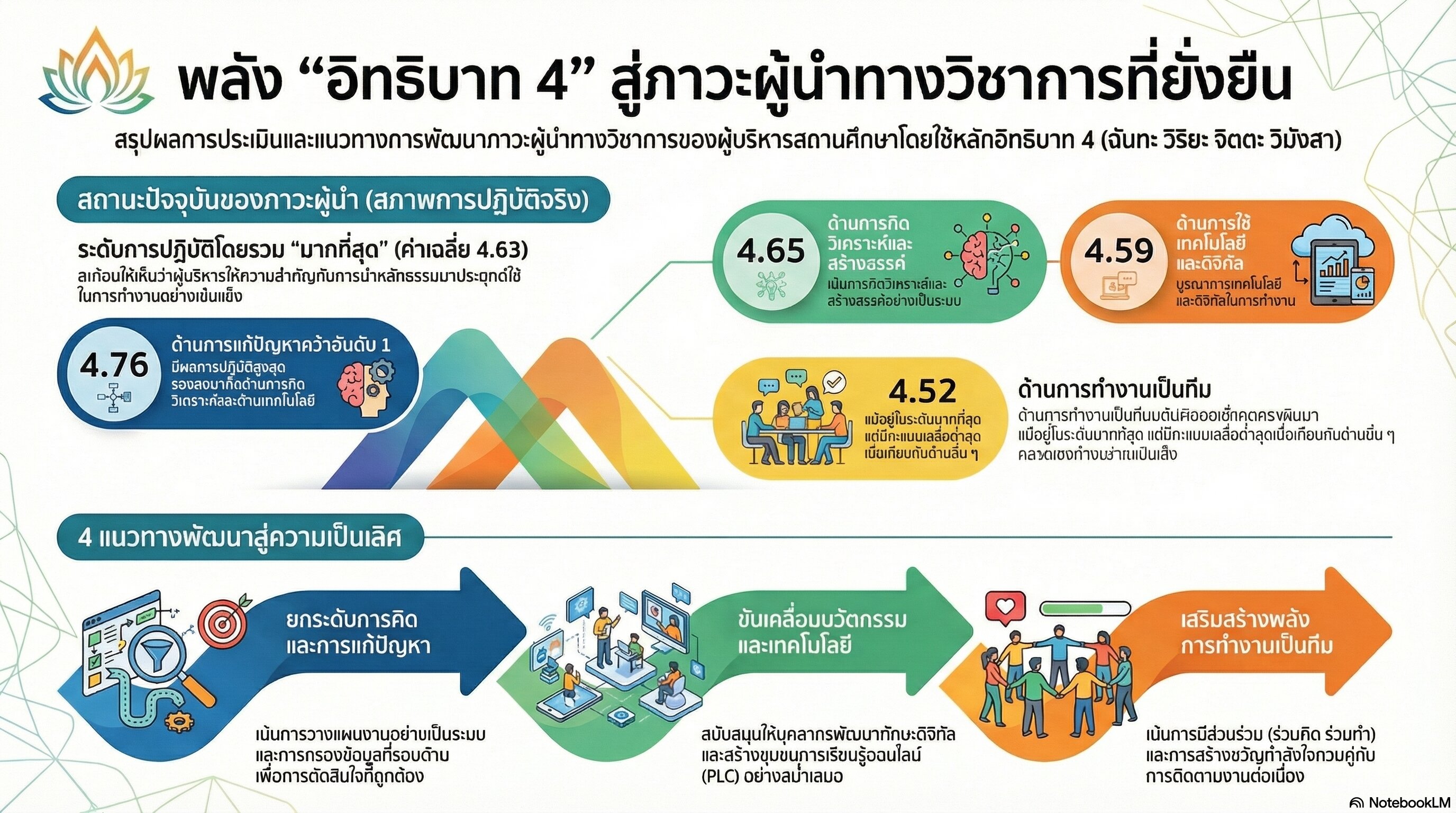
This study aimed to (1) to study the conditions of academic leadership based on the Four Iddhipāda Principles of educational institution administrators under the jurisdiction of the Khon Kaen Primary Educational Service Area Office 1. and (2) to propose guidelines for developing academic leadership based on the Four Iddhipāda Principles of educational institution administrators under the jurisdiction of the Khon Kaen Primary Educational Service Area Office 1. ensure a comprehensive analysis. For the quantitative research, data were collected through a structured questionnaire with a reliability coefficient of 0.98 The sample comprised 305 school administrators and teachers. Statistical tools utilized in the analysis included frequency, percentage, mean, and standard deviation. For the qualitative research, semi-structured interviews were conducted with nine key informants, comprising experts and experienced educators selected purposively to validate the findings. The research results were as follows: Academic leadership based on the Four Paths of Accomplishment (Iddhipāda IV) of school administrators under the Khon Kaen Primary Educational Service Area Office 1 is overall practiced at a high level. When considering each aspect individually, the highest-rated area of practice is problem-solving according to Iddhipāda IV, followed by analytical and creative thinking, and the use of technology and digital tools, respectively. Conversely, the aspect with the lowest level of practice is teamwork based on Iddhipāda IV. Consequently, the guidelines for developing academic leadership according to these principles include: establishing work plans for effective problem-solving, enhancing data-filtering capabilities to strengthen analytical and creative thinking, providing consistent support for personnel to develop technological skills, and promoting active participation in teamwork alongside continuous monitoring and follow-up.
References
ชินวัตร เจริญนิตย์. (2566). การใช้เทคโนโลยีดิจิทัลในการบริหารงานวิชาการในสถานศึกษา. วารสารบริหารการศึกษาบัวบัณฑิต, 17(2), 67–74.
ธวัชชัย ตรีวรชัย. (2561). ภาวะผู้นำของผู้บริหารตามหลักพรหมวิหาร 4 ในเทศบาลเมืองลำตาเสา อำเภอวังน้อย จังหวัดพระนครศรีอยุธยา. วารสารปรัชญาปริทรรศน์, 23(1), 1–11.
นฤมล คูหาแก้ว. (2563). ภาวะผู้นำของผู้บริหารสถานศึกษาในศตวรรษที่ 21 สังกัดสำนักงานเขตพื้นที่การศึกษาประถมศึกษาสระแก้ว เขต 2 (วิทยานิพนธ์ครุศาสตรบัณฑิต, มหาวิทยาลัยราชภัฏรำไพพรรณี).
พระครูปลัดบุญช่วย โชติวํโส (อุ้ยวงค์). (2564). ภาวะผู้นำเชิงกลยุทธ์ของผู้บริหารสถานศึกษาตามหลักอิทธิบาท 4 สังกัดสำนักงานเขตพื้นที่การศึกษาประถมศึกษาขอนแก่น เขต 2. วารสารนวัตกรรมการบริหารการศึกษา, 6(2), 3.
พระครูปลัดบุญช่วย โชติวํโส (อุ้ยวงค์). (2566a). การพัฒนาภาวะผู้นำการเปลี่ยนแปลงของผู้บริหารสถานศึกษาตามหลักพรหมวิหาร 4 สังกัดสำนักงานเขตพื้นที่การศึกษาประถมศึกษาขอนแก่น เขต 1. วารสารบัณฑิตศึกษามหาจุฬาขอนแก่น, 6(1), 3.
พระครูปลัดบุญช่วย โชติวํโส (อุ้ยวงค์). (2566b). ภาวะผู้นำทางการศึกษา (พิมพ์ครั้งที่ 4). เอมี่ ก๊อปปี้ เซ็นเตอร์.
พระราชบัญญัติการศึกษาแห่งชาติ. (2542). ราชกิจจานุเบกษา, 120(52ก), 1–23.
ศรสวรรค์ บุญณกรณ์ชัย. (2561). ภาวะผู้นำของผู้บริหารสถานศึกษาในศตวรรษที่ 21 โรงเรียนทวีธาภิเศก สังกัดสำนักงานเขตพื้นที่การศึกษามัธยมศึกษา เขต 1 (วิทยานิพนธ์ศึกษาศาสตรมหาบัณฑิต, มหาวิทยาลัยเกริก).
สำนักทดสอบทางการศึกษา. (2561). แนวทางการประเมินคุณภาพตามมาตรฐานการศึกษา. สำนักพิมพ์ชุมนุมสหกรณ์การเกษตรแห่งประเทศไทย.
สำนักงานเขตพื้นที่การศึกษาประถมศึกษาขอนแก่น เขต 1. (2566a). แผนพัฒนาคุณภาพการศึกษาขั้นพื้นฐาน พ.ศ. 2566–2570.
สำนักงานเขตพื้นที่การศึกษาประถมศึกษาขอนแก่น เขต 1. (2566b). แผนปฏิบัติการประจำปีงบประมาณ 2566.
Downloads
Published
How to Cite
Issue
Section
License
Copyright (c) 2026 Authors

This work is licensed under a Creative Commons Attribution-NonCommercial-NoDerivatives 4.0 International License.