A Study of the Concept of Opposition to the Brahmin Caste in Sanskrit Scriptures
Keywords:
Caste System, Brahmin, Sanskrit, Buddhism, IndiaAbstract
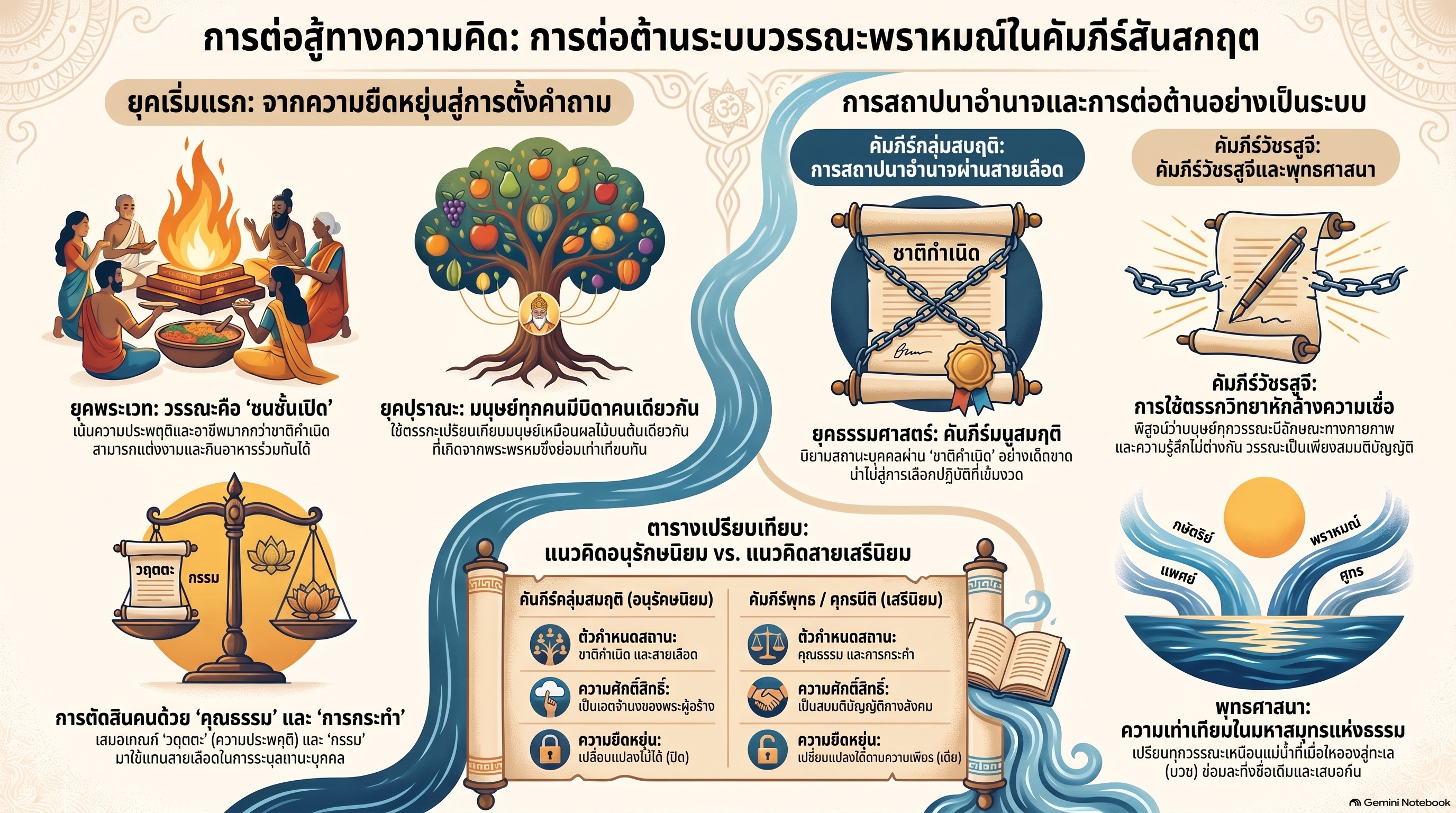
This academic article aims to analyze the concept of opposition to the Brahmin caste system as manifested in Sanskrit scriptures across different eras. The study reveals that the caste system possessed dynamic characteristics and underwent continuous ideological transitions. During the Vedic period, caste functioned as "open classes," where flexibility prevailed, and emphasis was placed on conduct and occupation rather than birthright. In the Epic and Puranic eras, the legitimacy of the Brahmins began to be questioned; criteria such as "virtue" (vṛtta) and "action" (karma) were proposed to determine an individual's status instead of lineage. Notably, the Bhaviṣya purāṇa employs the logic that all humans share a common father (Lord Brahma) and thus possess inherent equality, much like fruits growing on the same tree. However, during the Dharmashastra period, Brahminical authority was strictly established through the Smriti texts—most notably the Manusmṛti —which decisively defined social status through "birth" and lineage, leading to rigid discrimination. The most systematic resistance is found in the Sanskrit Buddhist literature, specifically Ashvaghosha’s Vajrasūcī. This text utilizes logical reasoning to debunk the belief in birth-based superiority, asserting that caste distinctions are merely social conventions since all humans share identical physical attributes and emotions. In conclusion, the opposition to the Brahmin caste in Sanskrit scriptures reflects the ideological conflict between lineage-based elitism and the concepts of human dignity and social justice in ancient Indian society.
References
มหาจุฬาลงกรณราชวิทยาลัย. (2539). พระไตรปิฎกภาษาไทย ฉบับมหาจุฬาลงกรณราชวิทยาลัย เล่ม 7 พระวินัยปิฎก จูฬวรรค เล่ม 2. โรงพิมพ์มหาจุฬาลงกรณราชวิทยาลัย.
มหาจุฬาลงกรณราชวิทยาลัย. (2539). พระไตรปิฎกภาษาไทย ฉบับมหาจุฬาลงกรณราชวิทยาลัย เล่ม 13 พระสุตตันตปิฎก มัชฌิมนิกาย มัชฌิมปัณณาสก์. โรงพิมพ์มหาจุฬาลงกรณราชวิทยาลัย.
มหาจุฬาลงกรณราชวิทยาลัย. (2539). พระไตรปิฎกภาษาไทย ฉบับมหาจุฬาลงกรณราชวิทยาลัย เล่ม 22 สุตตันตปิฎก อังคุตตรนิกาย ปัญจก-ฉักกนิบาต. โรงพิมพ์มหาจุฬาลงกรณราชวิทยาลัย.
มหาจุฬาลงกรณราชวิทยาลัย. (2539). พระไตรปิฎกภาษาไทย ฉบับมหาจุฬาลงกรณราชวิทยาลัย เล่ม 25 พระสุตตันตปิฎก ขุททกนิกาย ขุททกปาฐะ-ธรรมบท-อุทาน-อิติวุตตกะ-สุตตนิบาต. โรงพิมพ์มหาจุฬาลงกรณราชวิทยาลัย.
แสง มนวิทูร, ผู้แปล.(2512). คัมภีร์ลลิตวิสตระ พระพุทธประวัติฝ่ายมหายาน. กรมศิลปากร.
สำเนียง เลื่อมใส, รศ.ดร.(2557).มหาวัสตุอวทาน เล่ม 2. นิติธรรมการพิมพ์.
Basu, Jogiraj. (1969). India of the age of Brāhmaṇa. Calcutta : Sanskrit Pustak Bhandar.
Bhaktivedanta Swami Prabhupada, A.C. (1975). Śrimad Bhāgavatam : Fifth Canto (Part One – Chapter 1-13). Bhaktivedanta Book Trust.
Bharadwaj, Ramesh. (2021). Vajrasūcī of Aśvaghoṣa. Vidyanidhi Prakashan.
Bharadwaj, S.C. (1993). Society in Ancient India. D.K. Printworld.
Chaturvedi, Vrajmohan. (1983). The Vāyu Mahāpurāṇam. Nag Publishers.
Desai, I. S. (1893). Sukra Niti or The Science of Ethics and Politics. Gujarati Printing Press.
Dutt, Manmatha Nath. (1892). The Ramayana of Valmiki : Bala Kanda. Girish Chandra Chackravarti.
Dutt, N.K. (1931). Original and Growth of Caste in India., Vol.1. The Book Company. Ltd.
Eggeling, Julius. (1882). The Śatapatha-Brāhmaṇa: According to the Text of the Mādhyandina School Part II (V.26) : Books III & IV. Motilal Banarsidass.
Eliot, Sir Charles. (1921). Hinduism and Buddhism Vol.1. Routledge & Kegan Paul. LTD.
Ghurye, G.S. (1957). Caste And Class In India. Popular Book Depot Bombay.
Jha, Ganga Nath. (1983). Tantra Varttika Of Kumarila Bhatta. Sri Satguru Publications.
Jha, Ganganath. (1999). Manusmrti. Motilal Banarsidass Publishers Pvt. Ltd.
Kane, P.V. (1962). History of Dharmashastra. Vol.II. Bhandarkar Oriental Research Institute (BORI).
Kanthahara, Sri Gaudiya. (n.d.) Padma Purana, Srsthi-khanda 43.321, 322 (Gautamiya-samskarana), p.297. Retrieved from March 18, 2026, from https://www.scribd.com
Kashyap, R.L. (2007). Rig Veda Samhita : Fourth Mandala. Sri Aurobindo Kapali Sastry Institute of Vedic Culture.
Khandewal (Chukhamba), S.N. (2021). Brahma Purana Part 2. Chowkhamba Sanskrit Series office.
Khandelwal, S.N. (2022). Bhavishya Purana : Sanskrit Text with Hindi Translation. Chaukhamba Sanskrit Pratishthan.
Lal, Jain Panna. (1962). The Harivamsa Purana Of Jinasena. Bhāratīya Jñānapitha.
Mādhavānanda, Swāmi. (1950). The Bṛhadāraṇyaka upaniṣad. Advaita Ashrama.
Majumdar, R. C. & Datta, Kalikinkar (1970). An Advanced History of India. Macmillan and Co. LTD.
Muir, J. (1872). Original Sanskrit Texts on The Origin and History of The people of India, Vol.1. Trubner & Co., Paternoster.
Mukhopadhyaya, Sujitkumar. (1949). The Vajrasūcī of Aśvaghoṣa. The Visva-Bharati Annals.
Narasimhacharya, N.C.V. (2004). Śrimad Bhāgavata mahāpuraṇam-Skandha VII. T.T. Devasthanams.
O’Flanery, Wendy Doniger. (1976). The Origins of Evil in Hindu Mythology. Motilal Banarsidass.
Pratap Chandra, Roy. (1884). The Mahabharata of Krishna-Dwaipayana Vyasa : Adi Parva. Bharata Press.
Ramachandra Rao, S.K. (2006). Purusha Sūkta. Sri Aurobindo Kapali Sastry Institute of Vedic Culture.
Sage Ved. Vyāsa. (n.d.). महाभारत अनुशासन पर्व ।। Swargarohan.
Sarvadeshik Arya Pratinidhi Sabha. (n.d.). Rig Veda Bhasha Bhashya 7th And 8th Mandal. Mumukshu Bhawan Manuscript Collection.
Satavlekar, Shripad Damodar. (1978). Mahabharat Anushasan Parva. Swadhyaya Mandal.
Senart, Emile. (1896). Les castes dans l’inde : les faits et le système. Ernest Leroux, Editeur.
Shastri, Brahma Dutt. (1952a). The Smriti Sandarbha Part2 Gurumandal Series. Mansukhrai Mor.
Shastri, Brahma Dutt. (1952b). The Smriti Sandarbha Part3 Gurumandal Series. Mansukhrai Mor.
Shastri, Brahma Dutt. (1955). The Smriti Sandarbha Part5 Gurumandal Series. Mansukhrai Mor.
Shastri, Brahma Dutt. (1957). The Smriti Sandarbha Part6 Gurumandal Series. Mansukhrai Mor.
Smith, John D. (1999). महाभारत शान्ति पर्व ।। Bhandarkar Oriental Research Institute (BORI).
Swahananda, Swāmi. (1956). The Chāndogya upaniṣad. Ramakrishna Math.
Utgikar, Narayan Bapuji. (1928). Collected Works Of Sir R.g. Bhandarkar, Vol.II. Bhandarkar Oriental Research Institute.
Downloads
Published
How to Cite
Issue
Section
Categories
License
Copyright (c) 2026 Journal of Buddhist Education and Research (JBER)

This work is licensed under a Creative Commons Attribution-NonCommercial-NoDerivatives 4.0 International License.