A Study of the Communication Formats and Strategies in Propagating Dhamma Through Social Media: A Case Study of Facebook Pages
Keywords:
Communication, Dharma, FacebookAbstract
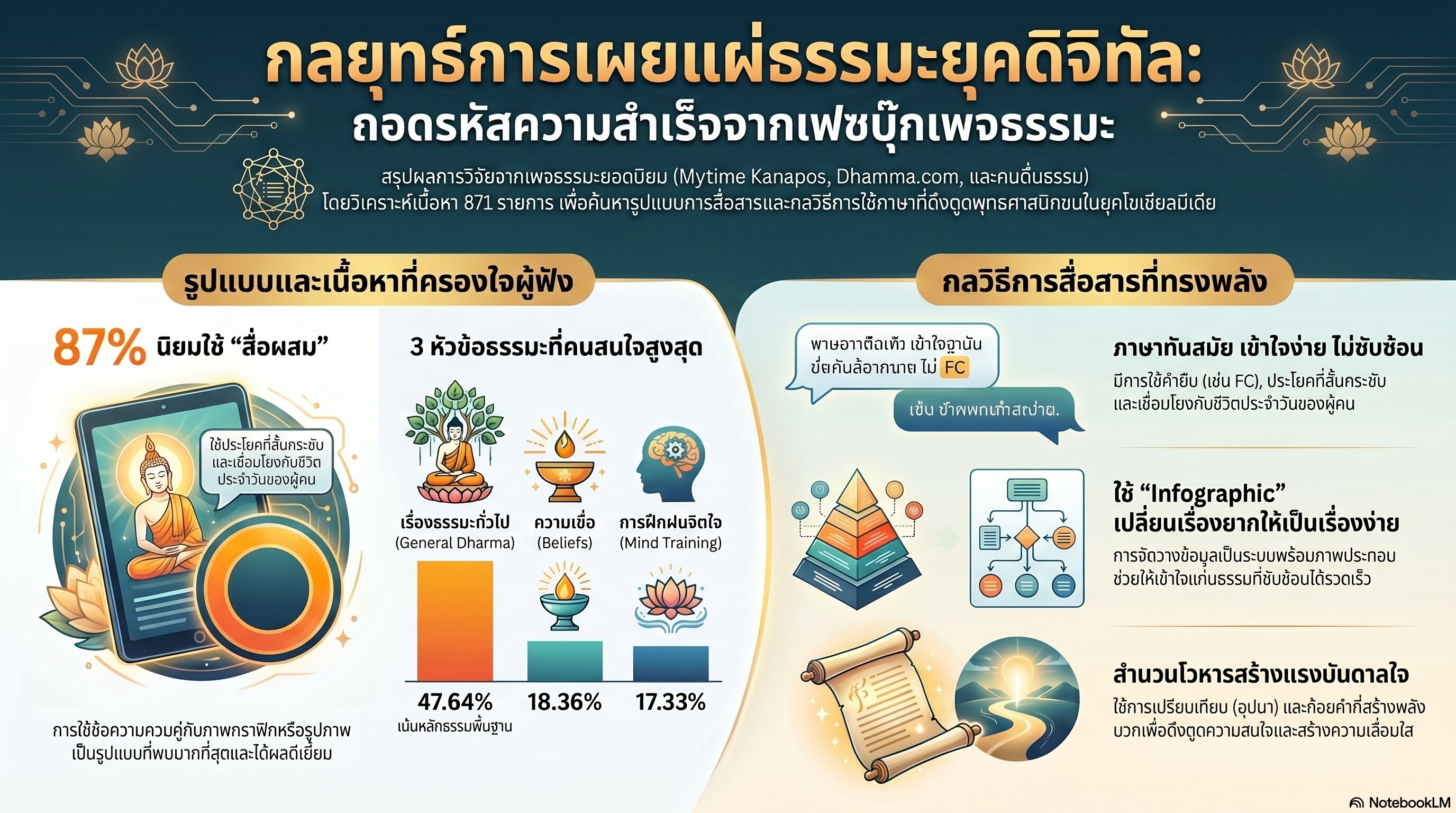
This research aims to 1) study formats and contents used in communicating Dhamma through social media, using Facebook pages as a case study, and 2) examine the linguistic strategies employed in propagating Dhamma through social media, using Facebook pages as a case study. A qualitative research methodology was adopted, focusing on the analysis of data from documents and social media contents from three selected Facebook pages. An analysis and interpretation of content formats and linguistic strategies were guided by theoretical frameworks including communication theories, linguistic theories, Buddhist propagation theories, and concepts related to social media and Facebook pages. The findings revealed that: The study of communication formats and linguistic strategies for Dhamma propagation through social media, based on three Facebook pages - Mytime Kanapos, Dhamma.com, and Kon Tuen Thum - utilized qualitative research methods. A total of 871 content items published between November 2023 and May 2024 were analyzed. The key results are summarized as follows: 1) The formats for communicating Dhamma through social media were categorized into three types: (1) mixed verbal and non-verbal communication, which was the most prevalent with 761 contents (87.37%); (2) verbal communication, with 86 contents (9.87%); and (3) non-verbal communication, with 24 contents (2.75%). Besides, the content types for Dhamma communication through social media were classified into eight main categories: (1) Dhamma topics, which were the most frequent with 415 contents (47.64%); (2) belief-related topics, with 160 contents (18.36%); (3) mental training topics, with 151 contents (17.33%); (4) significant days/promotional topics, with 98 content (11.25%); (5) the law of karma topics, with 20 contents (2.29%); (6) lifestyle topics, with 16 contents (1.83%); (7) merit-making topics, with 10 contents (1.14%); and (8) fortune-related topics, with 1 content (0.11%). 2) The linguistic strategies employed in propagating Dhamma through social media involved adapting language to suit diverse audiences. These strategies were divided into four main components: (1) word-level strategies for Dhamma propagation; (2) sentence-level strategies for Dhamma propagation; (3) figurative language strategies for Dhamma propagation; and (4) the use of supplementary media in Dhamma propagation.
References
กนกนาถ ลิขิตไพรวัลย์. (2563). กลยุทธ์การสื่อสารข้อมูลข่าวสารผ่านเฟซบุ๊กเพจในจังหวัดพิษณุโลก [วิทยานิพนธ์ปริญญามหาบัณฑิต, มหาวิทยาลัยนเรศวร].
ฐิติมา สุภภัค. (2562). บทบาทของสถาบันศาสนากับการเผยแพร่หลักคำสอนทางศาสนาและส่งเสริมคุณธรรมสู่ประชาชนภายใต้แผนยุทธศาสตร์ชาติ 20 ปี (พ.ศ. 2561–2580). วารสารสายตรงศาสนา, 17(1), 35–48.
ทับทิมทอง กอบัวแก้ว. (2561). ทฤษฎีการสื่อสาร [วิทยานิพนธ์ปริญญามหาบัณฑิต, มหาวิทยาลัยราชภัฏสวนสุนันทา].
เทพบดินทร์ ปานอีเม้ง. (2558). การใช้ภาษาไทยเพื่อการสื่อสารในเฟซบุ๊กของนักศึกษาสาขาวิชาภาษาไทย คณะครุศาสตร์ มหาวิทยาลัยราชภัฏเลย [วิทยานิพนธ์ปริญญามหาบัณฑิต, มหาวิทยาลัยราชภัฏเลย].
ณัฏฐพล บุญสา. (2565). คนตื่นธรรม. Facebook. คนตื่นธรรม Facebook Page
มหามกุฎราชวิทยาลัย. (2535). พระสุตตันตปิฎก สังยุตตนิกาย ขันธวารวรรค (เล่ม 27). โรงพิมพ์มหามกุฎราชวิทยาลัย.
มายทาม คณพศ. (2565). Mytime Kanapos. Facebook. Mytime Kanapos Facebook Page
สัญรญา นวลศิริ. (2560). ท่วงทำนองทางภาษาและกลวิธีการถ่ายทอดธรรมะในงานเขียนของพระมหาสมปอง ตาลปุตฺโต [วิทยานิพนธ์ปริญญามหาบัณฑิต, มหาวิทยาลัยราชภัฏเชียงใหม่].
หลวงปู่ปราโมทย์ ปาโมชฺโช. (2565). Dhamma.com. Facebook. Dhamma.com Facebook Page
Kemp, S. (2023). Digital 2023: Thailand. DataReportal Thailand Report 2023
Downloads
Published
How to Cite
Issue
Section
License
Copyright (c) 2026 Authors

This work is licensed under a Creative Commons Attribution-NonCommercial-NoDerivatives 4.0 International License.