The Development of Summary Writing Skills Using Citta Bhāvanā for Grade 7 Students at Khok Si Phitthayasap School, Khon Kaen Province
Keywords:
summary writing, Citta Bhāvanā, lesson plans, learning achievement, student satisfaction SatisfactionAbstract
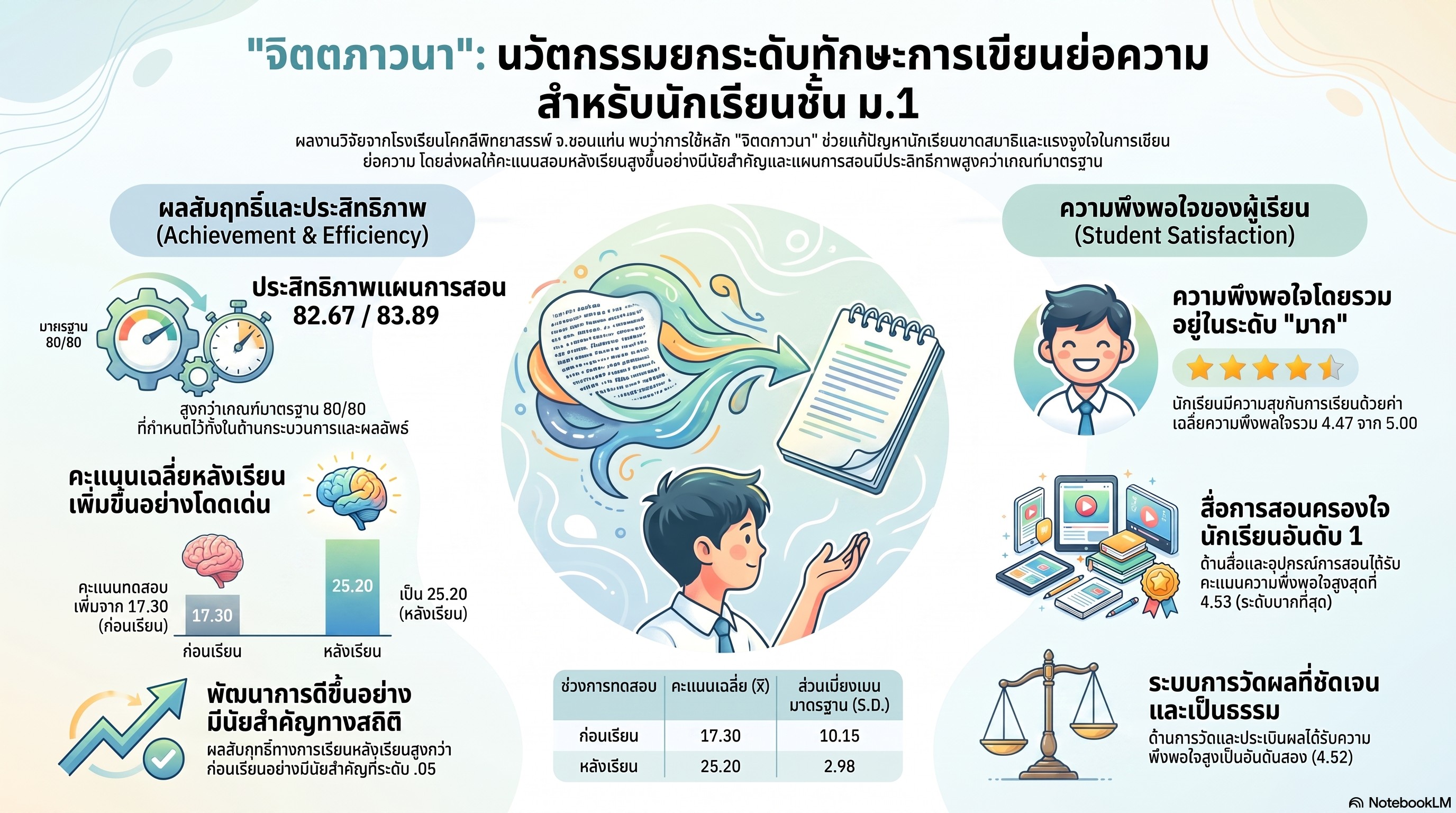
This research aimed to (1) develop lesson plans on summary writing based on the principles of Citta Bhāvanā to achieve the efficiency criterion of 80/80, (2) compare students’ learning achievement in summary writing before and after the implementation of the lesson plans, and (3) examine students’ satisfaction with the learning management. The sample consisted of 12 Grade 7 students from Khok Si Pittayasapp School, Khon Kaen Province. The research instruments included: (1) lesson plans on summary writing based on the principles of Citta Bhāvanā, (2) a summary writing achievement test, and (3) a student satisfaction questionnaire. Data were analyzed using mean, standard deviation (S.D.), and the dependent samples t-test. The results revealed that: (1) the lesson plans achieved a process efficiency (E1) of 82.67 and an outcome efficiency (E2) of 83.89, exceeding the established criterion of 80/80; (2) students’ post-test achievement in summary writing was significantly higher than their pre-test achievement at the .05 level of statistical significance, with a pre-test mean score of 17.30 (S.D. = 10.15) and a post-test mean score of 25.20 (S.D. = 2.98); and (3) the overall level of students’ satisfaction with the learning management was high (x̄ = 4.47). Among the evaluated aspects, instructional media and learning materials received the highest mean score (x̄ = 4.53), followed by measurement and evaluation (x̄ = 4.52), learning activities (x̄ = 4.44), and learning content (x̄ = 4.38).
References
กระทรวงศึกษาธิการ. (2551). หลักสูตรแกนกลางการศึกษาขั้นพื้นฐาน พุทธศักราช 2551. โรงพิมพ์ชุมนุมสหกรณ์การเกษตรแห่งประเทศไทย.
จุฑาทิพย์ ไกรนรา, และคณะ. (2560). การพัฒนาความสามารถในการเขียนย่อความของนักเรียนชั้นมัธยมศึกษาปีที่ 1 โดยใช้ชุดการสอนแบบแผนผังความคิด. วารสารมหาวิทยาลัยนราธิวาสราชนครินทร์ สาขามนุษยศาสตร์และสังคมศาสตร์, 4(1), 80–90.
ดิษยทรรศน์ ศรีบุญเรือง. (2561). นวัตกรรมกับการเรียนรู้วรรณกรรม (พิมพ์ครั้งที่ 2). อภิชาตการพิมพ์
ถิรพัฒน์ หล้าเตียง, และ อธิกมาส มากจุ้ย. (2567). การพัฒนาความสามารถในการเขียนย่อความของนักเรียนชั้นประถมศึกษาปีที่ 6 ด้วยการจัดการเรียนรู้เชิงรุก. วารสารสังคมศาสตร์วิจัย, 15(1), 47–61.
ฐะปะนีย์ นาครทรรพ. (2550). หนังสือเรียนสาระการเรียนรู้พื้นฐาน กลุ่มสาระการเรียนรู้ภาษาไทย ชั้นมัธยมศึกษาปีที่ 1 ช่วงชั้นที่ 3. อักษรเจริญทัศน์.
เทพสุดา แพงจันทร์ศรี. (2566). การพัฒนาความสามารถด้านการเขียนย่อความโดยใช้การจัดการเรียนรู้แบบห้องเรียนกลับด้านร่วมกับหนังสืออิเล็กทรอนิกส์ สำหรับนักเรียนชั้นประถมศึกษาปีที่ 6. Journal of Roi Kaensarn Academi, 8(11), 55–68.
วรรณี โสมประยูร. (2544). การสอนภาษาไทยระดับประถมศึกษา (พิมพ์ครั้งที่ 4). ไทยวัฒนาพานิช.
ศุภณัฐ เทียนทอง, และ รัศมี ธัญญาศิริทรัพย์. (2560). การพัฒนาความสามารถด้านการเขียนย่อความของนักเรียนชั้นมัธยมศึกษาปีที่ 3 โดยใช้รูปแบบการสอนซิปปาร่วมกับแผนภาพความคิด. วารสารวิชาการสถาบันการอาชีวศึกษาภาคใต้ 1, 8(2), 124–136.
สำนักงานคณะกรรมการการศึกษาขั้นพื้นฐาน. (2566). รายงานผลการประเมินคุณภาพผู้เรียน (NT)
ชั้นประถมศึกษาปีที่ 3 ปีการศึกษา 2566. กระทรวงศึกษาธิการ. สืบค้นเมื่อ 12 สิงหาคม 2567, จาก http://180.1244.42/NT/ExamWeb/FrLogin.aspx?ReturnUrl=%2fNT%2fExamWeb%2f.
Downloads
Published
How to Cite
Issue
Section
License
Copyright (c) 2026 Authors

This work is licensed under a Creative Commons Attribution-NonCommercial-NoDerivatives 4.0 International License.