Workplace Technological Behavior and Its Impact on Job Performance
Keywords:
Technological Behavior, Job Performance, Workplace Technology, Technological AdaptationAbstract
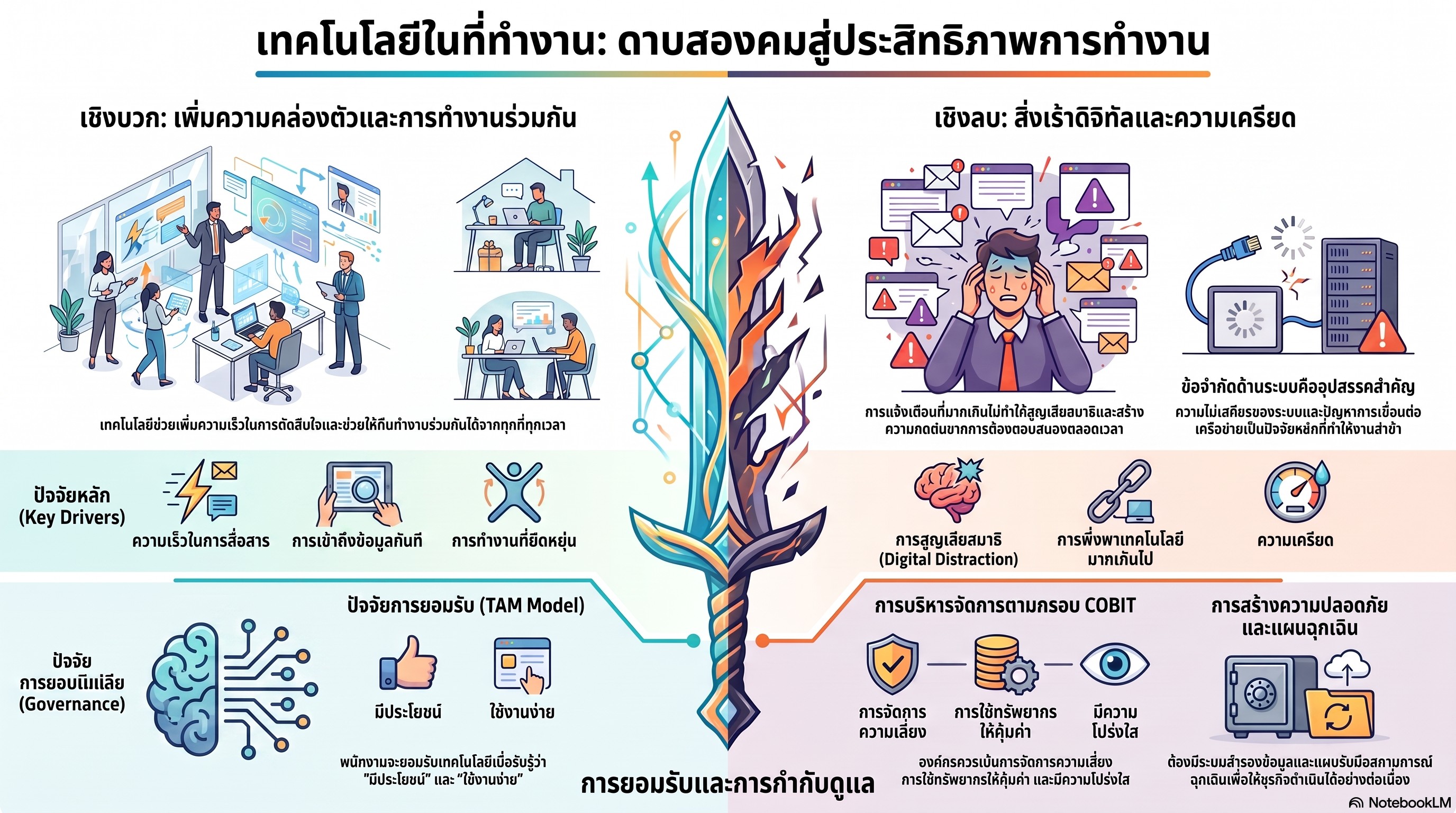
This academic article examines workplace technological behavior and its subsequent impact on job performance. The study reveals that employees' technological behaviors are shaped and altered by various contextual variables, including types of work devices, duration of usage, and physical work locations. The implementation of technology within organizations exerts a dual impact on overall job performance. Positively, technology serves as a critical catalyst in enhancing operational speed and facilitating agile task management through diverse specialized software. Conversely, the negative impacts primarily stem from connectivity constraints and system instability, which disrupt workflows and incur operational delays. This article highlights that while technology significantly elevates productivity, excessive usage beyond necessity or an individual's inability to adapt to emerging digital tools can paradoxically diminish organizational efficiency.
References
กองเทคโนโลยีและสารสนเทศ องค์การตลาดเพื่อเกษตรกร. (2566). แนวทางการกำกับดูแลและบริหารจัดการเทคโนโลยีดิจิทัลระดับองค์กรที่ดี พ.ศ. 2566.
กานตพงศ์ เย้าดุสิต. (2564). การใช้เทคโนโลยีสารสนเทศ. https://sites.google.com/site/kanoishi074/kar-chi-thekhnoloyi-sarsnthes
จันทนี รุ่งเรืองธนาพล, & พิสิฐ ลิ้มอารีย์สุข. (2558). พฤติกรรมการใช้เทคโนโลยีสารสนเทศของนักศึกษาระดับปริญญาตรีคณะบริหารธุรกิจ มหาวิทยาลัยเทคโนโลยีราชมงคลรัตนโกสินทร์.
ทศพร พนาเวชกิจกุล. (2555). ปัจจัยส่วนประสมทางการตลาด ค่านิยม และเทคโนโลยีที่มีอิทธิพลต่อพฤติกรรมการเปลี่ยนโทรศัพท์มือถือของวัยรุ่นที่สยาม [วิทยานิพนธ์ปริญญามหาบัณฑิต, มหาวิทยาลัยกรุงเทพ].
ปรีชา พินชุนศรี. (2560). ผลกระทบของเทคโนโลยีสารสนเทศที่ส่งผลต่อพฤติกรรมเยาวชน. วารสารมหาวิทยาลัยคริสเตียน, 23(3), 523–539.
เอกราช เครือศรี. (2558). การใช้เทคโนโลยีสารสนเทศในการบริหารงานของผู้บริหารสถานศึกษา สังกัดสำนักงานเขตพื้นที่การศึกษามัธยมศึกษา เขต 32. ใน การประชุมวิชาการและเสนอผลงานวิจัยระดับชาติ “สร้างสรรค์และพัฒนา เพื่อก้าวหน้าสู่ประชาคมอาเซียน” ครั้งที่ 2 (น. 202–210). วิทยาลัยนครราชสีมา
Davis, F. D. (1989). Perceived usefulness, perceived ease of use, and user acceptance of information technology. MIS Quarterly, 13(3), 319–340. https://doi.org/10.2307/249008
Jamkratoke, V. (1998). Factors related to fast food consumption behavior of high school students under the Department of General Education, Bangkok [Master's thesis, Srinakharinwirot University].
Kock, N. (2007). The effects of web-based communication on organizational performance: The role of communication in reducing the cost of coordination. Information Technology & Management, 8(4), 291–310.
Ng, I. C. L., & Wakenshaw, S. Y. L. (2017). The Internet of Things: Review and research directions. International Journal of Research in Marketing, 34(1), 3–21. https://doi.org/10.1016/j.ijresmar.2016.11.003
Rho, J. J., & Lee, H. J. (2020). The impact of digital distraction on work performance: A case study. Journal of Organizational Behavior, 41(1), 88–105.
Sansonyuth, Y., et al. (1990). Psychology. Academic Support Center.
Schumpeter, J. A. (1934). The theory of economic development. Harvard University Press.
Downloads
Published
How to Cite
Issue
Section
License
Copyright (c) 2026 Authors

This work is licensed under a Creative Commons Attribution-NonCommercial-NoDerivatives 4.0 International License.