Effects of Generative AI-Assisted Instruction on Creativity and Multidimensional Design Skills in Advertising Design Education: A Quasi-Experimental Study
Keywords:
Generative Artificial Intelligence; Creativity; Advertising Design Education; Design Skills; Quasi-Experimental StudyAbstract
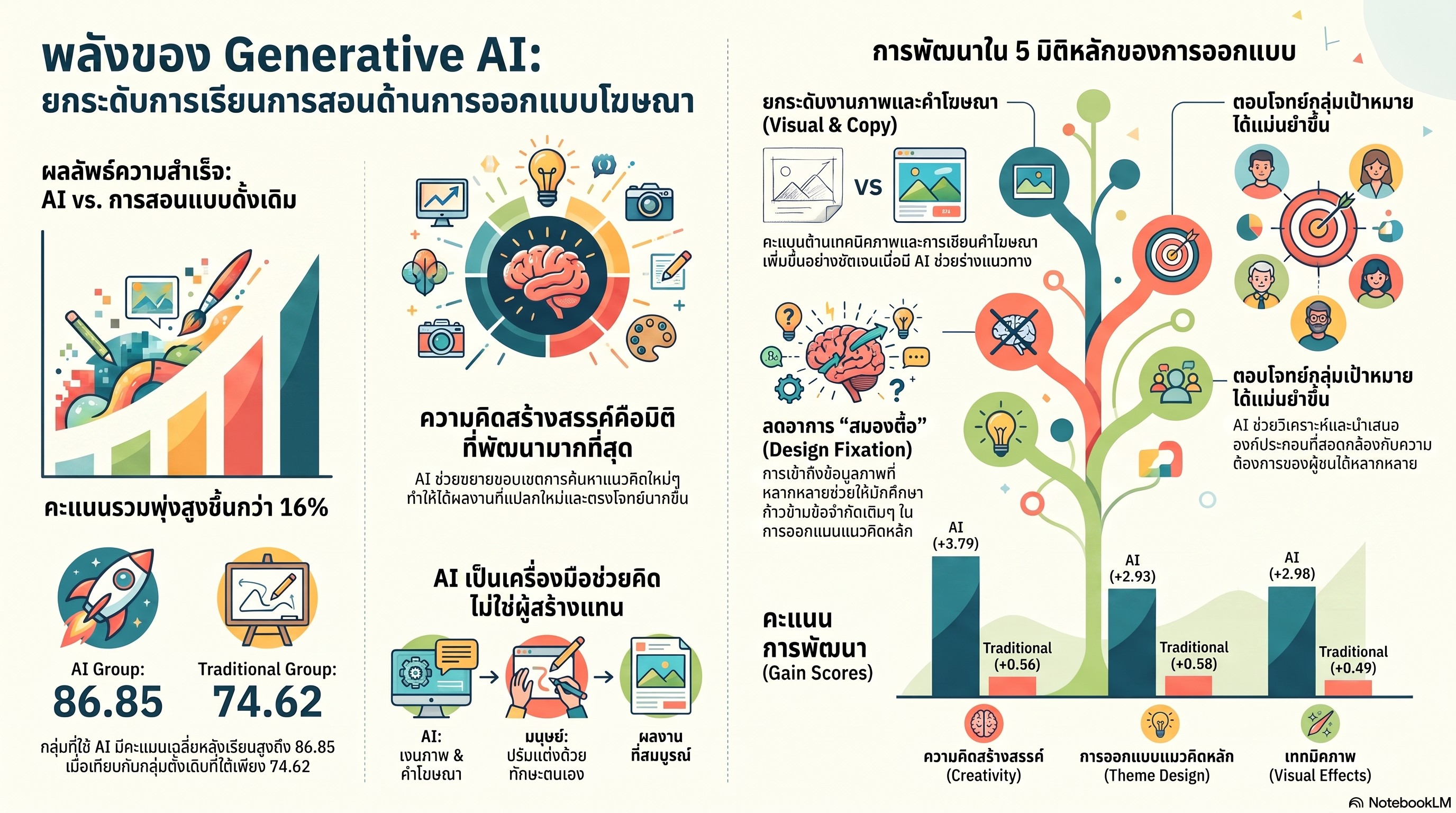
Generative artificial intelligence (GAI) is increasingly being integrated into higher education and has shown considerable potential for supporting creativity and design learning. Although a growing body of research has explored the educational applications of GAI, empirical evidence regarding its effectiveness in advertising design education remains limited, particularly in relation to students’ multidimensional design performance. This study investigated the effects of GAI-assisted instruction on advertising design learning through a quasi-experimental pre-test–post-test design. A total of 85 digital media students participated in the study, with intact classes assigned to either a GAI-assisted instruction group or a traditional instruction group. Students’ advertising design performance was evaluated across five dimensions: theme design, creativity, audience relevance, visual effects, and copywriting. Analysis of covariance (ANCOVA) was employed to compare post-test performance while controlling for pre-test scores. The results revealed that students receiving GAI-assisted instruction significantly outperformed those receiving traditional instruction in overall advertising design performance and across all five dimensions. Specifically, significant improvements were observed in theme design, creativity, audience relevance, visual effects, and copywriting. Among these dimensions, creativity demonstrated the largest effect. These findings suggest that GAI can serve as an effective pedagogical support tool when embedded within structured instructional guidance. Rather than replacing students’ creative work, GAI appears to support multidimensional advertising design performance by facilitating exploration, refinement, and iterative design development. This study contributes empirical evidence to the growing literature on AI-supported design education and offers practical implications for developing creativity-oriented learning environments that integrate technological support with human judgment.
References
Amabile, T. M. (1996). Creativity in context: Update to the social psychology of creativity. Westview Press.
AlGhamdi, R. (2024). Exploring the impact of ChatGPT-generated feedback on technical writing skills of computing students: A blinded study. Education and Information Technologies, 29, 18901–18926. https://doi.org/10.1007/s10639-024-12594-2
Asad, M. M., & Ajaz, A. (2024). Impact of ChatGPT and generative AI on lifelong learning and upskilling learners in higher education: Unveiling the challenges and opportunities globally. The International Journal of Information and Learning Technology, 41, 507–523. https://doi.org/10.1108/IJILT-06-2024-0103
Bahroun, Z., Anane, C., Ahmed, V., & Zacca, A. (2023). Transforming education: A comprehensive review of generative artificial intelligence in educational settings. Sustainability, 15, 12983. https://doi.org/10.3390/su151712983
Bandura, A. (1997). Self-efficacy: The exercise of control. W.H. Freeman.
Batista, J., Mesquita, A., & Carnaz, G. (2024). Generative AI and higher education: Trends, challenges, and future directions from a systematic literature review. Information, 15, 676. https://doi.org/10.3390/info15110676
Chan, C. K. Y., & Hu, W. (2023). Students’ voices on generative AI: Perceptions, benefits, and challenges in higher education. International Journal of Educational Technology in Higher Education, 20, 43. https://doi.org/10.1186/s41239-023-00411-8
Chang, Y. S., Kao, J. Y., Wang, Y. Y., & Huang, S. C. (2021). Effects of cloud-based learning on students’ engineering design creativity with different creative self-efficacy. Thinking Skills and Creativity, 40, 100813. https://doi.org/10.1016/j.tsc.2021.100813
Chen, J., Mokmin, N. A. M., & Su, H. (2025). Integrating generative artificial intelligence into design and art course: Effects on student achievement, motivation, and self-efficacy. Innovations in Education and Teaching International, 62, 1431–1446. https://doi.org/10.1080/14703297.2025.2503857
Chen, X., Yang, F., & Yu, W. (2024). The willingness of college educators in animation and digital media to embrace generative AI. In 2024 13th International Conference on Educational and Information Technology (ICEIT) (pp. 18–23). IEEE. https://doi.org/10.1109/ICEIT61397.2024.10540881
Cohen, J. (1988). Statistical power analysis for the behavioral sciences (2nd ed.). Lawrence Erlbaum Associates.
Fleischmann, K. (2024). Making the case for introducing generative artificial intelligence into design curricula. Art, Design & Communication in Higher Education, 23, 187–207. https://doi.org/10.1386/adch_00088_1
Garcia, M. B. (2025). The paradox of artificial creativity: Challenges and opportunities of generative AI artistry. Creativity Research Journal, 37, 755–768. https://doi.org/10.1080/10400419.2024.2354622
Goodyear, M. D. E., Krleza-Jeric, K., & Lemmens, T. (2007). The Declaration of Helsinki. BMJ, 335, 624–625. https://doi.org/10.1136/bmj.39339.610000.BE
Hutchins, E. (1995). Cognition in the wild. MIT Press.
Hutson, J., & Cotroneo, P. (2023). Generative AI tools in art education: Exploring prompt engineering and iterative processes for enhanced creativity. Metaverse, 4, 14. https://doi.org/10.54517/m.v4i1.2164
Jansson, D. G., & Smith, S. M. (1991). Design fixation. Design Studies, 12, 3–11. https://doi.org/10.1016/0142-694X(91)90003-F
Ji, Z., Lee, N., Frieske, R., Yu, T., Su, D., Xu, Y., Ishii, E., Bang, Y. J., Madotto, A., & Fung, P. (2023). Survey of hallucination in natural language generation. ACM Computing Surveys, 55, 1–38. https://doi.org/10.1145/3571730
Kasneci, E., Sessler, K., Küchemann, S., Bannert, M., Dementieva, D., Fischer, F., Gasser, U., Groh, G., Günnemann, S., Hüllermeier, E., Krusche, S., Kutyniok, G., Michaeli, T., Nerdel, C., Pfeffer, J., Poquet, O., Sailer, M., Schmidt, A., Seidel, T., Stadler, M., Weller, J., Kuhn, J., & Kasneci, G. (2023). ChatGPT for good? On opportunities and challenges of large language models for education. Learning and Individual Differences, 103, 102274. https://doi.org/10.1016/j.lindif.2023.102274
Kicklighter, C., Seo, J. H., Andreassen, M., & Bujnoch, E. (2024). Empowering creativity with generative AI in digital art education. In ACM SIGGRAPH 2024 Educator’s Forum (pp. 1–2). https://doi.org/10.1145/3641235.3664438
Koo, T. K., & Li, M. Y. (2016). A guideline of selecting and reporting intraclass correlation coefficients for reliability research. Journal of Chiropractic Medicine, 15, 155–163. https://doi.org/10.1016/j.jcm.2016.02.012
Liu, X., Guo, B., He, W., & Hu, X. (2025). Effects of generative artificial intelligence on K–12 and higher education students’ learning outcomes: A meta-analysis. Journal of Educational Computing Research, 63, 1249–1291.
Mittal, U., Sai, S., Chamola, V., & Sangwan, D. (2024). A comprehensive review on generative AI for education. IEEE Access, 12, 142733–142759. https://doi.org/10.1109/ACCESS.2024.3468368
Moorhouse, B. L., Yeo, M. A., & Wan, Y. (2023). Generative AI tools and assessment: Guidelines of the world’s top-ranking universities. Computers and Education Open, 5, 100151. https://doi.org/10.1016/j.caeo.2023.100151
Puozzo, I. C., & Audrin, C. (2021). Improving self-efficacy and creative self-efficacy to foster creativity and learning in schools. Thinking Skills and Creativity, 42, 100966. https://doi.org/10.1016/j.tsc.2021.100966
Qian, C., Ye, J. H., & Lee, Y. S. (2022). The effects of art design courses in higher vocational colleges based on C-STEAM. Frontiers in Psychology, 13, 995113. https://doi.org/10.3389/fpsyg.2022.995113
Reddig, J. M., Arora, A., & MacLellan, C. J. (2025). Generating in-context, personalized feedback for intelligent tutors with large language models. International Journal of Artificial Intelligence in Education, 1–42. https://doi.org/10.1007/s40593-025-00505-6
Ruiz-Rojas, L. I., Salvador-Ullauri, L., & Acosta-Vargas, P. (2024). Collaborative working and critical thinking: Adoption of generative artificial intelligence tools in higher education. Sustainability, 16(13), 5367. https://doi.org/10.3390/su16135367
Runco, M. A., & Jaeger, G. J. (2012). The standard definition of creativity. Creativity Research Journal, 24, 92–96. https://doi.org/10.1080/10400419.2012.650092
Sadler, T. D. (2009). Situated learning in science education: Socio-scientific issues as contexts for practice. Studies in Science Education, 45, 1–42. https://doi.org/10.1080/03057260802681839
Sáez-Velasco, S., Alaguero-Rodríguez, M., Delgado-Benito, V., & Rodríguez-Cano, S. (2024). Analysing the impact of generative AI in arts education: A cross-disciplinary perspective of educators and students in higher education. Informatics, 11, 37. https://doi.org/10.3390/informatics11020037
Samala, A. D., Rawas, S., Wang, T., et al. (2025). Unveiling the landscape of generative artificial intelligence in education: A comprehensive taxonomy of applications, challenges, and future prospects. Education and Information Technologies, 30, 3239–3278. https://doi.org/10.1007/s10639-024-12936-0
Schön, D. A. (1983). The reflective practitioner: How professionals think in action. Basic Books.
Shadish, W. R., Cook, T. D., & Campbell, D. T. (2002). Experimental and quasi-experimental designs for generalized causal inference. Houghton Mifflin.
Shankar, S., Pothancheri, G., Sasi, D., et al. (2025). Bringing teachers in the loop: Exploring perspectives on integrating generative AI in technology-enhanced learning. International Journal of Artificial Intelligence in Education, 35, 155–180. https://doi.org/10.1007/s40593-024-00428-8
Shen, X., Mo, X., & Xia, T. (2025). Exploring the attitude and use of GAI-image among art and design college students based on TAM and SDT. Interactive Learning Environments, 33, 1198–1215. https://doi.org/10.1080/10494820.2024.2365959
Sweller, J. (1988). Cognitive load during problem solving: Effects on learning. Cognitive Science, 12, 257–285. https://doi.org/10.1207/s15516709cog1202_4
UNESCO. (2023). Guidance for generative AI in education and research. UNESCO. https://unesdoc.unesco.org/ark:/48223/pf0000386693
Vygotsky, L. S. (1978). Mind in society: The development of higher psychological processes. Harvard University Press.
Wang, X., Leng, C. H., & Zainuddi, Z. (2024). The effectiveness of generative AI in education: A systematic review of empirical study. The Asia Pacific Journal of Curriculum & Teaching.
Wiggins, G. (1990). The case for authentic assessment. Practical Assessment, Research, and Evaluation, 2. https://doi.org/10.7275/ffb1-mm19
Yang, C. M., & Hsu, T. F. (2020). Integrating design thinking into a packaging design course to improve students’ creative self-efficacy and flow experience. Sustainability, 12, 5929. https://doi.org/10.3390/su12155929
Zhu, W., Guo, R., Zhu, G., Li, C., Li, H., & Song, Y. (2025). GAI4DE: Harnessing the design process to integrate GAI into design studios. International Journal of Human–Computer Interaction, 1–24. https://doi.org/10.1080/10447318.2025.2603662
Downloads
Published
How to Cite
Issue
Section
Categories
License
Copyright (c) 2026 Journal of Buddhist Education and Research (JBER)

This work is licensed under a Creative Commons Attribution-NonCommercial-NoDerivatives 4.0 International License.