Guidelines for Developing the Transformational Leadership of School Administrators under the Udon Thani Secondary Educational Service Area Office
Keywords:
Transformational Leadership, School Administrators, Development Guidelines, Needs Assessment, Udon Thani Secondary Educational Service Area Office1.Abstract
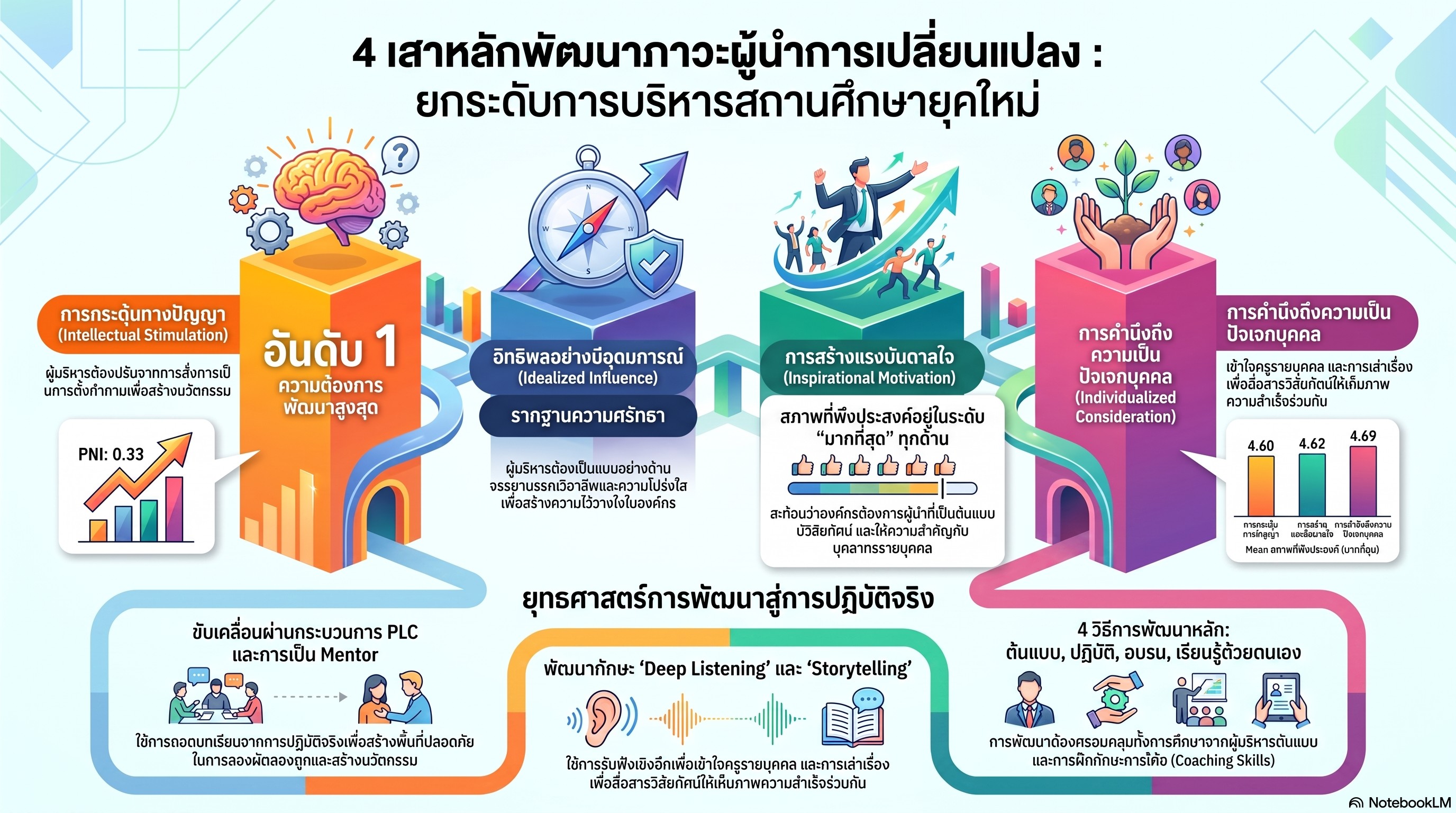
The objectives of this research were: 1) to study the current situation, desirable conditions, and necessary needs; 2) to investigate the development guidelines; and 3) to evaluate the development guidelines for transformational leadership of school administrators. The research was conducted in three phases. Phase 1 aimed to study the current situation, desirable conditions, and necessary needs across four components. The sample consisted of 335 school administrators and teachers. The instrument was a questionnaire. The reliability coefficients were 0.89 for the current situation and 0.91 for the desirable conditions. The statistics used included mean, standard deviation, and the priority needs index. Phase 2 aimed to develop the guidelines through semi-structured interviews with five key informants. The instruments included an interview form and a guideline validation form. Data were analyzed using percentage. Phase 3 aimed to evaluate the feasibility and appropriateness of the guidelines by five experts. Data were analyzed using mean and standard deviation. The research findings revealed that: 1. The overall current situation of transformational leadership was at a high level, while the desirable conditions were at the highest level. The highest priority need for development was intellectual stimulation, followed by inspirational motivation, individualized consideration, and idealized influence, respectively. 2. The development guidelines consisted of four main development methods and 32 practical guidelines, which were validated by the informants at 100 percent. 3. The evaluation of the development guidelines for transformational leadership of school administrators indicated that the overall appropriateness and feasibility were at the highest level.
References
ชุติกาญจน์ ทักโลวา. (2564). แนวทางการพัฒนาภาวะผู้นำการเปลี่ยนแปลงของผู้บริหารสถานศึกษาสังกัดสำนักงานเขตพื้นที่การศึกษามัธยมศึกษา เขต 21. วารสารมนุษยศาสตร์และสังคมศาสตร์, 15(31), 310–325.
ธวัชชัย หอมยามเย็น. (2548). การศึกษาภาวะผู้นำการเปลี่ยนแปลงของผู้บริหารสถานศึกษาขั้นพื้นฐาน สังกัดสำนักงานเขตพื้นที่การศึกษาหนองคาย เขต 2 [วิทยานิพนธ์ศึกษาศาสตรมหาบัณฑิต สาขาการบริหารการศึกษา, มหาวิทยาลัยขอนแก่น].
นนทลี แสนหิ่ง. (2561). ความสัมพันธ์ระหว่างภาวะผู้นำการเปลี่ยนแปลงของผู้บริหารกับประสิทธิผลของโรงเรียนประถมศึกษาในอำเภอบางละมุง สังกัดสำนักงานเขตพื้นที่การศึกษาประถมศึกษาชลบุรี เขต 3 [งานนิพนธ์การศึกษามหาบัณฑิต สาขาการบริหารการศึกษา].
บุญชม ศรีสะอาด. (2545). การวิจัยเบื้องต้น (พิมพ์ครั้งที่ 7, ฉบับปรับปรุงใหม่). สุวีริยาสาส์น.
ประชา โสภัณนา. (2563). การพัฒนาแนวทางการเสริมสร้างภาวะผู้นำการเปลี่ยนแปลงของผู้บริหารสถานศึกษา สังกัดสำนักงานเขตพื้นที่การศึกษามัธยมศึกษา เขต 27 [วิทยานิพนธ์การศึกษามหาบัณฑิต สาขาการบริหารและพัฒนาการศึกษา, มหาวิทยาลัยมหาสารคาม].
มัณฑนา อินทุสมิต. (2548). การรับรู้และการปฏิบัติตามบทบาทหน้าที่คณะกรรมการสถานศึกษาขั้นพื้นฐานในโรงเรียน สังกัดสำนักงานเขตพื้นที่การศึกษาเลย เขต 1 [วิทยานิพนธ์การศึกษามหาบัณฑิต สาขาการบริหารการศึกษา, มหาวิทยาลัยราชภัฏเลย].
รัตติกรณ์ จงวิศาล. (2559). ภาวะผู้นำ: ทฤษฎี การวิจัย และแนวทางสู่การพัฒนา (พิมพ์ครั้งที่ 3). สำนักพิมพ์แห่งจุฬาลงกรณ์มหาวิทยาลัย.
วันชาติ ยอดสูงสุด. (2566). ภาวะผู้นำการเปลี่ยนแปลงของผู้บริหารสถานศึกษา สังกัดสำนักงานเขตพื้นที่การศึกษาประถมศึกษาเชียงราย เขต 2. วารสารการบริหารการศึกษา, 17(2), 70–85.
ศศิรดา แพงไทย. (2559). บทบาทของผู้บริหารสถานศึกษาในศตวรรษที่ 21. วารสารวิทยาลัยบัณฑิตเอเชีย, 6(1), 7–11.
สำนักงานเขตพื้นที่การศึกษามัธยมศึกษาอุดรธานี. (2566). แผนพัฒนาการศึกษาขั้นพื้นฐาน พ.ศ. 2566–2570. สำนักงานเขตพื้นที่การศึกษามัธยมศึกษาอุดรธานี.
สำนักงานเลขาธิการสภาการศึกษา. (2564). ข้อเสนอระบบการเรียนรู้ที่ตอบสนองการเปลี่ยนแปลงของโลกอนาคตในปี 2040. อีเลฟเล่น สตาร์ อินเตอร์เทรด.
สำนักงานเลขานุการของคณะกรรมการยุทธศาสตร์ชาติ. (2561). ยุทธศาสตร์ชาติ พ.ศ. 2561–2580. สำนักงานคณะกรรมการพัฒนาเศรษฐกิจและสังคมแห่งชาติ.
สุกันยา ล่ำสัน. (2565). วัฒนธรรมองค์การที่ส่งผลต่อประสิทธิผลการบริหารงานโรงเรียน สังกัดสำนักงานเขตพื้นที่การศึกษามัธยมศึกษานครพนม. วารสารการบริหารการศึกษา, 18(2), 190–210.
Burns, J. M. (1978). Leadership. Harper & Row.
Kouzes, J. M., & Posner, B. Z. (1987). The leadership challenge. Jossey-Bass.
Krejcie, R. V., & Morgan, D. W. (1970). Determining sample size for research activities. Educational and Psychological Measurement, 30(3), 607–610. https://doi.org/10.1177/001316447003000308
Leithwood, K., & Jantzi, D. (1996). Toward an explanation of variation in teachers' perceptions of transformational school leadership. Educational Administration Quarterly, 32(4), 512–534. https://doi.org/10.1177/0013161X9603200404
Downloads
Published
How to Cite
Issue
Section
Categories
License
Copyright (c) 2026 Journal of Buddhist Education and Research (JBER)

This work is licensed under a Creative Commons Attribution-NonCommercial-NoDerivatives 4.0 International License.