The Development of Mathematical Problem-Solving Ability Using the DAPIC Problem-Solving Process Integrated with Applications on Linear Equations in One Variable for Grade 7 Students
Keywords:
mathematical problem-solvingAbstract
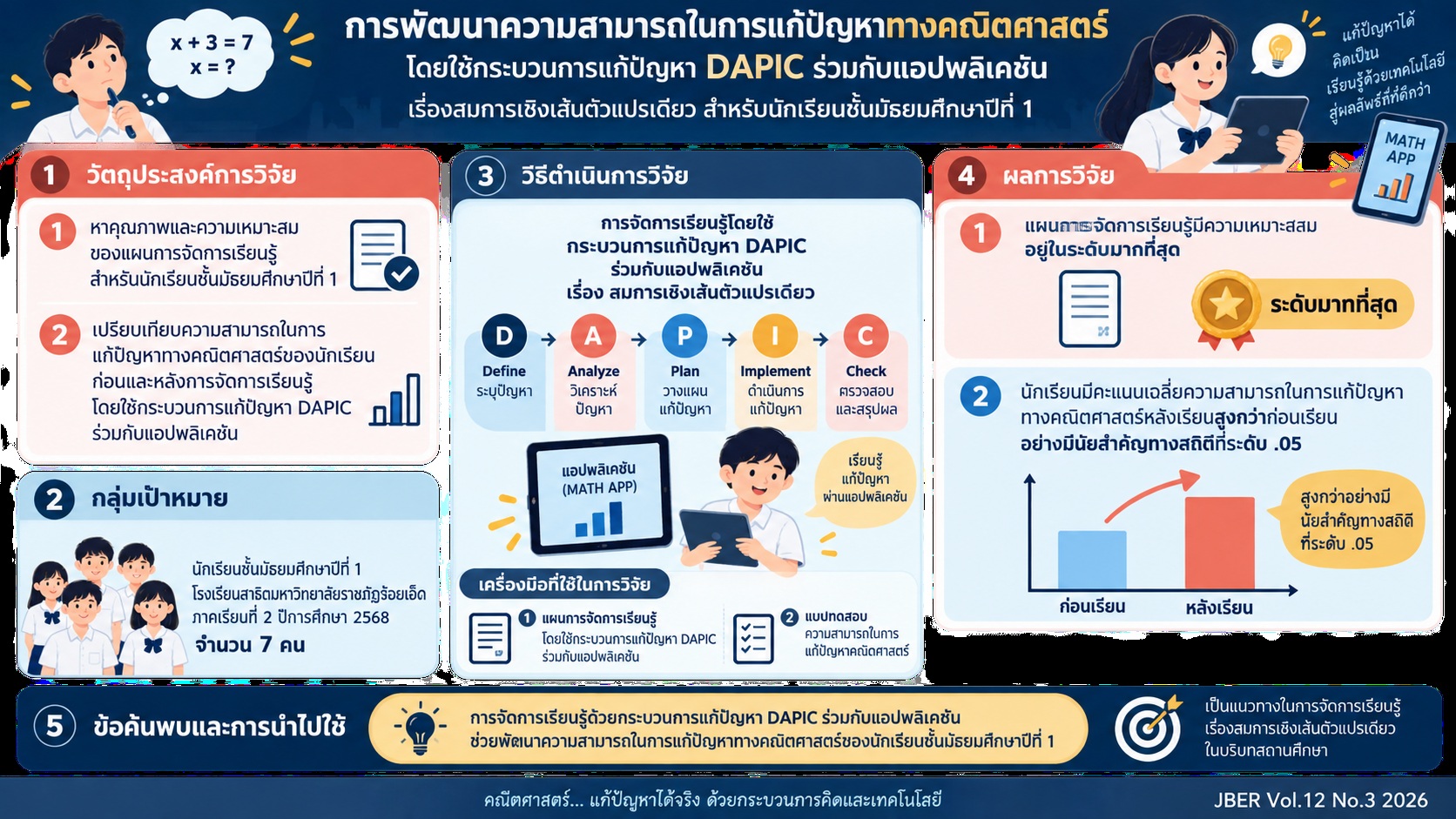
This research aimed to: 1) examine the quality and appropriateness of lesson plans for Grade 7 students, and 2) compare the mathematical problem-solving ability of Grade 7 students before and after instruction based on the DAPIC problem-solving process integrated with applications. The participants consisted of seven Grade 7 students from the Demonstration School of Roi Et Rajabhat University during the second semester of the 2025 academic year. The research instruments included: 1) lesson plans on linear equations in one variable developed according to the DAPIC problem-solving process integrated with applications for Grade 7 students, and 2) a mathematical problem-solving ability test. The results indicated that: 1) the lesson plans were rated at the highest level of appropriateness (x̄ = 4.53), and 2) the Grade 7 students who received instruction based on the DAPIC problem-solving process integrated with applications demonstrated a significantly higher mean score in mathematical problem-solving ability after the instruction than before the instruction, at the .05 level of statistical significance.
References
กระทรวงศึกษาธิการ. (2560). หลักสูตรแกนกลางการศึกษาขั้นพื้นฐาน พุทธศักราช 2551 (ฉบับปรับปรุง พ.ศ. 2560).ชุมนุมสหกรณ์การเกษตรแห่งประเทศไทย.
คณะกรรมการการจัดการความรู้ มหาวิทยาลัยรามคําแหง. (2562). การใช้แอปพลิเคชันในการจัดการเรียนรู้. มหาวิทยาลัยรามคําแหง.
ณัฐพนธ์ พัฒนะมนตรี, ชมนาด เชื้อสุวรรณทวี, & สุณิสา สุมิรัตนะ. (2567). การศึกษาความสามารถในการ แก้ปัญหาอย่างสร้างสรรค์ทางคณิตศาสตร์ของนักเรียนชั้นมัธยมศึกษาปีที่ 1 โดยใช้กระบวนการ DAPIC ร่วมกับเทคนิคการระดมสมอง.วารสารวิจัยทางการศึกษา, 17(2), 45–60.
วัชรพล จันทรวงศ์. (2562). ผลการจัดการเรียนรู้ด้วยกระบวนการแก้ปัญหา DAPIC ที่มีผลต่อความสามารถใน การคิดอย่างมีวิจารณญาณของนักเรียนชั้นมัธยมศึกษาปีที่ 4.มหาวิทยาลัยศรีนครินทรวิโรฒ.
สถาบันส่งเสริมการสอนวิทยาศาสตร์และเทคโนโลยี. (2551). การเรียนรู้แบบแก้ปัญหาในวิชาคณิตศาสตร์. สถาบันส่งเสริมการสอนวิทยาศาสตร์และเทคโนโลยี.
สิริกุล ยมจินดา. (2565). การพัฒนาการจัดการเรียนรู้โดยใช้เทคนิค KWDL ร่วมกับเกมเพื่อเสริมสร้าง ความสามารถในการแก้โจทย์ปัญหาคณิตศาสตร์ของนักเรียนชั้นประถมศึกษาปีที่ 1[วิทยานิพนธ์ ศึกษาศาสตรมหาบัณฑิต สาขาวิชาหลักสูตรและการสอน, มหาวิทยาลัยศิลปากร].
สิริพร ทิพย์คง. (2556). การพัฒนาทักษะการแก้ปัญหาคณิตศาสตร์โดยใช้กระบวนการสืบเสาะ.จุฬาลงกรณ์ มหาวิทยาลัย.
อัมพร ม้าคนอง. (2554). การพัฒนาทักษะการแก้ปัญหาคณิตศาสตร์โดยใช้กระบวนการ DAPIC[วิทยานิพนธ์ ศึกษาศาสตรมหาบัณฑิต, มหาวิทยาลัยราชภัฏเชียงใหม่].
Center for Mathematics, Science, and Technology. (1998). Problem-solving framework DAPIC.
Meier, J., Hovde, R., & Meier, R. (1996). Problem solving in mathematics and science classrooms. School Science and Mathematics, 96(1), 34–41.
National Council of Teachers of Mathematics. (1989). Curriculum and evaluation standards for school mathematics.Author.
Downloads
Published
How to Cite
Issue
Section
Categories
License
Copyright (c) 2026 Journal of Buddhist Education and Research (JBER)

This work is licensed under a Creative Commons Attribution-NonCommercial-NoDerivatives 4.0 International License.