Open Learning Management in Thai Language Education in the 21st Century in Khon Kaen Province
Keywords:
Creative Writing, Open Approach, Analytical Thinking, Thai Language Learning, 21st-Century LearningAbstract
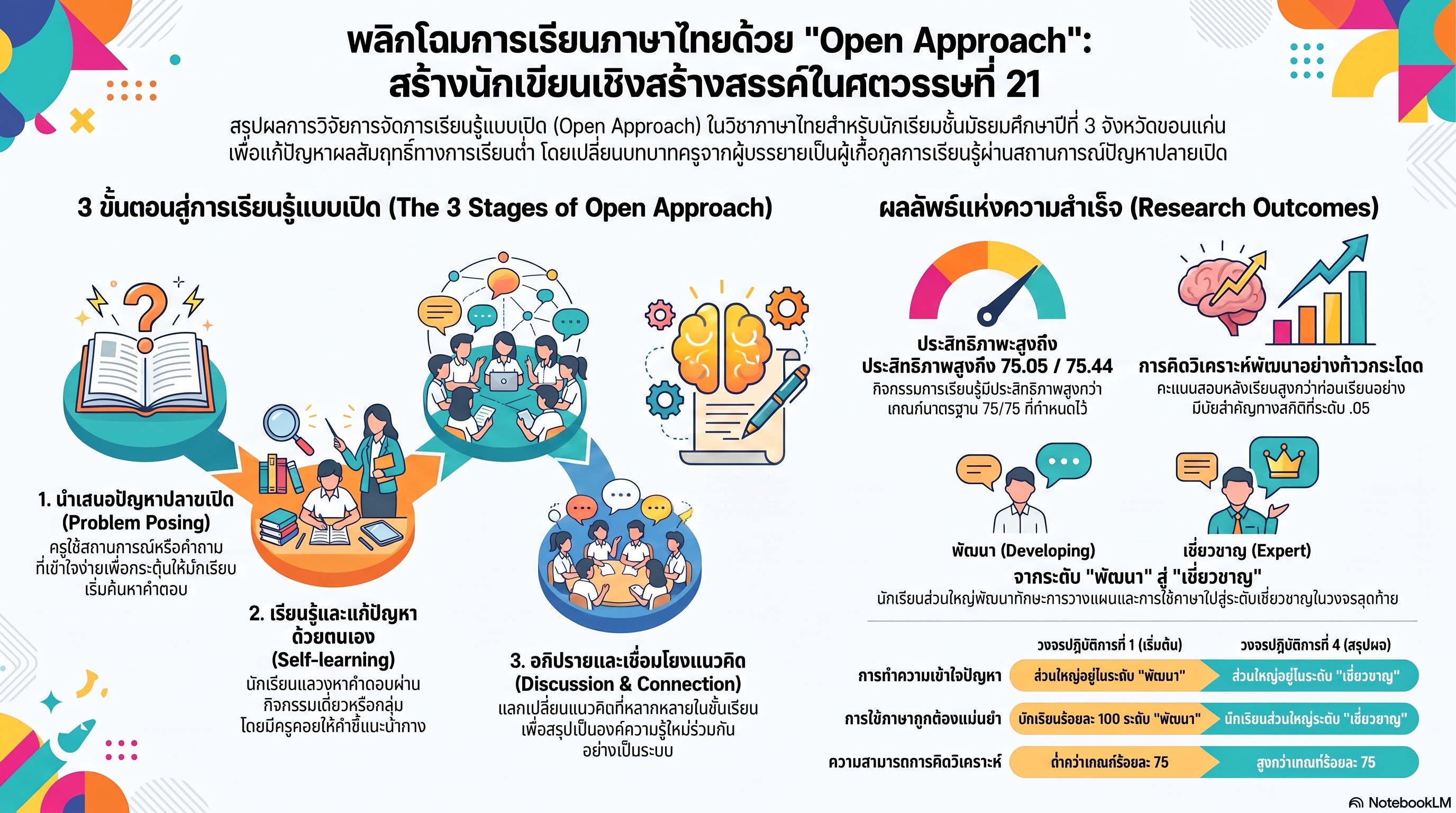
This research aimed to (1) develop and determine the efficiency of creative writing instructional activities based on the Open Approach to enhance the analytical thinking ability of Grade 9 students; (2) examine the effects of the Open Approach-based creative writing instructional activities on students' analytical thinking ability; and (3) investigate the enhancement of students' creative writing characteristics through Open Approach learning management in Thai language instruction for 21st-century learners. This study employed a mixed methods research design, integrating action research with qualitative research. The sample consisted of 19 Grade 9 students from Wiwekthamprasitwitthaya School, Khon Kaen Province, enrolled in the second semester of the 2025 academic year. The participants were selected using purposive sampling. The research instruments included (1) 13 Open Approach-based lesson plans for creative writing instruction and (2) a creative writing ability assessment. The instructional intervention was conducted over 13 instructional hours. Quantitative data were analyzed using the mean, standard deviation, and dependent samples t-test. The findings revealed that: (1) the Open Approach-based creative writing instructional activities consisted of four learning stages: problem posing, self-learning and problem solving, whole-class discussion, and summarization through connecting students' ideas. The instructional activities achieved an efficiency of 75.05/75.44; (2) students' analytical thinking ability after the intervention was significantly higher than before the intervention at the .05 level. In addition, students' achievement exceeded the 75 percent criterion, although the difference was not statistically significant at the .05 level; and (3) the Open Approach effectively promoted students' creative writing characteristics and analytical thinking ability by encouraging them to construct knowledge through logical reasoning and apply their learning across disciplines. Although students initially experienced difficulties in interpreting writing tasks, planning their writing, and using language appropriately, they demonstrated continuous improvement through open-ended learning activities and reflective learning based on the PAOR cycle. Consequently, the instructional approach effectively enhanced students' creative writing skills, analytical thinking, and essential learning competencies required for the 21st century.
References
ชัยยงค์ พรหมวงศ์. (2523). นวัตกรรมและเทคโนโลยีทางการศึกษาการสอน. ไทยวัฒนาพานิช.
ทิศนา แขมมณี. (2544). วิทยาการด้านการคิด. เดอะ มาสเตอร์ กรุ๊ป แมเนจเมนท์.
ปาริฉัตร ทับทิมหิน, & น้ำทิพย์ องอาจวาณิชย์. (2566). การพัฒนาตัวชี้วัดจิตนิสัยทางคณิตศาสตร์ของนักเรียนชั้นประถมศึกษาปีที่ 6. วารสาร มจร อุบลปริทรรศน์, 8(3), 1563–1576. https://so06.tci-thaijo.org/
ไมตรี อินทร์ประสิทธิ์. (2547a). การจัดกิจกรรมการเรียนรู้แบบปลายเปิด (Open Approach). คณะศึกษาศาสตร์ มหาวิทยาลัยขอนแก่น.
ไมตรี อินทร์ประสิทธิ์. (2547b). การสอนโดยใช้วิธีการแบบเปิดในชั้นเรียนคณิตศาสตร์ของญี่ปุ่น. KKU Journal of Mathematics Education, 1(1), 1–17.
โรงเรียนวิเวกธรรมประสิทธิ์วิทยา วัดธาตุ พระอารามหลวง. (2568). รายงานการประเมินตนเองของสถานศึกษา (Self-Assessment Report: SAR) ระดับการศึกษาขั้นพื้นฐาน ปีการศึกษา 2567. สำนักเขตการศึกษาพระปริยัติธรรม แผนกสามัญศึกษา เขต 7 สำนักงานการศึกษาพระปริยัติธรรม แผนกสามัญศึกษา.
ลัดดา ศิลาน้อย. (2548). สรุปโครงการพัฒนาแผนการจัดการเรียนรู้ด้วยวิธี Lesson Study Approach. คณะศึกษาศาสตร์ มหาวิทยาลัยขอนแก่น.
วีรยุทธ ด้วงใย. (2566). ผลการจัดการเรียนรู้คณิตศาสตร์เพื่อพัฒนาความสามารถในการวิเคราะห์และแก้ปัญหาโดยใช้การเรียนรู้เชิงรุก (Active Learning) สำหรับนักเรียนชั้นมัธยมศึกษาปีที่ 2. Journal of Roi Kaensarn Academi, 8(1), 119–135. https://so02.tci-thaijo.org/index.php/JRKSA
Downloads
Published
How to Cite
Issue
Section
License
Copyright (c) 2026 Authors

This work is licensed under a Creative Commons Attribution-NonCommercial-NoDerivatives 4.0 International License.