The Study of Mathematical Problem-Solving Ability on Ratio, Proportion and Percentage for Vocational Certificate Students Using Learning Management Based on Model-Eliciting Activities (MEAs)
Keywords:
Mathematical problem-solving ability, Learning management based on Model-Eliciting Activities (MEAs)Abstract
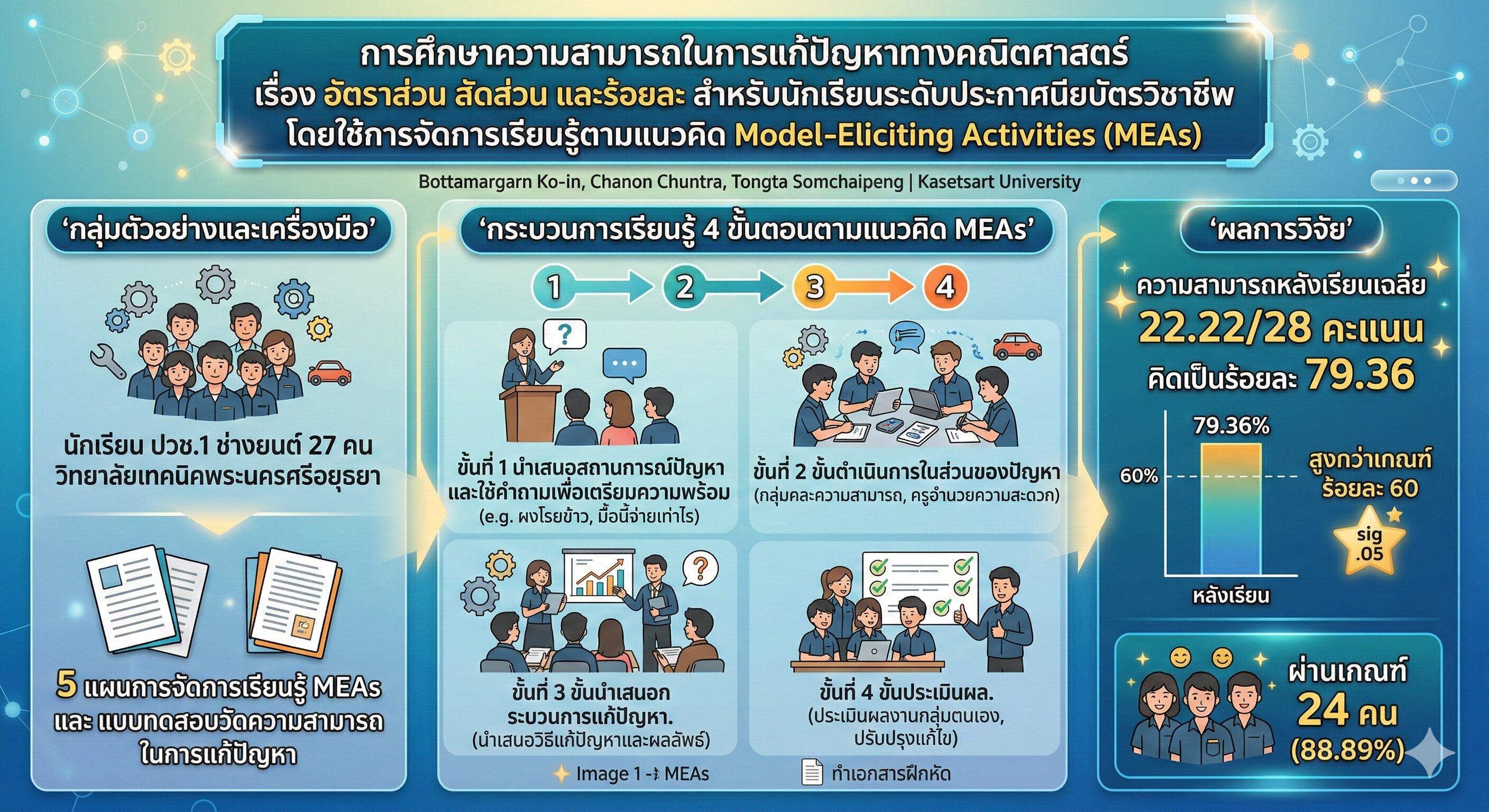
The objectives of this research were 1) to study the characteristics of learning activities based on Model-Eliciting Activities (MEAs) on ratio, proportion and percentage to promote the ability to solve mathematical problems and 2) to study mathematical problem-solving ability on ratio, proportion and percentage using Model-Eliciting Activities (MEAs). The sample of this research was 27 students of the 1st year Vocational Certificate students of the one classroom in Automotive department at Ayutthaya Technical College in the second semester of the academic year 2024. They were selected by cluster random sampling from 4 classrooms. The research instruments consisted of 5 learning plans based on Model-Eliciting Activities (MEAs) on ratio, proportion, and percentage and mathematical problem-solving ability test on ratio, proportion and percentage which were subjective test with 4 questions. The data was analyzed in terms of percentage, mean, standard deviation, and t-test statistic. The research results found that 1) The learning activity management consists of 4 steps: step 1: presenting the problem situations and using questions to prepare; step 2: implementing the problem; step 3: presenting the problem-solving processes; and step 4: evaluating the results. The roles of the teacher were to prepare and present real-life problem situations to students, divide students into groups, explain the steps of the activities, facilitate learning, use questions to stimulate students to think analytically, and provide suggestions. Meanwhile, the roles of the students were to understand the problem situations, analyze and find solutions, solve the problem collaboratively in the group, present the problem-solving method and the results of their groups in front of the class, discuss the correctness of the problem-solving process and the feasibility of the answer, listen to suggest and improve their group's problem-solving method to be more correctly and completely, And 2) students' mathematical problem-solving ability on ratio, proportion, and percentage after receiving learning activities based on Model-Eliciting Activities (MEAs) was significantly higher than the 60% criterion at the .05 statistical level.
References
กระทรวงศึกษาธิการ. (2560). ตัวชี้วัดและสาระการเรียนรู้แกนกลาง กลุ่มสาระการเรียนรู้คณิตศาสตร์ (ฉบับปรับปรุง พ.ศ. 2560) ตามหลักสูตรแกนกลางการศึกษาขั้นพื้นฐาน พุทธศักราช 2551. โรงพิมพ์ชุมนุมสหกรณ์การเกษตรแห่งประเทศไทย จำกัด.
จิดาภา จันทิมา. (2566). ผลการจัดกิจกรรมการเรียนรู้คณิตศาสตร์โดยใช้โมเดล MEAs ที่มีต่อความสามารถในการคิดวิเคราะห์ ของนักเรียนระดับชั้นมัธยมศึกษาตอนต้น[วิทยานิพนธ์ปริญญามหาบัณฑิต ไม่ได้ตีพิมพ์]. จุฬาลงกรณ์มหาวิทยาลัย.
ปรีดา ทองบ่อ, ชนิศวรา เลิศอมรพงษ์, และ ชานนท์ จันทรา. (2567). การส่งเสริมความสามารถในการแก้ปัญหาทางคณิตศาสตร์ โดยการจัดการเรียนรู้คณิตศาสตร์ตามแนวคิด Model-Eliciting Activities (MEAs) ของนักเรียนชั้นมัธยมศึกษาปีที่ 3. วารสารครุพิบูล คณะครุศาสตร์ มหาวิทยาลัยราชฏพิบูลสงคราม, 11(1), 106-120.
พงศธร มหาวิจิตร และ วราภรณ์ โชติรัตนากูล. (2563). เรียนคณิตศาสตร์ผ่านป่าชุมชน : โปรแกรมเสริมประสบการณ์โดยใช้ชุมชนเป็นฐาน. นิตยสาร สสวท., 49(227), 27-32.
พรศิริ สอนลิลา, ชนิศวรา เลิศอมรพงษ์, และ ชานนท์ จันทรา. (2566). ผลการจัดการเรียนรู้แบบ Model-Eliciting Activities (MEAs) ที่ส่งเสริมความสามารถการแก้ปัญหาทางคณิตศาสตร์ เรื่อง ดอกเบี้ยและมูลค่าของเงิน สำหรับนักเรียนชั้นมัธยมศึกษาปีที่ 5. วารสารพัฒนาการเรียนการสอน มหาวิทยาลัยรังสิต, 17(2), 155-172.
เมขลิน อมรรัตน์. (2563, 13 ตุลาคม). ประโยชน์ของคณิตศาสตร์ในชีวิตประจำวัน ตอนที่ 3 อัตราส่วนและร้อยละ. คลังความรู้ SciMath. https://www.scimath.org/article-mathematics/item/11474-3
สำนักงานคณะกรรมการการอาชีวศึกษา. (2567, 21 มีนาคม). โครงสร้างหลักสูตรประกาศนียบัตรวิชาชีพ พุทธศักราช 2567 หมวดวิชาสมรรถนะแกนกลาง. สำนักมาตรฐานการอาชีวศึกษาและวิชาชีพ. https://bsq.vec.go.th/Portals/9/Course/20/2567/20000v3.pdf
อภิสิทธิ์ แก้วพวง, ชานนท์ จันทรา, และ วันดี เกษมสุขพิพัฒน์. (2566). การศึกษาความสามารถการแก้ปัญหาและผลสัมฤทธิ์ทางการเรียนคณิตศาสตร์ ของนักเรียนชั้นประถมศึกษาปีที่ 6 เรื่อง ทศนิยมโดยการจัดการเรียนรู้ตามแนวคิด Model-Eliciting Activities (MEAs). วารสารการบริหารนิติบุคคลและนวัตกรรมท้องถิ่น, 9(3), 265-278.
Ayyubi, I. I. A., Widiani, E., Suryana, I., Andriani, A., Sari, D. W. (2024). Application of the Model-Eliciting Activities (MEAs) Learning Model on Mathematics Learning Based on higher-order thinking Skills (HOTS). Noumerico Journal of Technology in Mathematics Education, 2(2), 82-95.
Febriani, P. A., Mandailina, V., Abdillah, Syaharuddin, & Mehmood, S. (2024). Utilizing GeoGebra-assisted model-eliciting activities (MEAs) in mathematics instruction enhances students' comprehension of concepts and improves their problem-solving abilities. Jurnal Inovasi Pembelajaran, 10(1), 19-30.
Lesh, R., Hoover, M., Hole, B., Kelly, A., & Post, T. (2000). Principles for Developing Thought- Revealing Activities for Students and Teachers. In A. Kelly, R. Lesh (Eds.), Research Design in Mathematics and Science Education, (pp. 591-646). Lawrence Erlbaum Associates.
Rusliah, N., Handican, R., Laswadi, Deswita, R., & Oktafia, M. (2021). Mathematical problem-solving skills on relation and function through Model-Eliciting Activities (MEAs). Journal of Physics: Conference Series. https://doi.org/ 10.1088/1742-6596/1778/1/0 12016
Saputri, S. A., Sulistiawati, Murnaka, N. P., Arifin, A., & Permai, S. D. (2022). Application of the Model-Eliciting Activities (MEAs) Approach on Mathematics Problem Solving Capabilities. AIP Conference Proceedings 2479. https://doi.org/10.1063/ 5.0099566
Downloads
Published
How to Cite
Issue
Section
Categories
License
Copyright (c) 2026 Journal of Buddhist Education and Research (JBER)

This work is licensed under a Creative Commons Attribution-NonCommercial-NoDerivatives 4.0 International License.