English Listening and Speaking Difficulties and Self-Directed Enhancement Strategies among Undergraduate Aviation Business Students at North Bangkok University
Keywords:
English Listening and Speaking Difficulties, Self-Directed Enhancement Strategies, Aviation Business, North Bangkok UniversityAbstract
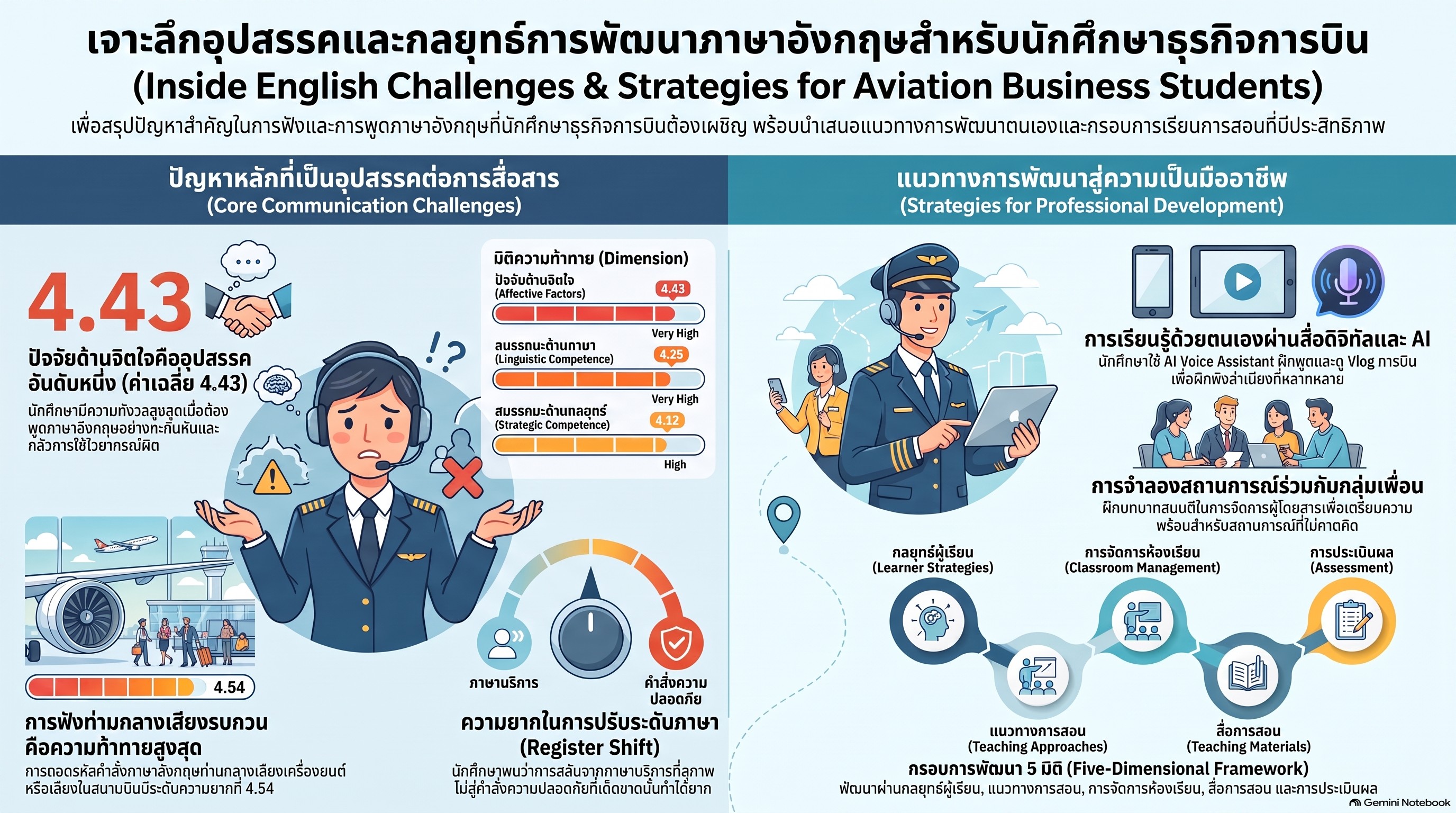
The objectives of this sequential mixed-methods research study were: 1) to examine the primary English listening and speaking difficulties experienced by undergraduate Aviation Business students at North Bangkok University (NBU) across linguistic, sociolinguistic, strategic, and affective dimensions; 2) to explore the self-directed enhancement strategies utilized by these students outside formal classroom boundaries; and 3) to propose an evidence-based, five-dimensional communicative enhancement framework tailored for their professional development. The target population comprised 400 undergraduate Aviation Business students within the Faculty of Arts. Criterion-based purposive sampling was employed, with inclusion criteria requiring Year 3 or Year 4 enrollment and completion of at least two Aviation English course units. All 200 students meeting these criteria constituted the study sample. Two primary research instruments were deployed: a 5-point difficulty rating questionnaire (n=200) to investigate core communicative difficulties across four theoretical constructs, and a semi-structured interview protocol (n=15) to explore autonomous learning practices. Quantitative data were analyzed using standard statistical procedures, yielding frequency counts, percentages, arithmetic means (x̄), and standard deviations (S.D.). Qualitative data underwent verbatim transcription and thematic content analysis. Content validity was established via an Index of Item-Objective Congruence (IOC) evaluation by three specialists, yielding congruence scores between 0.66 and 1.00. The quantitative results indicated that Affective Factors presented the highest dimension-level difficulty (x̄ = 4.43, S.D. = 0.55), with spontaneous production anxiety (x̄ = 4.62) and fear of grammatical evaluation (x̄ = 4.58) as the most acute individual items. Linguistic Competence ranked second at a Very High level (x̄ = 4.25), with decoding verbal instructions over background noise as the most demanding single item (x̄ = 4.54). Strategic and Sociolinguistic Competence constraints were also prominent. Qualitatively, three self-directed behavioral themes emerged: independent audiovisual immersion for accent adaptation, low-stakes AI-assisted practice for anxiety reduction, and collaborative peer role-plays for register-shift training. Synthesizing these findings, a five-dimensional communicative enhancement framework is proposed, organized across learner strategies, instructor approaches, classroom management, instructional materials, and assessment practices.
References
Basturkmen, H. (2018). English for specific purposes. In J. Liontas (Ed.), The TESOL encyclopedia of English language teaching (pp. 1–6). Wiley. https://doi.org/10.1002/9781118784235.eelt0545
Boonsuk, Y., & Ambele, E. A. (2021). Towards integrating lingua franca in Thai EFL: Insights from Thai tertiary learners. International Journal of Instruction, 14(3), 17–38. https://doi.org/10.29333/iji.2021.1432a
Creswell, J. W., & Plano Clark, V. L. (2018). Designing and conducting mixed methods research (3rd ed.). SAGE Publications.
Crystal, D. (2003). English as a global language (2nd ed.). Cambridge University Press.
European Union Aviation Safety Agency. (2024). Cabin crew language expectations. https://www.easa.europa.eu/en/faq/45819
Fitria, T. N. (2022). The implementation of English for specific purposes (ESP) in higher education. ELT Echo: The Journal of English Language Teaching in Foreign Language Context, 7(1), 88–99.
Goh, C. C. M. (2017). Cognition, metacognition, and L2 listening. In E. Hinkel (Ed.), Handbook of research in second language teaching and learning (Vol. 3, pp. 214–228). Routledge.
Goh, C. C. M., & Vandergrift, L. (2022). Teaching and learning second language listening: Metacognition in action (2nd ed.). Routledge.
Hamzah, H., Krish, P., & Hamat, A. (2023). Aviation communication challenges and language training development: Perspectives from pilots and air traffic controllers. Training, Language and Culture, 7(1), 86–100.
International Civil Aviation Organization. (2024). Language proficiency requirements. https://www.icao.int/safety/airnavigation/pages/peltrgfaq.aspx
Irianti, R. D., & Musthafa, B. (2022). EFL learners’ speaking anxiety in online classrooms during the COVID-19 pandemic. Jurnal Pendidikan Bahasa dan Sastra, 22(1), 25–35.
Kongsomboon, S., Wongsothorn, A., & Kittidachanupap, N. (2023). English-speaking class’s challenge in aviation students after COVID-19. EAUH Journal of Social Sciences, 9(2), 11–25.
Krashen, S. D. (1985). The input hypothesis: Issues and implications. Longman.
Lestari, A., & Wahyuni, S. (2022). Students’ difficulties in speaking English: A case study at EFL classroom. JEES: Journal of English Education Studies, 3(2), 149–160.
Limprasert, S., & Witthawassamrankul, K. (2016). English communication problems between passengers and flight attendants: A review. In Proceedings of the 8th International Conference on Humanities and Social Sciences (pp. 1–10). Faculty of Liberal Arts, Prince of Songkla University.
Mahmood, A. S., Saad, N. S. M., & Nur, N. M. (2023). The ups and downs of learning and using English: Aviation students’ voices. International Journal of Language Instruction, 2(1), 1–15. https://doi.org/10.54855/ijli.23211
Malik, E., Rohmatillah, R., & Rahmawati, I. N. (2025). An analysis of English as a foreign language (EFL) learners’ problems in speaking skills based on their perception at senior high school. Edunesia: Jurnal Ilmiah Pendidikan, 6(1), 190–206. https://doi.org/10.51276/edu.v6i1.1106
Michael, K. L., Lietz, G., Noicharoen, N., & Natee, N. (2025). English communication challenges and coping strategies of Thai call center staff in a European airline group. International Journal of Multidisciplinary in Management and Tourism, 9(2), 223–232. https://doi.org/10.14456/ijmmt.2025.15
Nurdin, N., & Subiyantoro, S. (2023). Factors affecting students’ speaking skills in aviation English. Dinasti International Journal of Education Management and Social Science, 4(3), 578–586.
Renandya, W. A., & Farrell, T. S. C. (2018). Teaching and learning second language listening. Routledge.
Satvindar Singh, R. K., Cheong, C. Y. M., & Rahman, N. A. A. (2021). Spoken and written communication needs of aviation management trainees. International Journal on Social and Education Sciences, 3(3), 535–547. https://doi.org/10.46328/ijonses.235
Sylvia, N., Kusumawardhani, P., & Marlina, L. (2024). E-aviation speaking preparation test for aviation vocational school. In Proceedings of the International Conference on Multidisciplinary Research (pp. 140–146). Lembaga Penerbitan Universitas.
Thuratham, W. (2022). Individual, pair and group EFL activities for aviation students at a Thai university: A closer look at language achievement and attitudes. LEARN Journal: Language Education and Acquisition Research Network, 15(2), 892–921.
Downloads
Published
How to Cite
Issue
Section
License

This work is licensed under a Creative Commons Attribution-NonCommercial-NoDerivatives 4.0 International License.