Natural Law in Buddhism and Plato’s World of Ideas
Keywords:
Natural Law, Buddhism, World of Ideas, PlatoAbstract
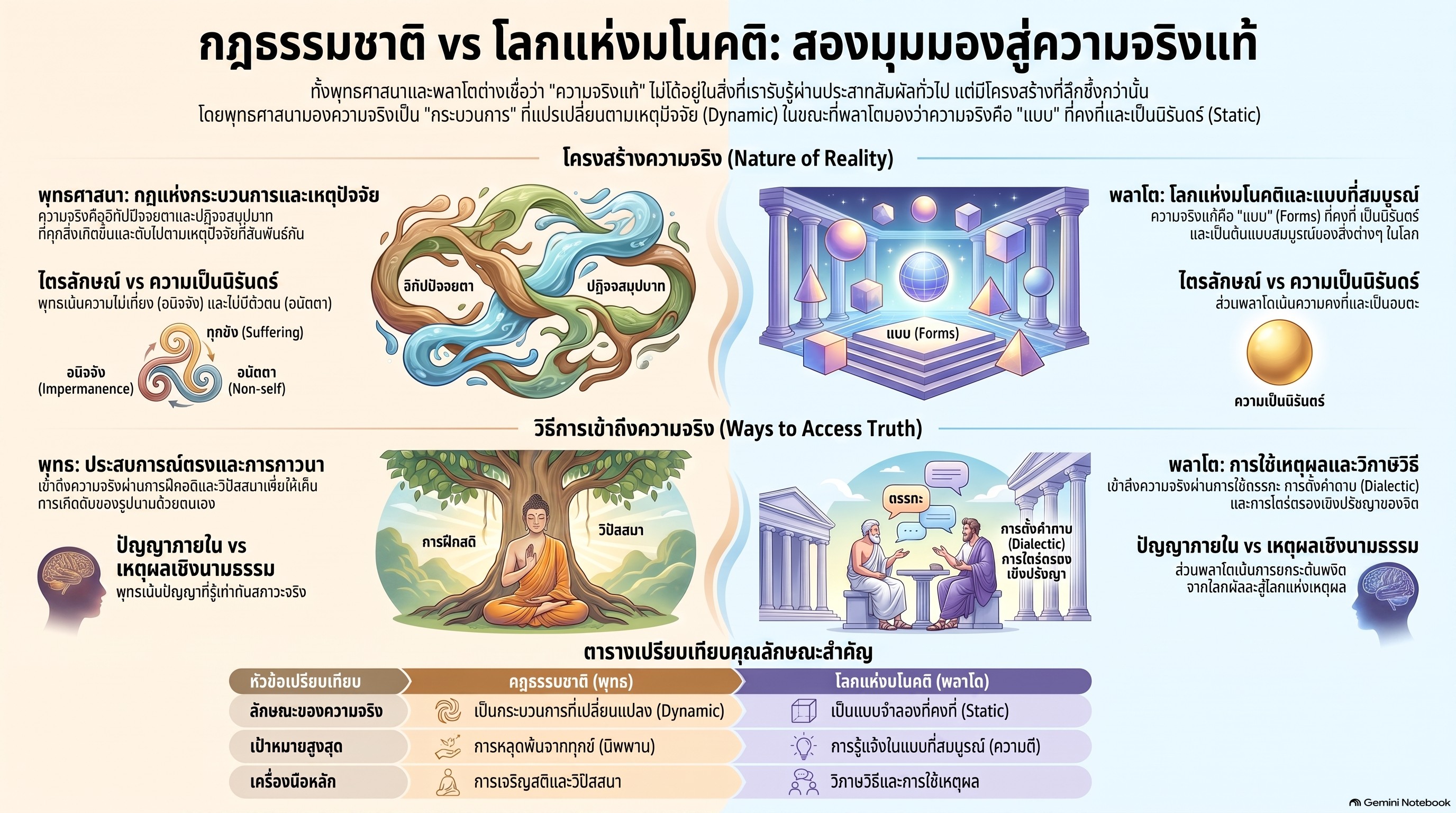
This article aims to analyze the concept of “natural law” in Buddhism in comparison with the concept of the “World of Forms” proposed by Plato. The objective is to understand the structure of reality and the fundamental principles underlying all phenomena in both systems of thought. Buddhism explains natural law through the principles of conditionality (idappaccayata), dependent origination, and the Three Marks of Existence, which illustrate causal relationships and the impermanent nature of all things. In contrast, Plato proposes that the World of Forms represents ultimate reality, serving as the eternal and unchanging archetype of all phenomena in the empirical world. The findings reveal that while both perspectives share a common aim in the pursuit of ultimate truth, they differ significantly in their methodologies and metaphysical foundations. Buddhism emphasizes process, causality, and arising-and-ceasing phenomena, whereas Plato underscores permanence and the eternal nature of Forms. These findings highlight the diverse philosophical perspectives between Eastern and Western traditions and provide a significant foundation for further in-depth comparative philosophical studies.
References
มหาวิทยาลัยมหาจุฬาลงกรณราชวิทยาลัย. (2539). พระไตรปิฎกภาษาไทย ฉบับมหาจุฬาลงกรณราชวิทยาลัย.
พระพรหมคุณาภรณ์ (ป.อ. ปยุตฺโต). (2559). พุทธธรรม. มหาวิทยาลัยมหาจุฬาลงกรณราชวิทยาลัย.
พระธรรมโกศาจารย์ (ประยูร ธมฺมจิตฺโต). (2550). ปรัชญากรีก: บ่อเกิดภูมิปัญญาตะวันตก (พิมพ์ครั้งที่ 6). ศยาม.
พระราชวรมุนี (ประยุทธ์ ปยุตฺโต). (2543). แก่นแท้ของพุทธธรรม. ธรรมสภา.
วิธาน สุชีวคุปต์. (2529). อภิปรัชญา. แสงจันทร์การพิมพ์.
สมภาร พรมทา. (2548). ปรัชญากรีก: กำเนิดและพัฒนาการ. สำนักพิมพ์แห่งจุฬาลงกรณ์มหาวิทยาลัย.
สุรพงษ์ ชัยนาม. (2554). ปรัชญากรีก: จากโสเครติสถึงอริสโตเติล. สำนักพิมพ์แห่งจุฬาลงกรณ์มหาวิทยาลัย.
Copleston, F. (1998). A history of philosophy. Image Books.
Plato. (1894). The republic (B. Jowett, Trans.). Clarendon Press.
Downloads
Published
How to Cite
Issue
Section
License

This work is licensed under a Creative Commons Attribution-NonCommercial-NoDerivatives 4.0 International License.