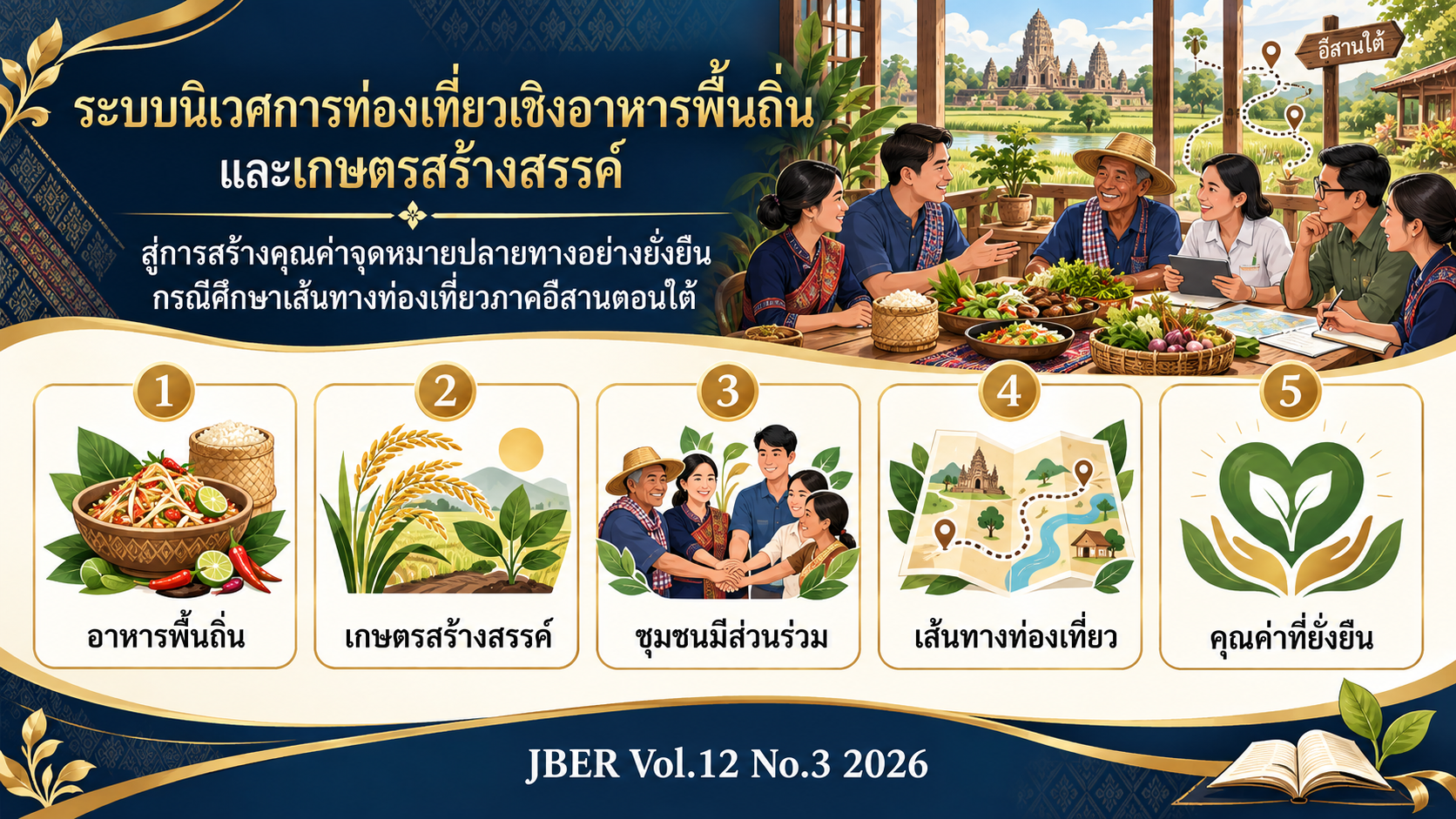
The Ecosystem of Local Gastronomy and Creative Agriculture Tourism for Sustainable Destination Value Creation: A Case Study of the Lower Northeastern Thematic Tourism Route, Thailand
Keywords:
Gastronomy Tourism, Creative Agricultural Tourism, Tourism Ecosystem, Destination Value Creation, Southern Northeastern Region of ThailandAbstract
This article employs a qualitative case study approach combined with the synthesis of academic literature and policy documents. The findings reveal that tourism development in the study area lacks systematic integration among food and agricultural resources, stakeholders, tourism activities, and governance mechanisms, resulting in discontinuities within the tourism value chain. The study proposes a tourism ecosystem framework to explain systemic relationships, with case studies from Surin, Sisaket, and Ubon Ratchathani provinces demonstrating that ecosystem-based management can generate destination value across economic, social, cultural, and experiential dimensions in a holistic manner. The knowledge generated from this study contributes to expanding perspectives on tourism policy formulation, shifting the focus from activity-based development toward an integrated understanding of resource linkages, stakeholder networks, and management mechanisms within a territorial context. The findings also provide empirical insights to support the development of gastronomy and agro-tourism policies tailored to local contexts. As a policy recommendation, integrated tourism management should be promoted through collaborative mechanisms among local stakeholders, using the tourism ecosystem as a guiding framework for policy formulation and development planning aligned with local capacities and potentials.
References
กนกวรรณ สมศิริวรางกูล. (2565). เกษตรกรผู้ประกอบการหลากรุ่นกับพหุเกษตรกรรมในบริบทการท่องเที่ยวเชิงเกษตรแบบฟาร์มสเตย์. วารสารสังคมศาสตร์ มหาวิทยาลัยเชียงใหม่, 34(1), 76–101.
กนกวรรณกรณ์ หลวงวังโพธิ์, & สิทธิศักดิ์ เตียงงา. (2568). รูปแบบเส้นทางท่องเที่ยวเชิงอาหารอีสานพื้นถิ่นในจังหวัดร้อยเอ็ด. วารสารวิทยาการจัดการ มหาวิทยาลัยราชภัฏพิบูลสงคราม, 7(1), 61–80.
กระทรวงการท่องเที่ยวและกีฬา. (2562). รายงานสถานการณ์การท่องเที่ยวประเทศไทย ปี 2562. กระทรวงการท่องเที่ยวและกีฬา.
กัลยรักษ์ ลิ่มโอภาสมณี. (2567). กระบวนการพัฒนาตัวแบบแผนที่ท่องเที่ยวเชิงวัฒนธรรมเพื่อส่งเสริมเศรษฐกิจการท่องเที่ยวจังหวัดอุดรธานี. วารสารสมาคมรัฐประศาสนศาสตร์แห่งประเทศไทย, 6(1), 37–52.
จีรนันท์ เขิมขันธ์. (2561). มุมมองของการพัฒนาภาคการท่องเที่ยวเชิงเกษตรในประเทศไทย. วารสารเกษตรพระจอมเกล้า, 36(2), 162–167.
นิปาตีเมาะ หยีหามะ. (2568). แนวทางการสืบสาน อนุรักษ์ วัฒนธรรมอาหารพื้นบ้านเพื่อความยั่งยืน. วารสารสังคมศาสตร์และวัฒนธรรม, 9(2), 100–112.
เบญจมาภรณ์ ชำนาญฉา. (2561). การท่องเที่ยวเชิงอาหาร: ศักยภาพและความได้เปรียบของประเทศไทย. วารสารวิชาการสมาคมสถาบันอุดมศึกษาเอกชนแห่งชาติ, 24(1), 103–116.
ปวิธ ตันสกุล. (2563). แนวทางการส่งเสริมอาหารพื้นถิ่นเพื่อการท่องเที่ยวเชิงอาหาร: กรณีศึกษาชุมชนขนาบนาก อำเภอปากพนัง จังหวัดนครศรีธรรมราช. วารสารการจัดการ มหาวิทยาลัยวลัยลักษณ์, 9(1), 81–92.
ปัทเมศย์ ประดิษฐ์แสงทอง, ภัสสรกันต์ ทรัพย์มาโชค, & พัทธ์ยมล สื่อสวัสดิ์วิณิชย์. (2565). การบริหารจัดการการท่องเที่ยวเชิงเกษตรด้วยแนวคิด POSDCoRB. วารสารศิลปศาสตร์ราชมงคลสุวรรณภูมิ, 4(1), 173–186.
พรยศ ฉัตรธารากุล, กรุณา เคลือบมงคล, & ณัฐพล วงศ์เยาว์. (2566). การศึกษาความตระหนักในสถานการณ์การพัฒนาทรัพยากรทางวัฒนธรรมและปัจจัยในการขับเคลื่อนระบบนิเวศการเรียนรู้ของการท่องเที่ยวเชิงวัฒนธรรม Satun UNESCO Global Geopark. Journal of Inclusive and Innovative Education, 7(3), 120–134.
พิชญ์สินี บุญญานุพงศ์, & ปิยะลักษณ์ พุทธวงศ์. (2564). พฤติกรรมการท่องเที่ยวเชิงอาหารและความคิดเห็นต่อปัจจัยส่วนประสมทางการตลาดของนักท่องเที่ยวชาวต่างชาติในจังหวัดเชียงใหม่. วารสารเศรษฐศาสตร์ มหาวิทยาลัยแม่โจ้, 1(1), 37–47.
ภูริ ชุณห์ขจร, & ชวลีย์ ณ ถลาง. (2564). องค์ประกอบการท่องเที่ยวเชิงอาหารและส่วนประสมทางการตลาดบริการของนักท่องเที่ยวชาวไทยในการท่องเที่ยวเชิงอาหารชายฝั่งทะเลตะวันตก. วารสารวิทยาลัยดุสิตธานี, 15(1), 66–82.
ศิริภา มณีรัตน์, & จุฑาทิพย์ เฉลิมผล. (2560). รูปแบบการจัดการท่องเที่ยวเชิงเกษตรที่เหมาะสมของเส้นทางสายแม่ริม–สะเมิง อำเภอแม่ริม จังหวัดเชียงใหม่. แก่นเกษตร, 45(ฉบับพิเศษ 1), 540–544.
สุดี บุญมาจรินทร์, กรกมล มุสิกชาติ, สิรินทร์นิชา รังสรรค์ธาดา, & พิทักษ์ชัย ทศดร. (2568). แนวทางการออกแบบกิจกรรมการท่องเที่ยวเชิงเกษตรวัฒนธรรมเพื่อการเรียนรู้อย่างสร้างสรรค์ในสวนเกษตรจังหวัดนครนายก. วารสารมณีเชษฐาราม วัดจอมมณี, 8(6), 161–179.
อภิไทย แก้วจรัส, ชวลีย์ ณ ถลาง, & เสรี วงษ์มณฑา. (2566). พฤติกรรมและความต้องการของนักท่องเที่ยวชาวไทยที่มีต่ออาหารท้องถิ่นภาคเหนือของจังหวัดเชียงใหม่. วารสารวิทยาการจัดการวไลยอลงกรณ์ปริทัศน์, 4(3), 1–15.
อินทร์ชญาณ์ เอกธนวัตน์. (2559). ความคาดหวังและการรับรู้ของนักท่องเที่ยวชาวจีนต่อคุณลักษณะจุดหมายปลายทางของแหล่งท่องเที่ยว: กรณีศึกษาเมืองพัทยา. [วิทยานิพนธ์ปริญญามหาบัณฑิต] มหาวิทยาลัยบูรพา.
Baby, J., & Kim, D. Y. (2025). Segmenting agritourism visitors: Moving beyond the general market. Sustainability, 17(8), 1–13.
Baggio, R., & Sainaghi, R. (2011). Complex and chaotic tourism systems: Towards a quantitative approach. International Journal of Contemporary Hospitality Management, 23(6), 840–861.
Chen, J., Guan, J., Xu, J., & Clergeau, C. (2018). Constructing the green supply chain for rural tourism in China: Perspective of front–back stage decoupling. Sustainability, 10(11), Article 4276. https://doi.org/10.3390/su10114276
Gössling, S., & Hall, C. M. (2019). Sustainable tourism futures: Perspectives on systems, restructuring and innovations. Journal of Sustainable Tourism, 27(10), 1637–1674.
Hegarty, J., & Barry, G. (2001). Gastronomy: A phenomenon of cultural expressionism and an aesthetic for living. Journal of Hospitality & Tourism Education, 11(1), 25–29.
Mitchell, J., & Ashley, C. (2010). Tourism and poverty reduction: Pathways to prosperity. Earthscan.
Organisation for Economic Co-operation and Development. (2001). Multifunctionality: Towards an analytical framework. OECD Publishing. https://doi.org/10.1787/9789264192171-en
Prahalad, C. K., & Ramaswamy, V. (2004). Co-creation experiences: The next practice in value creation. Journal of Interactive Marketing, 18(3), 5–14.
Richards, G. (2015). Evolving gastronomic experiences: From food to foodies to foodscapes. Journal of Gastronomy and Tourism, 1(1), 5–17.
Shalini, D., & Duggal, S. (2015). A review on food tourism quality and its associated forms around the world. African Journal of Hospitality, Tourism and Leisure, 4(1), 1–12.
United Nations World Tourism Organization. (2018). Tourism and the Sustainable Development Goals: Journey to 2030. https://doi.org/10.18111/9789284419401
Downloads
Published
How to Cite
License
Copyright (c) 2026 Journal of Buddhist Education and Research (JBER)

This work is licensed under a Creative Commons Attribution-NonCommercial-NoDerivatives 4.0 International License.