Balancing Insulin, Balancing Monastic Life: An Integrative Review of Middle Path Lifestyle Practices for Metabolic Health in Buddhist Monastic Communities
Keywords:
insulin resistance, Buddhist monks, time-restricted eating, lifestyle medicine, Middle Path, noncommunicable diseases, ThailandAbstract
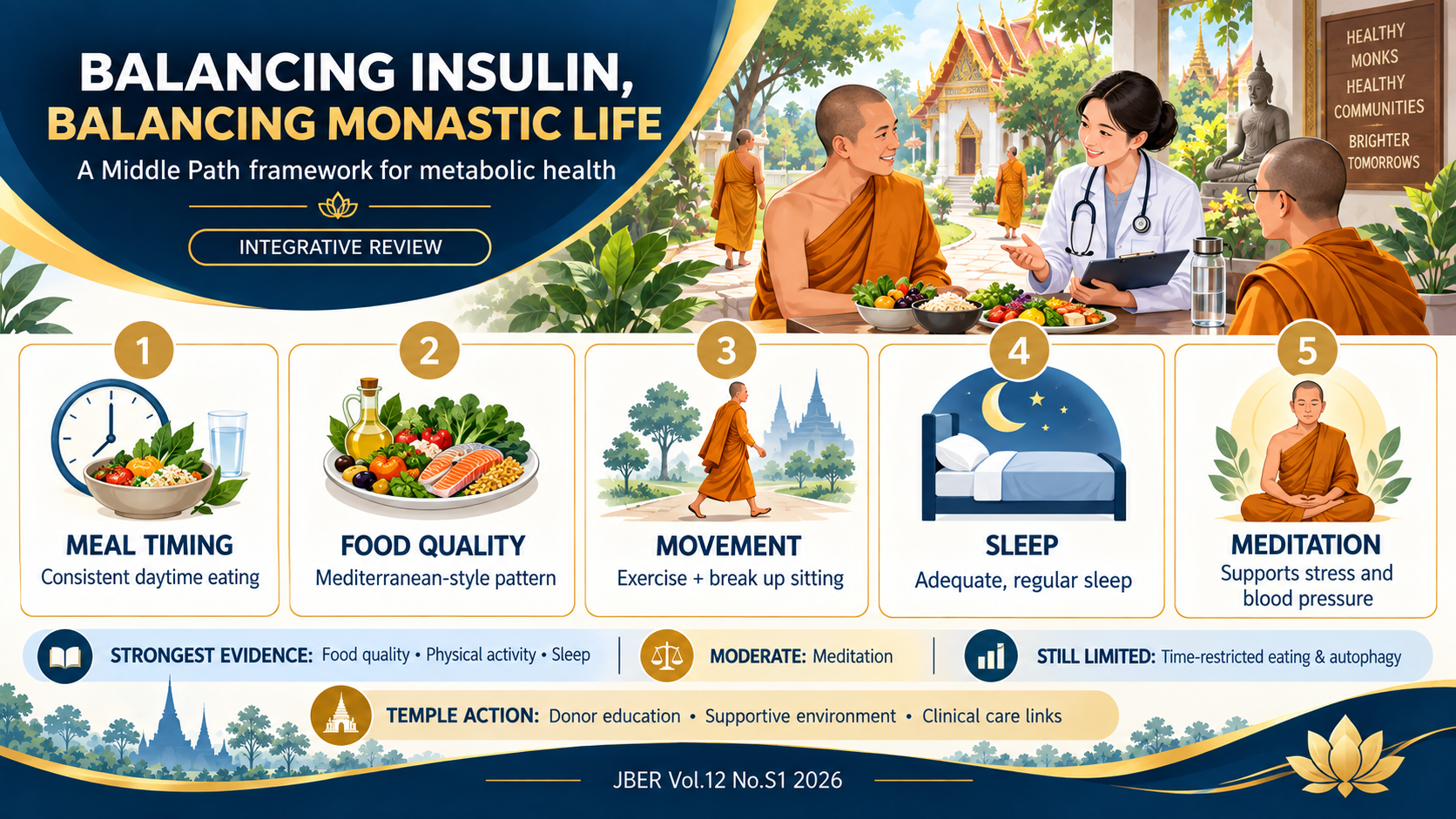
Noncommunicable diseases are prevalent among Thai Buddhist monks. Reliance on alms, prolonged sedentary study and meditation, and limited control over donated food create a distinctive metabolic risk profile. Insulin resistance may contribute to obesity, type 2 diabetes, hypertension, and dyslipidemia in this population. This integrative narrative review examines five lifestyle domains—meal timing, food quality, movement, sleep, and meditation—in relation to insulin action, organises the evidence within a Buddhist Middle Path framework, and assesses claims commonly used in monastic health education. The review was anchored in a Thai-language health-education volume produced under a national research fund and supplemented by targeted searches of PubMed and publisher records. Cited sources were checked against their DOI records. Monastic studies indicate a substantial burden of obesity, hypertension, and dysglycemia despite a naturally compressed eating window. Evidence is strongest for improving food quality through a Mediterranean-style dietary pattern, engaging in regular physical activity and interrupting prolonged sitting, and obtaining adequate sleep. Evidence for meditation as an intervention for stress and blood pressure is moderate, whereas evidence for time-restricted eating and proposed autophagy-related mechanisms remains limited to small, short-term trials. Several widely quoted effect sizes could not be verified in the sources cited for them. A temple-level programme combining education for lay donors, environmental changes, and links to clinical care is biologically plausible and culturally congruent. Its effectiveness among monks requires cluster-randomised evaluation before efficacy claims can be made.
References
Aekplakorn, W., Chariyalertsak, S., Kessomboon, P., Sangthong, R., Inthawong, R., Putwatana, P., Taneepanichskul, S., & Thai National Health Examination Survey IV Study Group. (2011). Prevalence and management of diabetes and metabolic risk factors in Thai adults: The Thai National Health Examination Survey IV, 2009. Diabetes Care, 34(9), 1980–1985. https://doi.org/10.2337/dc11-0099
Bagherniya, M., Butler, A. E., Barreto, G. E., & Sahebkar, A. (2018). The effect of fasting or calorie restriction on autophagy induction: A review of the literature. Ageing Research Reviews, 47, 183–197. https://doi.org/10.1016/j.arr.2018.08.004
Cappuccio, F. P., D'Elia, L., Strazzullo, P., & Miller, M. A. (2010). Quantity and quality of sleep and incidence of type 2 diabetes: A systematic review and meta-analysis. Diabetes Care, 33(2), 414–420. https://doi.org/10.2337/dc09-1124
Colberg, S. R., Sigal, R. J., Yardley, J. E., Riddell, M. C., Dunstan, D. W., Dempsey, P. C., Horton, E. S., Castorino, K., & Tate, D. F. (2016). Physical activity/exercise and diabetes: A position statement of the American Diabetes Association. Diabetes Care, 39(11), 2065–2079. https://doi.org/10.2337/dc16-1728
Daubenmier, J., Kristeller, J., Hecht, F. M., Maninger, N., Kuwata, M., Jhaveri, K., Lustig, R. H., Kemeny, M., Karan, L., & Epel, E. (2011). Mindfulness intervention for stress eating to reduce cortisol and abdominal fat among overweight and obese women: An exploratory randomized controlled study. Journal of Obesity, 2011, 651936. https://doi.org/10.1155/2011/651936
Daubenmier, J., Moran, P. J., Kristeller, J., Acree, M., Bacchetti, P., Kemeny, M. E., Dallman, M., Lustig, R. H., Grunfeld, C., Nixon, D. F., Milush, J. M., Goldman, V., Laraia, B., Laugero, K. D., Woodhouse, L., Epel, E. S., & Hecht, F. M. (2016). Effects of a mindfulness-based weight loss intervention in adults with obesity: A randomized clinical trial. Obesity, 24(4), 794–804. https://doi.org/10.1002/oby.21396
de Cabo, R., & Mattson, M. P. (2019). Effects of intermittent fasting on health, aging, and disease. The New England Journal of Medicine, 381(26), 2541–2551. https://doi.org/10.1056/NEJMra1905136
Estruch, R., Ros, E., Salas-Salvadó, J., Covas, M. I., Corella, D., Arós, F., Gómez-Gracia, E., Ruiz-Gutiérrez, V., Fiol, M., Lapetra, J., Lamuela-Raventos, R. M., Serra-Majem, L., Pintó, X., Basora, J., Muñoz, M. A., Sorlí, J. V., Martínez, J. A., Fitó, M., Gea, A., … Martínez-González, M. A. (2018). Primary prevention of cardiovascular disease with a Mediterranean diet supplemented with extra-virgin olive oil or nuts. The New England Journal of Medicine, 378(25), e34. https://doi.org/10.1056/NEJMoa1800389
Goyal, M., Singh, S., Sibinga, E. M., Gould, N. F., Rowland-Seymour, A., Sharma, R., Berger, Z., Sleicher, D., Maron, D. D., Shihab, H. M., Ranasinghe, P. D., Linn, S., Saha, S., Bass, E. B., & Haythornthwaite, J. A. (2014). Meditation programs for psychological stress and well-being: A systematic review and meta-analysis. JAMA Internal Medicine, 174(3), 357–368. https://doi.org/10.1001/jamainternmed.2013.13018
Hallberg, S. J., McKenzie, A. L., Williams, P. T., Bhanpuri, N. H., Peters, A. L., Campbell, W. W., Hazbun, T. L., Volk, B. M., McCarter, J. P., Phinney, S. D., & Volek, J. S. (2018). Effectiveness and safety of a novel care model for the management of type 2 diabetes at 1 year: An open-label, non-randomized, controlled study. Diabetes Therapy, 9(2), 583–612. https://doi.org/10.1007/s13300-018-0373-9
Hölzel, B. K., Carmody, J., Vangel, M., Congleton, C., Yerramsetti, S. M., Gard, T., & Lazar, S. W. (2011). Mindfulness practice leads to increases in regional brain gray matter density. Psychiatry Research: Neuroimaging, 191(1), 36–43. https://doi.org/10.1016/j.pscychresns.2010.08.006
Jamshed, H., Beyl, R. A., Della Manna, D. L., Yang, E. S., Ravussin, E., & Peterson, C. M. (2019). Early time-restricted feeding improves 24-hour glucose levels and affects markers of the circadian clock, aging, and autophagy in humans. Nutrients, 11(6), Article 1234. https://doi.org/10.3390/nu11061234
Jeamjitvibool, T., Tankumpuan, T., Lukkahatai, N., & Davidson, P. M. (2022). Noncommunicable diseases and social determinants of health in Buddhist monks: An integrative review. Research in Nursing & Health, 45(2), 249–260. https://doi.org/10.1002/nur.22215
Kahn, S. E., Cooper, M. E., & Del Prato, S. (2014). Pathophysiology and treatment of type 2 diabetes: Perspectives on the past, present, and future. The Lancet, 383(9922), 1068–1083. https://doi.org/10.1016/S0140-6736(13)62154-6
Katz, A., Nambi, S. S., Mather, K., Baron, A. D., Follmann, D. A., Sullivan, G., & Quon, M. J. (2000). Quantitative insulin sensitivity check index: A simple, accurate method for assessing insulin sensitivity in humans. The Journal of Clinical Endocrinology & Metabolism, 85(7), 2402–2410. https://doi.org/10.1210/jcem.85.7.6661
Kim, J., Kundu, M., Viollet, B., & Guan, K. L. (2011). AMPK and mTOR regulate autophagy through direct phosphorylation of Ulk1. Nature Cell Biology, 13(2), 132–141. https://doi.org/10.1038/ncb2152
Klionsky, D. J., Abdel-Aziz, A. K., Abdelfatah, S., Abdellatif, M., Abdoli, A., Abel, S., Abeliovich, H., Abildgaard, M. H., Abudu, Y. P., Acevedo-Arozena, A., Adamopoulos, I. E., Adeli, K., Adolph, T. E., Adornetto, A., Aflaki, E., Agam, G., Agarwal, A., Aggarwal, B. B., Agnello, M., … Tong, C. K. (2021). Guidelines for the use and interpretation of assays for monitoring autophagy (4th edition). Autophagy, 17(1), 1–382. https://doi.org/10.1080/15548627.2020.1797280
Knowler, W. C., Barrett-Connor, E., Fowler, S. E., Hamman, R. F., Lachin, J. M., Walker, E. A., Nathan, D. M., & Diabetes Prevention Program Research Group. (2002). Reduction in the incidence of type 2 diabetes with lifestyle intervention or metformin. The New England Journal of Medicine, 346(6), 393–403. https://doi.org/10.1056/NEJMoa012512
Kuramasuwan, B., Howteerakul, N., Suwannapong, N., & Rawdaree, P. (2013). Diabetes, impaired fasting glucose, daily life activities, food and beverage consumption among Buddhist monks in Chanthaburi Province, Thailand. International Journal of Diabetes in Developing Countries, 33(1), 23–28. https://doi.org/10.1007/s13410-012-0094-y
Levine, B., & Kroemer, G. (2019). Biological functions of autophagy genes: A disease perspective. Cell, 176(1–2), 11–42. https://doi.org/10.1016/j.cell.2018.09.048
Li, Y., Pan, A., Wang, D. D., Liu, X., Dhana, K., Franco, O. H., Kaptoge, S., Di Angelantonio, E., Stampfer, M., Willett, W. C., & Hu, F. B. (2018). Impact of healthy lifestyle factors on life expectancies in the US population. Circulation, 138(4), 345–355. https://doi.org/10.1161/CIRCULATIONAHA.117.032047
Liu, D., Huang, Y., Huang, C., Yang, S., Wei, X., Zhang, P., Guo, D., Lin, J., Xu, B., Li, C., He, H., He, J., Liu, S., Shi, L., Xue, Y., & Zhang, H. (2022). Calorie restriction with or without time-restricted eating in weight loss. The New England Journal of Medicine, 386(16), 1495–1504. https://doi.org/10.1056/NEJMoa2114833
Longo, V. D., & Panda, S. (2016). Fasting, circadian rhythms, and time-restricted feeding in healthy lifespan. Cell Metabolism, 23(6), 1048–1059. https://doi.org/10.1016/j.cmet.2016.06.001
Lowe, D. A., Wu, N., Rohdin-Bibby, L., Moore, A. H., Kelly, N., Liu, Y. E., Philip, E., Vittinghoff, E., Heymsfield, S. B., Olgin, J. E., Shepherd, J. A., & Weiss, E. J. (2020). Effects of time-restricted eating on weight loss and other metabolic parameters in women and men with overweight and obesity: The TREAT randomized clinical trial. JAMA Internal Medicine, 180(11), 1491–1499. https://doi.org/10.1001/jamainternmed.2020.4153
Matthews, D. R., Hosker, J. P., Rudenski, A. S., Naylor, B. A., Treacher, D. F., & Turner, R. C. (1985). Homeostasis model assessment: Insulin resistance and β-cell function from fasting plasma glucose and insulin concentrations in man. Diabetologia, 28(7), 412–419. https://doi.org/10.1007/BF00280883
Mattson, M. P., Longo, V. D., & Harvie, M. (2017). Impact of intermittent fasting on health and disease processes. Ageing Research Reviews, 39, 46–58. https://doi.org/10.1016/j.arr.2016.10.005
Mizushima, N., & Komatsu, M. (2011). Autophagy: Renovation of cells and tissues. Cell, 147(4), 728–741. https://doi.org/10.1016/j.cell.2011.10.026
NCD Risk Factor Collaboration (NCD-RisC). (2024). Worldwide trends in diabetes prevalence and treatment from 1990 to 2022: A pooled analysis of 1108 population-representative studies with 141 million participants. The Lancet, 404(10467), 2077–2093. https://doi.org/10.1016/S0140-6736(24)02317-1
Noo-In, S., Somdee, T., Srichompoo, C., & Khiewkhern, S. (2022). The effects of health behavior changing program for systolic blood pressure reduction among Thai Buddhist monks, Thailand. Studies in Health Technology and Informatics, 295, 193–196. https://doi.org/10.3233/SHTI220695
Pascoe, M. C., Thompson, D. R., Jenkins, Z. M., & Ski, C. F. (2017). Mindfulness mediates the physiological markers of stress: Systematic review and meta-analysis. Journal of Psychiatric Research, 95, 156–178. https://doi.org/10.1016/j.jpsychires.2017.08.004
Patterson, R. E., & Sears, D. D. (2017). Metabolic effects of intermittent fasting. Annual Review of Nutrition, 37, 371–393. https://doi.org/10.1146/annurev-nutr-071816-064634
Patterson, R., McNamara, E., Tainio, M., de Sá, T. H., Smith, A. D., Sharp, S. J., Edwards, P., Woodcock, J., Brage, S., & Wijndaele, K. (2018). Sedentary behaviour and risk of all-cause, cardiovascular and cancer mortality, and incident type 2 diabetes: A systematic review and dose response meta-analysis. European Journal of Epidemiology, 33(9), 811–829. https://doi.org/10.1007/s10654-018-0380-1
Petersen, M. C., & Shulman, G. I. (2018). Mechanisms of insulin action and insulin resistance. Physiological Reviews, 98(4), 2133–2223. https://doi.org/10.1152/physrev.00063.2017
Reynolds, A. N., Mann, J. I., Williams, S., & Venn, B. J. (2016). Advice to walk after meals is more effective for lowering postprandial glycaemia in type 2 diabetes mellitus than advice that does not specify timing: A randomised crossover study. Diabetologia, 59(12), 2572–2578. https://doi.org/10.1007/s00125-016-4085-2
Ruangsan, N., Niltakan, K., & Namsithan, S. (2026). อินซูลินสมดุล ชีวิตสมณะสมดุล [Balanced insulin, balanced monastic life]. Mahachulalongkornrajavidyalaya University, Khon Kaen Campus. ISBN 978-616-618-200-2.
Samuel, V. T., & Shulman, G. I. (2016). The pathogenesis of insulin resistance: Integrating signaling pathways and substrate flux. The Journal of Clinical Investigation, 126(1), 12–22. https://doi.org/10.1172/JCI77812
Saxton, R. A., & Sabatini, D. M. (2017). mTOR signaling in growth, metabolism, and disease. Cell, 168(6), 960–976. https://doi.org/10.1016/j.cell.2017.02.004
Shukla, A. P., Iliescu, R. G., Thomas, C. E., & Aronne, L. J. (2015). Food order has a significant impact on postprandial glucose and insulin levels. Diabetes Care, 38(7), e98–e99. https://doi.org/10.2337/dc15-0429
Spiegel, K., Leproult, R., & Van Cauter, E. (1999). Impact of sleep debt on metabolic and endocrine function. The Lancet, 354(9188), 1435–1439. https://doi.org/10.1016/S0140-6736(99)01376-8
Sutton, E. F., Beyl, R., Early, K. S., Cefalu, W. T., Ravussin, E., & Peterson, C. M. (2018). Early time-restricted feeding improves insulin sensitivity, blood pressure, and oxidative stress even without weight loss in men with prediabetes. Cell Metabolism, 27(6), 1212–1221.e3. https://doi.org/10.1016/j.cmet.2018.04.010
Tang, Y. Y., Hölzel, B. K., & Posner, M. I. (2015). The neuroscience of mindfulness meditation. Nature Reviews Neuroscience, 16(4), 213–225. https://doi.org/10.1038/nrn3916
Thorp, A. A., Owen, N., Neuhaus, M., & Dunstan, D. W. (2011). Sedentary behaviors and subsequent health outcomes in adults: A systematic review of longitudinal studies, 1996–2011. American Journal of Preventive Medicine, 41(2), 207–215. https://doi.org/10.1016/j.amepre.2011.05.004
Trepanowski, J. F., & Bloomer, R. J. (2010). The impact of religious fasting on human health. Nutrition Journal, 9, 57. https://doi.org/10.1186/1475-2891-9-57
Warburton, D. E. R., & Bredin, S. S. D. (2017). Health benefits of physical activity: A systematic review of current systematic reviews. Current Opinion in Cardiology, 32(5), 541–556. https://doi.org/10.1097/HCO.0000000000000437
Wilkinson, M. J., Manoogian, E. N. C., Zadourian, A., Lo, H., Fakhouri, S., Shoghi, A., Wang, X., Fleischer, J. G., Navlakha, S., Panda, S., & Taub, P. R. (2020). Ten-hour time-restricted eating reduces weight, blood pressure, and atherogenic lipids in patients with metabolic syndrome. Cell Metabolism, 31(1), 92–104.e5. https://doi.org/10.1016/j.cmet.2019.11.004
Zhao, X., An, X., Yang, C., Sun, W., Ji, H., & Lian, F. (2023). The crucial role and mechanism of insulin resistance in metabolic disease. Frontiers in Endocrinology, 14, 1149239. https://doi.org/10.3389/fendo.2023.1149239
Downloads
Published
How to Cite
Issue
Section
License

This work is licensed under a Creative Commons Attribution-NonCommercial-NoDerivatives 4.0 International License.