Development of Integrated Buddhist Political Participation Anticipation for Exercising Voting Rights in the Election of Members of the House of Representatives in Khon Kaen Province
Keywords:
Participation development. political activities. good people. elections. members of the House of RepresentativesAbstract
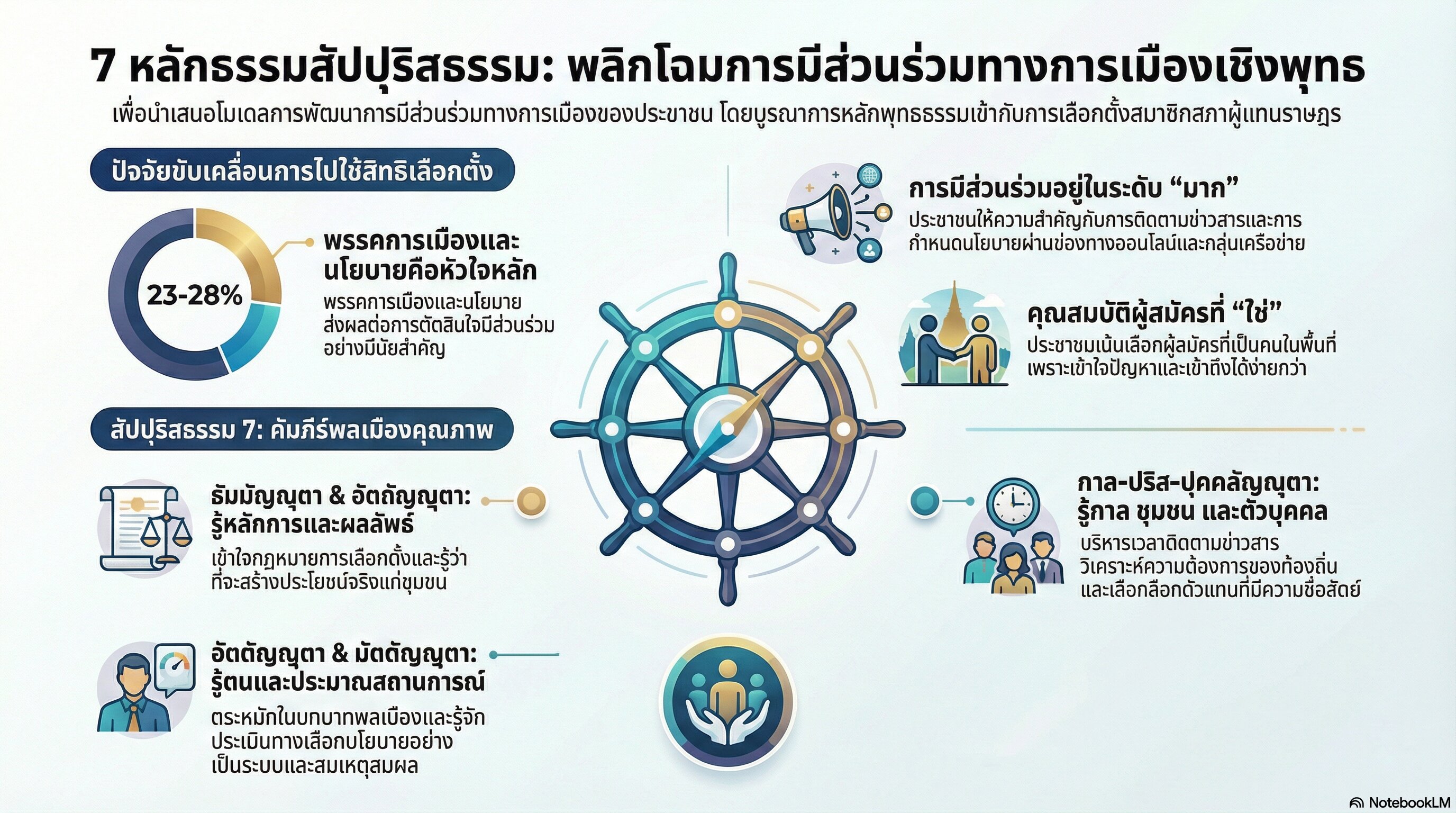
This research employed a mixed methods approach with three objectives: 1) to study political participation in the election of members of the House of Representatives in Khon Kaen Province; 2) to examine the factors influencing such participation; and 3) to propose the development of integrated Buddhist political participation for exercising the right to vote. In the first phase, in-depth interviews were conducted with 18 key informants, including monks, academics, politicians, local leaders, civil servants, and representatives from relevant agencies. In the second phase, questionnaires were distributed to a sample of 400 residents in Mueang District, Khon Kaen Province. In the third phase, focus group discussions were conducted with 9 participants from the same target groups. The research results revealed that public opinion regarding political participation in the election was at a high level overall. Factors significantly influencing political participation (at the 0.05 level) included political parties, party policies, puggalaññutā (knowing individuals), atthaññutā (knowing results), candidate qualifications, dhammaññutā (knowing principles and reasons), and election campaigning. The proposed model for integrated Buddhist political participation emphasized the application of the sappurisa-dhamma (virtues of a true person), consisting of: 1) dhammaññutā (knowing principles and reasons), 2) atthaññutā (knowing results and their causes), 3) attanññutā (knowing oneself and one’s role), 4) mattaññutā (knowing moderation and appropriate evaluation), 5) kālajñutā (knowing time management), 6) parisaññutā (knowing the community), and 7) puggalaññutā (knowing people). This framework enhances opportunities for people to participate in various monitoring and civic engagement activities.
References
คงฤทธิ์ กุลวงศ์. (2561). การมีส่วนร่วมทางการเมืองของประชาชนในเขตองค์การบริหารส่วนตำบลหนองบ่อ อำเภอนาแก จังหวัดนครพนม. วารสารวิชาการบัณฑิตวิทยาลัยสวนดุสิต, 14(3), 109–125.
ณรงค์ เส็งประชา. (2538). มนุษย์กับสังคม (พิมพ์ครั้งที่ 3). โอ.เอส.พริ้นติ้งเฮ้าส์.
ถนัด ไชยพันธ์. (2564). การประยุกต์ใช้หลักพุทธธรรมเพื่อการส่งเสริมประสิทธิผลในการบริหารงานขององค์กรปกครองส่วนท้องถิ่น จังหวัดอุบลราชธานี (ดุษฎีนิพนธ์ปรัชญาดุษฎีบัณฑิต สาขาวิชารัฐประศาสนศาสตร์). มหาวิทยาลัยมหาจุฬาลงกรณราชวิทยาลัย.
นิติพันธ์ อินทโชติ. (2564). การมีส่วนร่วมทางการเมืองของประชาชนในการเป็นสมาชิกพรรคการเมืองไทยในจังหวัดชัยภูมิ (ดุษฎีนิพนธ์ปรัชญาดุษฎีบัณฑิต สาขาวิชารัฐศาสตร์). มหาวิทยาลัยมหาจุฬาลงกรณราชวิทยาลัย.
สำนักงานเลขาธิการสภาผู้แทนราษฎร. (2555). รัฐธรรมนูญแห่งราชอาณาจักรไทย พุทธศักราช 2550. สำนักงานเลขาธิการสภาผู้แทนราษฎร.
เจตน์ ตันติวณิชชานนท์. (2557). บทบาทของพระพุทธศาสนาในการพัฒนาชาติ: มุมมองของอาจารย์ป๋วย อึ๊งภากรณ์. วารสารสันติศึกษาปริทรรศน์ มจร, 4(2), 343–358.
สุทน ทองเล็ก. (2562). การมีส่วนร่วมทางการเมืองของประชาชนจังหวัดสระแก้วในการเลือกตั้งทั่วไป (ดุษฎีนิพนธ์ปรัชญาดุษฎีบัณฑิต สาขาวิชารัฐศาสตร์). มหาวิทยาลัยมหาจุฬาลงกรณราชวิทยาลัย.
พระครูอุเทศธรรมสาทิส (อดิศักดิ์ อชิโต). (2564). การบูรณาการหลักพุทธธรรมเพื่อการเสริมสร้างภาวะผู้นำในการปกครองคณะสงฆ์จังหวัดอุทัยธานี (ดุษฎีนิพนธ์พุทธศาสตรดุษฎีบัณฑิต สาขาการจัดการเชิงพุทธ). มหาวิทยาลัยมหาจุฬาลงกรณราชวิทยาลัย.
สุวรรณ์ แก้วนะ. (2564). การพัฒนาคุณลักษณะผู้นำตามหลักสัปปุริสธรรมของผู้บริหารเทศบาลในจังหวัดสมุทรปราการ (ดุษฎีนิพนธ์ปรัชญาดุษฎีบัณฑิต สาขาวิชารัฐประศาสนศาสตร์). มหาวิทยาลัยมหาจุฬาลงกรณราชวิทยาลัย.
Downloads
Published
How to Cite
Issue
Section
Categories
License
Copyright (c) 2026 Journal of Buddhist Education and Research (JBER)

This work is licensed under a Creative Commons Attribution-NonCommercial-NoDerivatives 4.0 International License.