Guidelines for Educational Administration to Promote Ethical Use of Artificial Intelligence in Schools Under the Phetchabun Secondary Educational Service Area Office
Keywords:
Educational administration, Artificial Intelligence EthicsAbstract
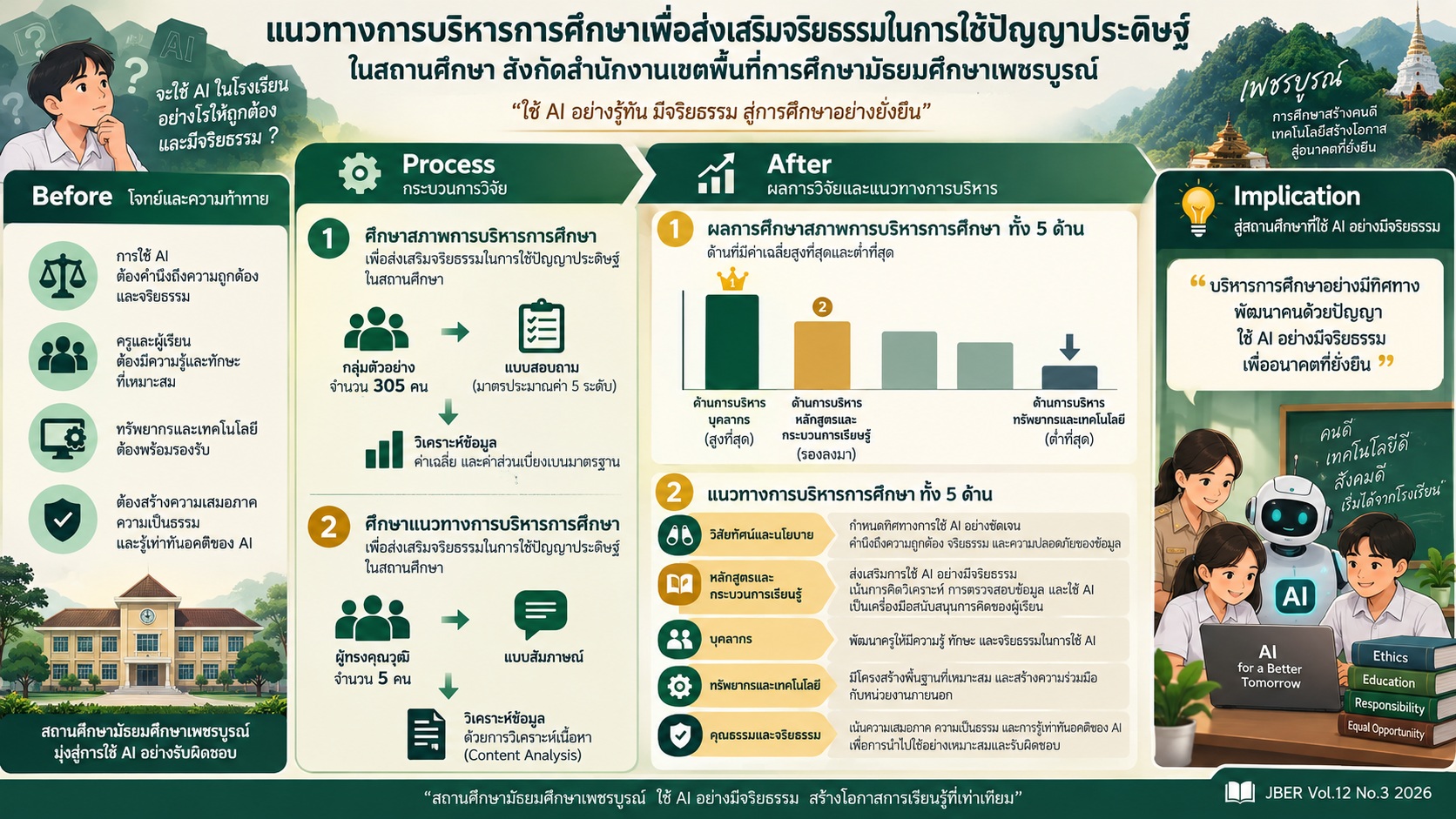
This research aimed to study the current state of educational administration for promoting ethics in the use of artificial intelligence in schools under the Phetchabun Secondary Educational Service Area Office, and to study guidelines for educational administration to promote ethics in the use of artificial intelligence in such schools. The research methodology was divided into 2 stage. The first stage studying of educational administration in promoting ethics in the use of artificial intelligence in schools under the Phetchabun Secondary Educational Service Area Office. The research instrument was a questionnaire on educational administration for promoting ethics in the use of artificial intelligence, using a five-level rating scale. The sample consisted of 305 respondents. The data were analyzed using mean and standard deviation. The second stage studying guidelines for educational administration to promote ethics in the use of artificial intelligence in schools under the Phetchabun Secondary Educational Service Area Office. The data were collected through interviews with five experts, using an interview form on educational administration guidelines for promoting ethics in the use of artificial intelligence. The data were analyzed and synthesized using content analysis. The research findings revealed that:
- The study of educational administration for promoting ethics in the use of artificial intelligence in schools under the Phetchabun Secondary Educational Service Area Office, across five aspects, revealed that personnel administration had the highest mean score, followed by curriculum and learning process administration, while resource and technology administration had the lowest mean score.
- The results of the study on guidelines for educational administration to promote ethics in the use of artificial intelligence in schools under the Phetchabun Secondary Educational Service Area Office, across five aspects, found that: Regarding vision and policy, schools must clearly define the direction of AI use, considering data accuracy, ethics, and data security. In terms of curriculum and learning process management, it should promote ethical use of AI, emphasizing critical thinking, data verification, and using AI as a tool to support student thinking. Regarding personnel management, it should prioritize the development of teachers' knowledge, skills, and ethics in using AI. In terms of resource and technology management, schools must provide appropriate infrastructure and establish collaboration with external organizations. Finally, in terms of ethics and morality management, it should emphasize equality, fairness, and awareness of AI biases to ensure appropriate and responsible use.
References
กระทรวงการอุดมศึกษา วิทยาศาสตร์ วิจัยและนวัตกรรม, และกระทรวงดิจิทัลเพื่อเศรษฐกิจและ
สังคม. (2565, 26 กรกฎาคม). แผนปฏิบัติการด้านปัญญาประดิษฐ์แห่งชาติ เพื่อการพัฒนา
ประเทศไทย (พ.ศ. 2565–2570). https://www.ai.in.th/wp-content/uploads/2022/12/20220726-AI.pdf
กระทรวงศึกษาธิการ. (2563). แผนยุทธศาสตร์กระทรวงศึกษาธิการ พ.ศ. 2563–2565.
แหล่งที่มา: https://www.moe.go.th/wp-content/uploads/2020/11/plan63-65.pdf
กฤติยา รัตแพทย์. (2561). AI:ArtificialIntelligenceหรือปัญญาประดิษฐ์.จาก http://www.dstd.mi.th/board/index.php?topic=3400.0.
คณะกรรมการอิสระเพื่อการปฏิรูปการศึกษา. (2562, พฤษภาคม). แผนการปฏิรูปประเทศด้านการศึกษา.
แหล่งที่มา: https://www.mpeo.go.th/ms/sites/default/files/2022-07/7-แผนการปฏิรูปประเทศด้านการศึกษา.
จิติมา วรรณศรี. (2564). การบริหารจัดการศึกษายุคดิจิทัล. พิษณุโลก: รัตนสุวรรณการพิมพ์.
ทัตพงศ์ พานทองคำ และทิพรัตน์ สิทธิวงศ์. (2568). แนวทางการบริหารทรัพยากรทางการศึกษา
เพื่อส่งเสริมระบบนิเวศการเรียนรู้ยุคปัญญาประดิษฐ์ของสถานศึกษา สังกัดสำนักงานเขตพื้นที่การศึกษามัธยมศึกษาเลย หนองบัวลำภู. วารสารสังคมศาสตร์ปัญญาพัฒน์, 7(2), 135-148.
ธนารักษ์ ธีระมั่นคง. (2563). AI ทางรอดอุตสาหกรรมไทยในยุค Covid-19 [สไลด์การนำเสนอ]. การ
เสวนา Morning Talk ครั้งที่ 4 “AI ทางรอดอุตสาหกรรมไทย ภายใต้วิกฤต COVID-19” ภายใต้โครงการ Intelligence Unit ปี 2563, 11 พฤศจิกายน 2563, โรงแรมใบหยกบูติก, กรุงเทพมหานคร, ประเทศไทย.
ธีรศักดิ์ อุปไมยอธิชัย และสุขาติ บางวิเศษ. (2563). การบริหารและการจัดการศึกษาสู่การพัฒนาที่
ยั่งยืน.พิษณุโลก: สำนักพิมพ์มหาวิทยาลัยนเรศวร.
นันทยา รื่นกลิ่น. (2568). จริยธรรมในการใช้ปัญญาประดิษฐ์อย่างรับผิดชอบในการตัดสินใจด้าน
ทรัพยากรมนุษย์. วารสารวิชาการ รัฐศาสตร์และรัฐประศาสนศาสตร์, 7(2).
บุญชม ศรีสะอาด. (2560). การวิจัยเบื้องต้น (พิมพ์ครั้งที่ 10). สุวีริยาสาส์น.
บุษกร วิเศษสมบัติ และคณะ. (2567). ปัญญาประดิษฐ์ (AI) : กับรูปแบบการนิเทศสมัยใหม่. วารสาร
การศึกษาและวิจัยพระพุทธศาสนา, 10(4).
เผด็จ จงสกุลศิริ (2568) ได้ทำวิจัยเรื่อง จริยธรรมในการใช้เทคโนโลยีดิจิทัล: ความท้าทายและ
แนวทางในการสร้างสังคมดิจิทัลที่ยั่งยืน. วารสารพุทธพัฒนศาสตร์ศึกษา (Online), 3(1).
พงษ์ศักดิ์ ผกามาศ และคณะ (2568). กลยุทธ์การใช้ปัญญาประดิษฐ์(AI) เพื่อการบริหารสถาบัน
การอาชีวศึกษาสู่ความเป็นเลิศตามกรอบมาตรฐานคุณวุฒิอาชีวศึกษาของประเทศไทย.
วารสารนวัตกรรมการเรียนรู้และเทคโนโลยี, 5(2).
พนิตา ชอบทำกิจ และคณะ. (2567). จริยธรรมปัญญาประดิษฐ์ในการศึกษาปฐมวัย. วารสารวิชาการ
มหาวิทยาลัยการจัดการและเทคโนโลยีอีสเทิร์น, 21(2).
ราชกิจจานุเบกษา. (2561, 13 ตุลาคม). ประกาศ เรื่อง ยุทธศาสตร์ชาติ (พ.ศ. 2561–2580). ราชกิจ
จานุเบกษา, เล่ม 135 ตอนพิเศษ 82 ก.แหล่งที่มา: https://www.ratchakitcha.soc.go.th/DATA/PDF/2561/A/082/T_0001.PDF
ศรัณย์ศิริ คัมภิรานนท์. (2562). AI เทคโนโลยีอนาคตของประเทศไทย (Artificial Intelligence in
Thailand). สำนักวิชาการ สำนักงานเลขาธิการวุฒิสภา, https://www.senate.go.th/view/1/article_detail
สิริน ฉกามานนท์. (2568). แนวทางการยกระดับความฉลาดรู้ทางปัญญาประดิษฐ์ของครูไทยในยุคดิจิทัล.
Journal of Education and Innovation, 27(1), 184-199.
สิริภา สงคราม. (2568). การบริหารสถานศึกษาเพื่อส่งเสริมการใช้ปัญญาประดิษฐ์ (AI) ในการจัดการ
เรียนรู้เชิงรุก. วารสารสมาคมพัฒนาวิชาชีพการบริหารการศึกษาแห่งประเทศไทย (สพบท.),
(2).
สุกัญญา แช่มช้อย. (2561). การบริหารสถานศึกษาในยุคดิจิทัล. กรุงเทพฯ: สำนักพิมพ์แห่ง
จุฬาลงกรณ์มหาวิทยาลัย.
สุพัตรา ปากดี. (2566). แนวทางการประยุกต์ใช้ปัญญาประดิษฐ์ (AI) ในการจัดการศึกษา สังกัด
สำนักงานเขตพื้นที่การศึกษามัธยมศึกษากรุงเทพมหานคร เขต 2. (ปริญญานิพนธ์การศึกษา
มหาบัณฑิต).มหาวิทยาลัยศรีนครินทรวิโรฒ.
สุรสิทธิ์ งามจิตร. (2568). การบริหารสถานศึกษาในยุคดิจิทัล. รายงานการประชุม Graduate
School Conference (Vol. 8, No. 1, p. 682).
เสนาะ ติเยาว์. (2546). หลักการบริหาร.พิมพ์ครั้งที่ 3:กรุงเทพฯ : มหาวิทยาลัยธรรมศาสตร์.
สำนักงานเขตพื้นที่การศึกษามัธยมศึกษาเพชรบูรณ์. (2567). แผนพัฒนาคุณภาพการศึกษา
พ.ศ. 2566 – 2567 ฉบับทบทวนปีงบประมาณ พ.ศ. 2569. https://online.anyflip.com/vkbeh/qmae/mobile/index.html
สำนักงานคณะกรรมการการศึกษาขั้นพื้นฐาน. (2567, 21 พฤศจิกายน). ประกาศสำนักงานคณะกรรมการ
การศึกษาขั้นพื้นฐาน เรื่อง นโยบายและจุดเน้นของสำนักงานคณะกรรมการการศึกษาขั้นพื้นฐาน ประจำปีงบประมาณ พ.ศ. 2568–2569.แหล่งที่มา: https://personnel.obec.go.th/wp-content/uploads/2024/12
สำนักงานพัฒนารัฐบาลดิจิทัล (องค์การมหาชน) สพร. (2563). AI Ethics Guideline (พิมพ์ครั้งที่ 1).
สำนักงานพัฒนาวิทยาศาสตร์และเทคโนโลยีแห่งชาติ. (2565). แนวปฏิบัติจริยธรรมด้าน
ปัญญาประดิษฐ์. หนังสือประกาศ ลงวันที่ 31 มีนาคม 2565.
สำนักวิชาการและมาตรฐานการศึกษา. (2568). คู่มือการใช้ AI สำหรับครู นักเรียน โรงเรียน และ
ผู้ปกครองในประเทศไทย พ.ศ. 2568. พิมพ์ครั้งที่ 1:กรุงเทพฯ: สำนักวิชาการและมาตรฐาน
การศึกษา.
Adams, C., Pente, P., Lemermeyer, G., Turville, J., & Rockwell, G. (2022). Artificial
intelligence and teachers’ new ethical obligations. International Review of
Information Ethics, 31, 1-18. https://informationethics.ca/index.php/irie/article/view/483
Afshan Bibi et al. (2024). Navigating the ethical landscape: AI integration in education.
Educational Administration: Theory and Practice, 30(6). https://doi.org/10.53555/kuey.v30i6.5546.
Darling-Hammond, L. (2006). Constructing 21st-century teacher education. Journal of
Teacher Education, 57(3). https://doi.org/10.1177/0022487105285962
Dignum, V. (2018). Ethics in artificial intelligence: Introduction to the special issue.
Ethics and Information Technology, 20. https://doi.org/10.1007/s10676-018-9450-z
Emre Kazim & Koshiyama (2021). A high-level overview of AI ethics. Patterns, 2(9).
https://doi.org/10.1016/j.patter.2021.100314
Floridi, L. et al. (2018) . AI4People—An ethical framework for a good AI society:
Opportunities, risks, principles, and recommendations. Minds and Machines,
(4). https://doi.org/10.1007/s11023-018-9482-5
Griffin, R. W. (1997). Management (8th ed.). Texas A&M University.
Hfocus. (2568, 11 มกราคม). เด็กไทยป่วยซึมเศร้าสูง 2.2 พันคนต่อประชากรแสนคน มิหนำซ้ำเข้าไม่ถึง
บริการสุขภาพจิต. https://www.hfocus.org/content/2025/01/32784
Krejcie, R. V., & Morgan, D. W. (1970). Determining sample size for research activities.
Educational and Psychological Measurement, 30(3), 607–610.
https://doi.org/10.1177/001316447003000308
Ma’amor, H., et al. (2024). The effect of artificial intelligence (AI) on students'
learning. Information Management and Business Review, 16(3S[a]).
McCarthy, J. (2007). What is artificial intelligence? Stanford University.
https://www-formal.stanford.edu/jmc/whatisai/whatisai.html.
Nguyen, A., Ngo, H. N., Hong, Y., Dang, B., & Nguyen, B.-P. T. (2022). Ethical principles
For artificial intelligence in education. Education and Information
Technologies, 28. https://doi.org/10.1007/s10639-022-11316-w
OECD. (2021). Education at a glance 2018: OECD indicators. OECD Publishing.
https://doi.org/10.1787/eag-2018-en
SCBX. (2568, 15 สิงหาคม). Future Trends [บทความเกี่ยวกับความเสี่ยงการทุจริตของผู้เรียนจาก
การใช้ AI และแนวทางยืนยันตัวตน/ตรวจจับการลอกเลียนแบบ]. SCBX. https://www.scbx.com.
Slimi, Z., & Villarejo Carballido, B. (2023). Navigating the ethical challenges of artificial
intelligence in higher education: An analysis of seven global AI ethics policies. TEM Journal, 12(2). https://doi.org/10.18421/TEM122-02.
Smith, E., Ali, D., Wilkerson, B., Dawson, W. D., Sobowale, K., Reynolds, C. F., III, Berk, M.,
Lavretsky, H.,Jeste, D., Ng, C. H., Soares, J. C., Aragam, G., Wainer, Z., Manji, H. K.,
Licinio, J., Lo, A. W., Storch, E., Fu, E., Leboyer, M., ... Eyre, H. A. (2021). A brain
capital grand strategy: Toward economic reimagination. Molecular Psychiatry,
, 3–22. https://doi.org/10.1038/s41380-020-00918-w
Timnit Gebru. (2021). Ethical challenges of AI: Bias, transparency, and human-centered
approaches. Journal of Artificial Intelligence Ethics, 2(3).
UNESCO. (2021). Recommendation on the ethics of artificial intelligence. United
Nations Educational, Scientific and Cultural Organization. https://unesdoc.unesco.org/ ark:/48223/pf0000381137
UNESCO. (2021). AI and education: Guidance for policy-makers. United Nations
Educational, Scientific and Cultural Organization. https://doi.org/10.54675/PCSP735
Wattanapanit, N. et al (2024). An EducationalAdministration Innovation in the Digital
Age and Sustainable Development. Advances in Business Strategy and
Competitive Advantage Book Series. https://doi.org/10.4018/979-8-3693-6720-9.ch008.
Downloads
Published
How to Cite
Issue
Section
Categories
License
Copyright (c) 2026 Journal of Buddhist Education and Research (JBER)

This work is licensed under a Creative Commons Attribution-NonCommercial-NoDerivatives 4.0 International License.