Guidelines for the Application of Artificial Intelligence Technology to Enhance the Efficiency of Human Resource Management in Schools under the Din Daeng District Office, Bangkok Metropolitan Administration
Keywords:
Artificial Intelligence Technology, Personnel Administration, Priority Needs, Bangkok Metropolitan Administration SchoolsAbstract
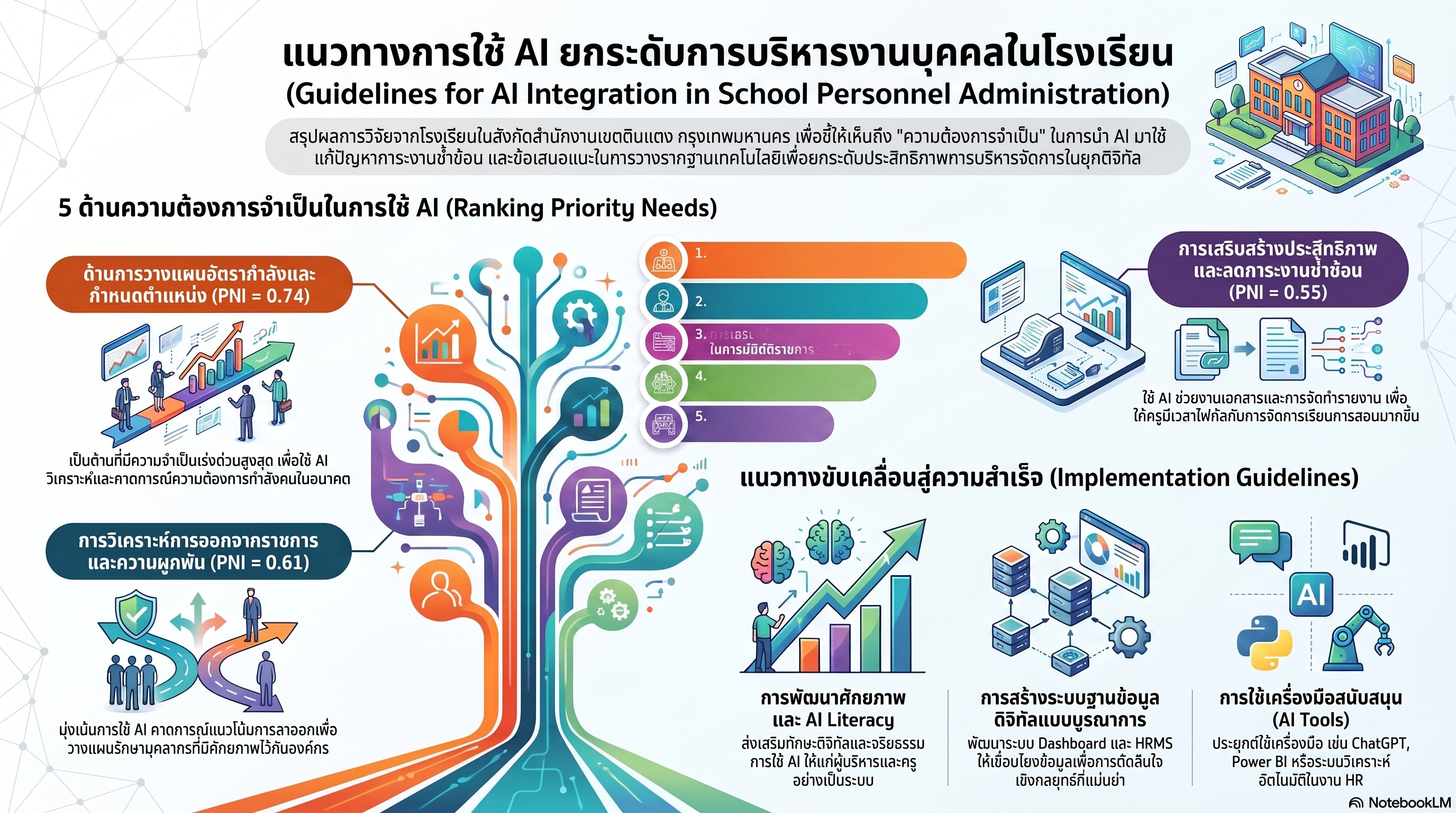
This study aimed to 1) examine the current states, desirable states, and priority needs, and 2) explore guidelines for implementing Artificial Intelligence (AI) technology to enhance personnel administration efficiency in schools under the Din Daeng District Office, Bangkok Metropolitan Administration. The research was conducted in two phases. Phase 1 involved quantitative research, utilizing questionnaires with a sample of 181 personnel from three schools. Data were analyzed using the Modified Priority Needs Index (PNI_modified) to rank the priority needs. Phase 2 involved qualitative research, conducted through in-depth interviews with seven experts, including three personnel administration experts and four educational AI technology experts. Data were analyzed using content analysis. The results indicated that: 1) The priority needs for using AI technology to enhance personnel administration efficiency were at a high level. The PNI _modified values, ranked from highest to lowest, were workforce planning and position classification (PNI _modified=0.74 ), retirement and termination (PNI _modified= 0.61), performance efficiency enhancement (PNI _modified=0.55 ), recruitment and appointment (PNI _modified = 0.49), and discipline and maintenance of discipline (PNI_modified = 0.36). 2) Guidelines for AI technology integration revealed that implementation is highly feasible under the conditions of systematic planning and adequate support in terms of policy, resources, technology, and capacity building for personnel at both the institutional and organizational levels, leading to a sustainable upgrade of personnel administration in the digital era.
References
กระทรวงศึกษาธิการ. (2553). แนวทางการดำเนินงานโรงเรียนมาตรฐานสากล. ชุมนุมสหกรณ์การเกษตรแห่งประเทศไทย.
กุลยา ตันติผลาชีวะ. (2558). การประเมินความต้องการจำเป็นทางการศึกษา. สำนักพิมพ์มหาวิทยาลัยศรีนครินทรวิโรฒ.
จริญญา เฟื่องน้อย. (2567). การศึกษาการนำนวัตกรรมปัญญาประดิษฐ์เพื่อการสรรหาทรัพยากรในองค์กรธุรกิจสตาร์ทอัพเกี่ยวกับเทคโนโลยีแห่งหนึ่ง [สารนิพนธ์ปริญญามหาบัณฑิต, มหาวิทยาลัยมหิดล].
จิรนันท์ แสงเรือง, วัชรพงศ์ อยู่ขวัญ, & ค. มาลัยวงศ์. (2564). บทบาทของประเทศไทยในการพัฒนาปัญญาประดิษฐ์. วารสารปรัชญาปริทรรศน์, 26(1), 137–145. https://so05.tci-thaijo.org/index.php/phiv/article/view/252691
ชญานุช จาตุรจินดา. (2565). AI กับการบริหารงานบุคคล. วารสารสังคมศาสตร์ จุฬาลงกรณ์มหาวิทยาลัย, 51(1), 31–50. https://doi.org/10.61462/cujss.v51i1.691
ฐิติมา ระสอน. (2564). การประเมินความต้องการจำเป็นในการพัฒนาการบริหารงานบุคคลของโรงเรียน สังกัดสำนักงานเขตพื้นที่การศึกษาประถมศึกษาศรีสะเกษ เขต 2 [วิทยานิพนธ์ปริญญามหาบัณฑิต, มหาวิทยาลัยราชภัฏศรีสะเกษ]. https://tdc.thailis.or.th/
ทัตพงศ์ พานทองคำ, & ทิพรัตน์ สิทธิวงศ์. (2568). แนวทางการบริหารทรัพยากรทางการศึกษาเพื่อส่งเสริมระบบนิเวศการเรียนรู้ยุคปัญญาประดิษฐ์ของสถานศึกษา สังกัดสำนักงานเขตพื้นที่การศึกษามัธยมศึกษาเลย หนองบัวลำภู. วารสารสังคมศาสตร์ปัญญาพัฒน์, 7(2), 135–148. https://so06.tci-thaijo.org/index.php/JSSP/article/view/283437
บริษัท ปตท. จำกัด (มหาชน). (2566). HRbot ระบบ AI เพื่อการบริหารงานสวัสดิการ.
ราชบัณฑิตยสถาน. (2562). พจนานุกรมศัพท์ศึกษาศาสตร์ ฉบับราชบัณฑิตยสถาน. ราชบัณฑิตยสถาน.
วราพินทร์ ชาววิวัฒน์. (2565). แนวทางการส่งเสริมทักษะดิจิทัลของครู สังกัดสำนักงานเขตพื้นที่การศึกษาประถมศึกษาพิษณุโลก เขต 2 [สารนิพนธ์ปริญญามหาบัณฑิต, มหาวิทยาลัยนเรศวร].
วรลักษณ์ หิมะกลัส. (2566). รายงานทบทวนวรรณกรรม: การใช้ AI ในการศึกษาไทย. สถาบันส่งเสริมการสอนวิทยาศาสตร์และเทคโนโลยี.
สรณ์สิริ กิจติยะพงศ์. (2565). การบริหารงานบุคคลในสถานศึกษา. บัณฑิตศึกษาปริทรรศน์ วิทยาลัยสงฆ์นครสวรรค์, 10(1), 149–156.
สำนักงานเขตดินแดง. (2568, 1 มีนาคม). โครงสร้างหน่วยงาน. https://webportal.bangkok.go.th/dindaeng/
สำนักงานพัฒนารัฐบาลดิจิทัล. (2563). AI government framework. https://www.dga.or.th/document-sharing/dga-e-book/annual-ai/47112/
สุดารัตน์ ชุ่มใจ, & กษิฎิฏฏ์ มีพรหม. (2568). แนวทางการบริหารงานบุคคลโดยการใช้เทคโนโลยีดิจิทัลของโรงเรียน สังกัดสำนักงานเขตพื้นที่การศึกษาประถมศึกษาเชียงราย เขต 4. Journal of Educational Innovation and Research. https://doi.org/10.14456/jeir.2025.12
สุภัทรศักดิ์ คำสามารถ. (2568). การใช้ปัญญาประดิษฐ์ (AI) ในการบริหารการศึกษาสำหรับการปรับปรุงการเรียนรู้เฉพาะบุคคล. Journal of Educational Innovation and Research. https://doi.org/10.14456/jeir.2025.40
สุวิมล ว่องวานิช. (2558). การวิจัยประเมินความต้องการจำเป็น. สำนักพิมพ์จุฬาลงกรณ์มหาวิทยาลัย.
สุวิมล ว่องวานิช. (2562). การประเมินความต้องการจำเป็น: แนวคิด วิธีการ และการประยุกต์ใช้. สำนักพิมพ์จุฬาลงกรณ์มหาวิทยาลัย.
อนิวัตธิ์ กาญจน์วราธร, & มัทนา วังถนอมศักดิ์. (2567). ระบบสารสนเทศทรัพยากรมนุษย์สำหรับสำนักงานเขตพื้นที่การศึกษาประถมศึกษา. วารสาร มจร พุทธปัญญาปริทรรศน์, 9(6), 155–162. https://so03.tci-thaijo.org/index.php/jmbr/article/view/278349/187404
Akgun, S., & Greenhow, C. (2022). Artificial intelligence in education: Addressing ethical challenges in K–12 settings. AI and Ethics, 2(3), 431–440. https://doi.org/10.1007/s43681-021-00096-7
Ali, O., & Kallach, L. (2024). Artificial intelligence enabled human resources recruitment functionalities: A scoping review. Procedia Computer Science, 232, 3268–3277. https://doi.org/10.1016/j.procs.2024.02.142
Armstrong, M. (2014). Armstrong's handbook of human resource management practice (13th ed.). Kogan Page.
BambooHR. (2024). AI-powered employee discipline and performance monitoring system. https://www.bamboohr.com
Culture Amp. (2024). AI and machine learning for employee engagement analytics. https://www.cultureamp.com
Dessler, G. (2020). Human resource management (16th ed.). Pearson.
Dynamic Intelligence Asia. (2020). Artificial intelligence for everyday life. Dynamic Intelligence Asia.
Eightfold. (2022). AI-powered talent intelligence platform. https://eightfold.ai
Gao, Y., Liu, S., & Yang, L. (2025). Artificial intelligence and innovation capability: A dynamic capabilities perspective. International Review of Economics & Finance, 98, 103923. https://doi.org/10.1016/j.iref.2025.103923
Ge, S., & Hu, Y. (2020). Artificial intelligence for education: A multidisciplinary perspective. Higher Education Press.
Glint. (2024). Employee engagement and retention analytics powered by AI. https://www.glintinc.com
HOLEO. (2024). AI-powered employee development and training platform. https://www.holeo.com
HireVue. (2025). AI-driven video interviewing and assessment platform. https://www.hirevue.com
JETRO. (2023). Human resource management software in Japan: The case of Jinjer. Japan External Trade Organization.
Kamalov, F., et al. (2023). Applications of artificial intelligence in education: Personalized learning and beyond. Journal of Educational Technology & Society, 26(3), 45–60.
Kaufman, R., Rojas, A., & Mayer, R. (1993). Needs assessment. Educational Technology Publications.
Khosravi, H., Sadiq, S., & Amer-Yahia, S. (2023). Data management of AI-powered education technologies: Challenges and opportunities. Learning Letters, 1, Article 2. https://doi.org/10.59453/XLUD7002
Leite, R. (2024). Benefits and drawbacks of artificial intelligence in human resource management: Between utopian and dystopian visions. In Artificial intelligence in production engineering and management (pp. 65–81). https://doi.org/10.1016/B978-0-12-819471-3.00008-2
LinkedIn. (2024). AI-powered talent solutions: Matching candidates with jobs and career insights. https://www.linkedin.com
Madanchian, M. (2025). A conceptual framework for integrating artificial intelligence in human resource management and workforce adaptation. International Journal of Human Resource Studies, 15(1), 22–40.
McCarthy, J. (1956). Artificial intelligence. In Proceedings of the Dartmouth Summer Research Project on Artificial Intelligence. Dartmouth College.
McCastin, S., & Tibezinda, E. (2020). Needs assessment for organizational planning: Prioritizing information for development. Journal of Organizational Development, 12(1), 33–48.
Microsoft. (2024). Introducing Microsoft Viva: AI-powered employee experience platform. https://www.microsoft.com
Mitra, M. D. (2023). Artificial intelligence in MOOCs: Enhancing personalized learning on Coursera. Journal of Online Learning and Teaching, 19(2), 55–70.
MPY. (2024). AI-driven training and professional development system. https://www.mpy.com
Mrazek, J. (2022). Digital technology in organizational management. Springer.
Nawaz, N., Arunachalam, H., Pathi, B. K., & Gajenderan, V. (2024). The adoption of artificial intelligence in human resources management practices. International Journal of Information Management Data Insights, 4(1). https://doi.org/10.1016/j.jjimei.2023.100208
OECD. (2020). OECD learning compass 2030: A series of concept notes. OECD Publishing. https://www.oecd.org/education/2030-project
Office of the Civil Service Commission. (2022). คู่มือระบบ Human Resource Optimization System (HROS).
Peakon. (2024). AI-driven employee engagement and happiness surveys. https://www.peakon.com
People Plus. (2024). Human capital development and training analytics. https://www.peopleplus.com
Qualtrics. (2024). AI-powered employee engagement and exit surveys. https://www.qualtrics.com
Russell, S. J., & Norvig, P. (2021). Artificial intelligence: A modern approach (4th ed.). Pearson.
Tian, J., & Zhang, Y. (2025). Does artificial intelligence help in improving human capital based educational development? Evidence from 29 countries. Technology in Society, 83, 103004. https://doi.org/10.1016/j.techsoc.2025.103004
Tinguely, P. N., Lee, J., & He, V. F. (2023). Designing human resource management systems in the age of AI. Journal of Organization Design, 12(4), 263–269. https://doi.org/10.1007/s41469-023-00153-x
UNESCO. (2023). Guidance for generative AI in education and research. UNESCO. https://doi.org/10.54675/EWZM9535
Witkin, B. R. (1984). Assessing needs in educational and social programs. Jossey-Bass.
York, R. (1982). The political definition of social problems. Academic Press.
Zoho. (2024). Zoho People: AI-based employee management and disciplinary history. https://www.zoho.com/people
Downloads
Published
How to Cite
Issue
Section
License
Copyright (c) 2026 Author(s)

This work is licensed under a Creative Commons Attribution-NonCommercial-NoDerivatives 4.0 International License.