Model for Digital Leadership Development of School Administrators in Opportunity-Expansion Schools under the Office of the Basic Education Commission
Keywords:
priority needs; digital leadership; school administratorsAbstract
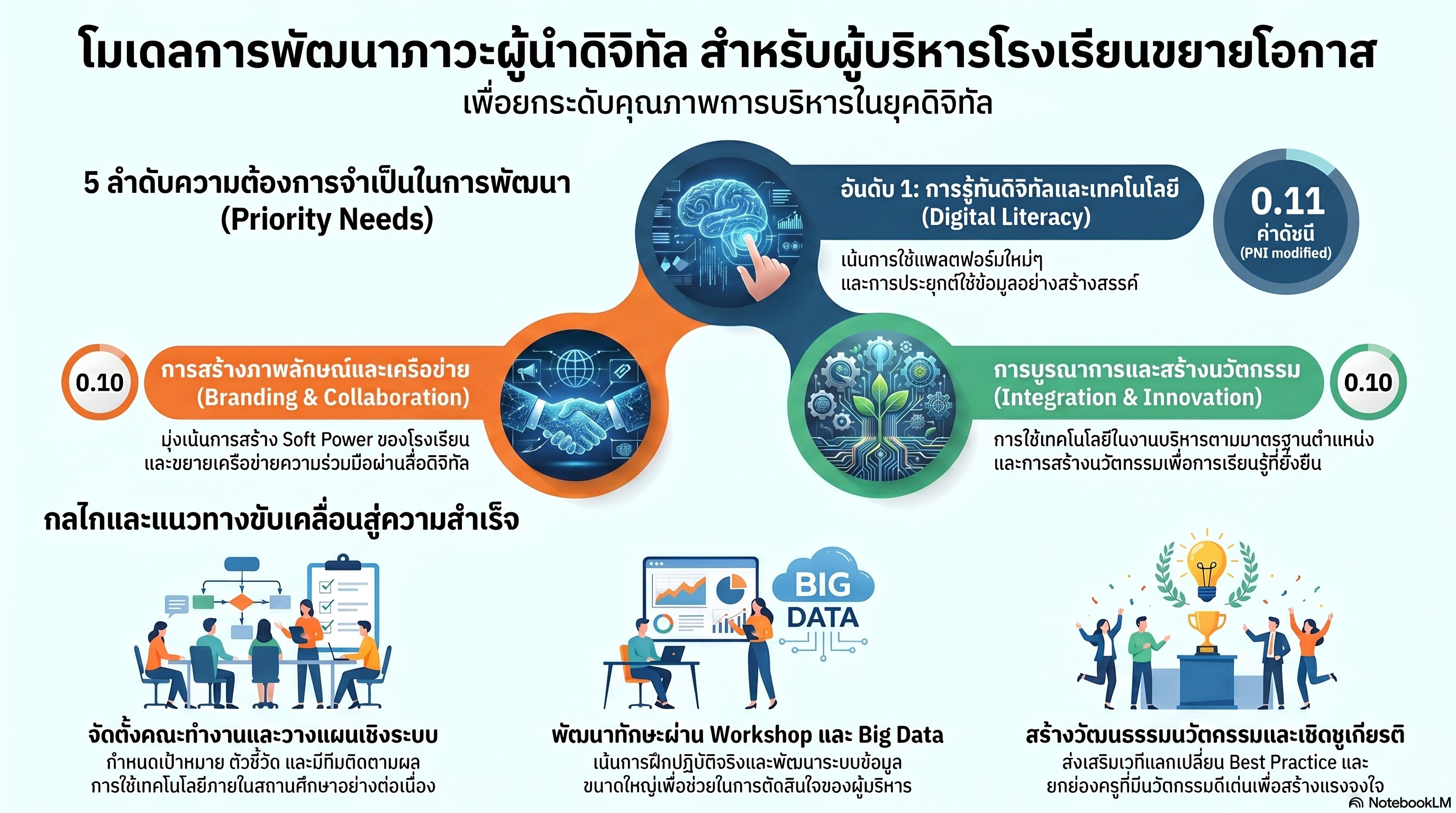
This research aimed to study the priority needs and propose a model for developing digital leadership among school administrators in educational opportunity expansion schools under the Office of the Basic Education Commission. A mixed-methods research design with a multi-stage approach was employed. Data collection included qualitative research through the analysis of documents, related research, concepts, and theories, as well as focus group discussions with experts. Quantitative research was conducted via a survey of 400 educational opportunity expansion schools across four regions. The research instrument was a 5-point Likert scale questionnaire. Data were analyzed using descriptive statistics and the Modified Priority Needs Index (PNI modified). The research findings revealed that the highest priority need for developing digital leadership among school administrators was Digital Literacy. This was followed by Branding and Network Collaboration, Integrating Digital Technology in Work Development, Innovation Building in Teaching and Working, and Digital Vision, respectively. The aspect with the lowest priority need was Digital Communication. These findings led to the development of a digital leadership development model that can serve as a practical guideline and a mechanism for driving success.
References
กัญญารัตน์ สุขแสน, และคณะ. (2564). รูปแบบการพัฒนาภาวะผู้นำด้านดิจิทัลของผู้บริหารโรงเรียนในเครือมูลนิธิคณะเซนต์คาเบรียลแห่งประเทศไทย. วารสารสังคมศาสตร์และมนุษยวิทยาเชิงพุทธ, 6(7). https://rsuir-library.rsu.ac.th/handle/123456789/607
เกียรติศักดิ์ ลำพองชาติ. (2563). ทักษะการทำงานในโลกยุคดิจิทัล. สำนักวิชาการ สำนักงานเลขาธิการวุฒิสภา, 10(4), 1–3.
สำนักงานคณะกรรมการการศึกษาขั้นพื้นฐาน. (2565). แผนพัฒนาการศึกษาขั้นพื้นฐาน (พ.ศ. 2566–2570). http://www.secondarytak.go.th
สุกัญญา แช่มช้อย. (2561). การบริหารสถานศึกษาในยุคดิจิทัล. สำนักพิมพ์จุฬาลงกรณ์มหาวิทยาลัย.
สุรศักดิ์ แก้วเกิด. (2563). ภาวะผู้นำดิจิทัลของผู้บริหารสถานศึกษา สังกัดสำนักงานเขตพื้นที่การศึกษามัธยมศึกษา. วารสารศึกษาศาสตร์, 14(2), 45–60.
สุวิมล ว่องวาณิช. (2559). การวิจัยเพื่อพัฒนาการเรียนรู้และการจัดการศึกษา. สำนักพิมพ์จุฬาลงกรณ์มหาวิทยาลัย.
สุวิมล ว่องวาณิช. (2562). การวิจัยและพัฒนาความต้องการจำเป็นทางการศึกษา. สำนักพิมพ์จุฬาลงกรณ์มหาวิทยาลัย.
เอกชัย กี่สุขพันธ์. (2561). การบริหารสถานศึกษายุคดิจิทัล. สำนักพิมพ์มหาวิทยาลัยศรีนครินทรวิโรฒ.
Deming, W. E. (1986). Out of the crisis. MIT Press.
Fullan, M. (2016). The new meaning of educational change (5th ed.). Teachers College Press.
Herzberg, F. (1968). One more time: How do you motivate employees? Harvard Business Review, 46(1), 53–62.
Ng, W. (2012). Can we teach digital natives digital literacy? Computers & Education, 59(3), 1065–1078. https://doi.org/10.1016/j.compedu.2012.04.016
Sheninger, E. (2019). Digital leadership: Changing paradigms for changing times (2nd ed.). Corwin Press.
Sheninger, E. (2022). Digital leadership: Changing paradigms for changing times. Corwin Press.
Yamane, T. (1973). Statistics: An introductory analysis (3rd ed.). Harper & Row.
Zhu, P. (2014). Digital leadership: Change management in the digital age. Kogan Page.
รายการที่อยู่ใน References แต่ไม่พบการอ้างอิงในเนื้อหา
Sheninger, E. (2022, November 9). 7 pillars of digital leadership in education. https://www.teachthought.com
Downloads
Published
How to Cite
Issue
Section
Categories
License
Copyright (c) 2026 Journal of Buddhist Education and Research (JBER)

This work is licensed under a Creative Commons Attribution-NonCommercial-NoDerivatives 4.0 International License.