Community-Based Learning Activities for Tracing the History of Trat City to Promote Local Awareness among Grade 4 Students
Keywords:
community-based learning, history of Trat City, local awarenessAbstract
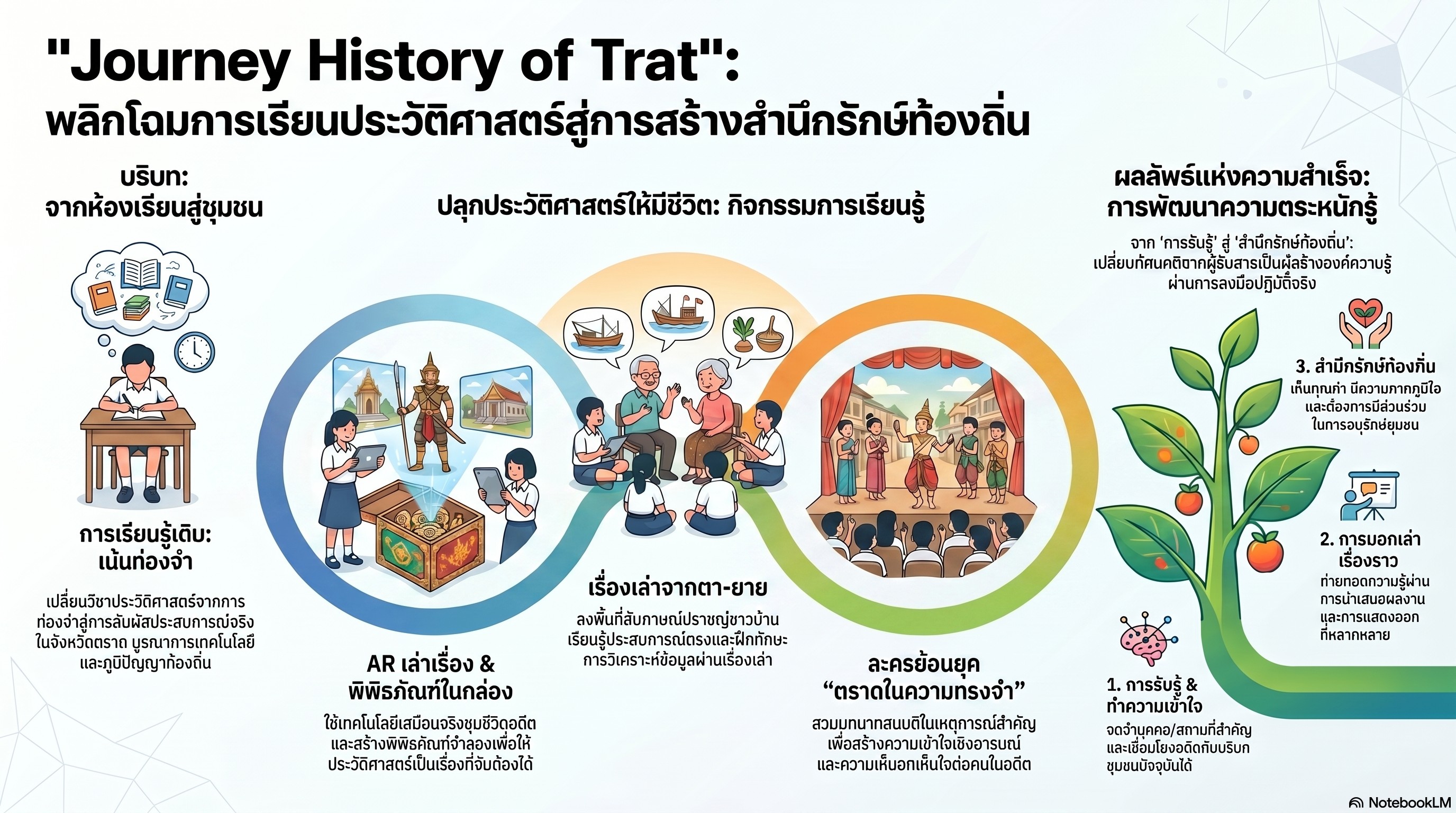
This qualitative research aimed to examine the current conditions of community-based learning in local history, specifically the history of Trat Province, among Grade 4 students in Nong Bon Subdistrict, Bo Rai District, Trat Province, and to develop community-based learning activities entitled “Journey History of Trat” to enhance students’ local awareness and authentic learning outcomes. The key informants consisted of five history teachers and ten students. The research instruments included in-depth interviews and focus group discussions. Data were analyzed using content analysis and descriptive synthesis. The findings revealed that current history instruction remains primarily classroom-based and follows the historical method as a framework for learning. Multimedia resources are commonly used, and authentic assessment practices are implemented. Teachers act as learning designers and facilitators. However, students tend to perceive history as a subject focused on memorization. The developed community-based learning activities, “Journey History of Trat,” integrate Augmented Reality (AR), multimedia, and community-based learning resources. The activities consist of four components: (1) AR storytelling of Trat history, (2) Box Museum, (3) local storytelling from community elders, and (4) historical drama entitled “Trat in the Memory of the Land.” The implementation of these activities enhanced students’ understanding of local history, fostered pride in local identity, and raised awareness of historical resources within the community. Moreover, the activities encouraged students to connect with local people, communicate knowledge to others, and develop a stronger sense of local awareness and stewardship. These findings indicate that integrating community-based learning with experiential learning and digital technology provides meaningful and sustainable learning experiences for students.
References
กรมศิลปากร. (2556). ปกิณกศิลปวัฒนธรรม เล่ม 19 จังหวัดตราด. สำนักวรรณกรรมและประวัติศาสตร์.
แสงสรรค์ ภูมิสถาน. (2558). การศึกษาศักยภาพแหล่งท่องเที่ยวเพื่อการพัฒนาการท่องเที่ยวเชิงสร้างสรรค์ จังหวัดตราด [รายงานวิจัย]. สำนักงานคณะกรรมการวิจัยแห่งชาติ.
วนิดา ศรีสุข. (2560). การพัฒนารูปแบบการสอนโดยใช้ชุมชนเป็นฐานเพื่อส่งเสริมทักษะกระบวนการทางวิทยาศาสตร์สำหรับนักเรียนชั้นมัธยมศึกษาปีที่ 2 โรงเรียนส้มป่อยพิทยาคม [วิทยานิพนธ์ปริญญามหาบัณฑิต]. มหาวิทยาลัยบูรพา.
ออมสิน จตุพร, & อมรรัตน์ วัฒนาธร. (2562). การพัฒนาหลักสูตรประวัติศาสตร์ท้องถิ่นตามแนวคิดการศึกษาอิงถิ่นฐานสำหรับนักเรียนระดับประถมศึกษา: กรณีชุมชนลุ่มแม่น้ำเจ้าพระยาตอนบน จังหวัดนครสวรรค์. วารสารศึกษาศาสตร์ มหาวิทยาลัยนเรศวร, 21(1), 1–18.
ปัณฑิตา ไชยโย. (2566). การจัดกิจกรรมการเรียนรู้ประวัติศาสตร์ท้องถิ่นโดยใช้ชุมชนเป็นฐานเพื่อส่งเสริมกระบวนการคิดอย่างมีวิจารณญาณของผู้เรียน. วารสารปัญญาภิวัฒน์, 15(2), 120–134.
พระมหาไพศาล ธิตสีโล. (2566). รูปแบบการจัดการเรียนรู้ประวัติศาสตร์ไทยที่บูรณาการบริบทวัฒนธรรมท้องถิ่นเพื่อส่งเสริมอัตลักษณ์ทางวัฒนธรรมของผู้เรียน. วารสารการจัดการศึกษาเชิงนวัตกรรม, 2(2), 66–79.
วิภาดา พินลา, & วิภาพรรณ พินลา. (2566). ห้องเรียนครูสังคมศึกษากับการจัดการเรียนรู้โดยใช้ชุมชนเป็นฐาน. วารสารศึกษาศาสตร์ มหาวิทยาลัยทักษิณ, 24(1), 1–12.
Colaizzi, P. F. (1978). In R. Valle & M. King (Eds.), Existential-phenomenological alternatives for psychology (pp. 48–71). Oxford University Press.
Dewey, J. (1938). Experience and education. Macmillan.
Kolb, D. A. (1984). Experiential learning: Experience as the source of learning and development. Prentice Hall.
Wineburg, S. (2001). Historical thinking and other unnatural acts: Charting the future of teaching the past. Temple University Press.
Downloads
Published
How to Cite
Issue
Section
Categories
License
Copyright (c) 2026 Journal of Buddhist Education and Research (JBER)

This work is licensed under a Creative Commons Attribution-NonCommercial-NoDerivatives 4.0 International License.