Curriculum Development in Business Administration Based on Stakeholder Needs
Keywords:
Curriculum development, Stakeholders, Business administrationAbstract
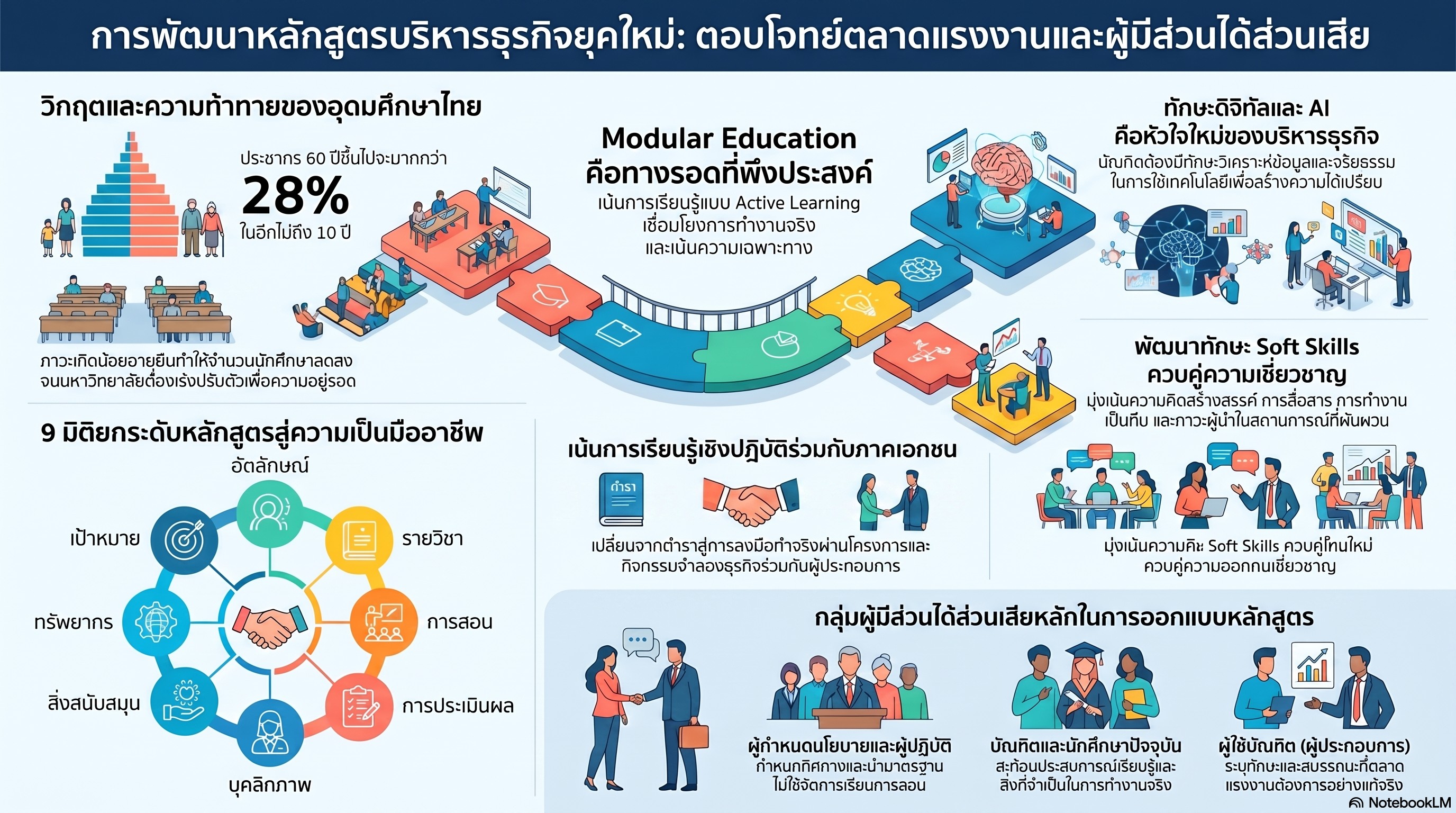
The study aimed to develop a Business Administration curriculum aligned with the requirements of key stakeholders within the field. Adopting a qualitative methodology grounded in a phenomenological approach, data were gathered through a comprehensive document review, structured individual interviews, and focus group discussions. The findings indicate that the development of a high-quality Business Administration curriculum necessitates a strategic focus on labor market demands. This is achieved through instructional design that facilitates professional readiness and promotes experiential learning integrated with diverse industrial sectors. Furthermore, the curriculum should emphasize the cultivation of multifaceted competencies and distinct graduate identities, particularly in creativity, communication, and project-based learning (PBL) techniques. The research also highlights the significance of a robust selection process and a comprehensive evaluation system encompassing both theoretical and practical domains. Such a framework is essential for fostering professional personality traits, ethics, and attitudes conducive to the profession. These elements must be reinforced by engaging co-curricular activities and modernized educational resources to enhance student motivation and optimize learning effectiveness.
References
ธีรนันท์ ตันพานิชย์, ศุภวรรณ วงศ์สร้างทรัพย์, และต่อศักดิ์ แก้วจรัสวิไล. (2567). การศึกษาความคาดหวังและความต้องการของผู้มีส่วนได้ส่วนเสียที่มีต่อหลักสูตรศึกษาศาสตรมหาบัณฑิต สาขาวิชาพลศึกษา. วารสารศาสตร์การศึกษาและการพัฒนามนุษย์, 8(1), 40-54.
นาวา มาสวนจิก, อัจฉรพร เฉลิมชิต, พรวดี รักษาศรี, กชนิภา วานิชกิตติกูล, สุนทรียา ไชยปัญหา, ศิรินทร เลียงจินดาถาวร, และสมใจ จอมหงษ์. (2568). ความต้องการของผู้มีส่วนได้ส่วนเสียต่อการพัฒนาหลักสูตรบริหารธุรกิจบัณฑิต สาขาวิชาการจัดการ มหาวิทยาลัยราชภัฏมหาสารคาม. วารสารสังคมศาสตร์เพื่อการพัฒนาท้องถิ่น มหาวิทยาลัยราชภัฏมหาสารคาม, 9(1), 555-567.
มูลนิธิสถาบันวิจัยเพื่อการพัฒนาประเทศไทย. (2564). รายงานฉบับสมบูรณ์ ประเทศไทยในอนาคต Future Thailand มิติที่ 3 การศึกษาไทย Future Thailand: Education. สำนักงานคณะกรรมการวิจัยแห่ง ชาติ.
วัชราภรณ์ ขายม, ประวิทย์ พุ่มพา, ขจรจิตร์ ธนะสาร, และสรวงภรณ์ สัจภาพพิชิต. (2568). การวิเคราะห์ผู้มีส่วนได้ส่วนเสียเพื่อพัฒนาหลักสูตรบริหารธุรกิจบัณฑิต แขนงวิชาการตลาด มหาวิทยาลัยเทคโนโลยีราชมงคลตะวันออก. วารสารศิลปการจัดการ, 9(5), 281-295.
วารีรัตน์ แก้วอุไร. (2564). การพัฒนาหลักสูตร: จากการเรียนรู้สู่การปฏิบัติ. สำนักพิมพ์มหาวิทยาลัยนเรศวร.
ศิรินธร เอี๊ยบศิริเมธี, ประภากร อุ่นอินทร์, กิตติยา ปริญญาสุรเดช, จตุรวิทย์ ศศิธรานนท์, และฌานนพ สืบพิลา. (2567). ความคิดเห็นของผู้มีส่วนได้เสียต่อการจัดการศึกษาหลักสูตรบริหารธุรกิจบัณฑิต สาขาวิชาการจัดการโลจิสติกส์ วิทยาลัยนครราชสีมา. วารสารวิทยาลัยนครราชสีมา สาขามนุษยศาสตร์และสังคมศาสตร์, 18(3), 249–266.
สถาบันวิจัยประชากรและสังคม มหาวิทยาลัยมหิดล. (2569). สถานการณ์ประชากรไทยปี 2569 “พลิกวิกฤตเกิดน้อย-สังคมสูงวัย”. สถาบันวิจัยประชากรและสังคม มหาวิทยาลัยมหิดล.
สำนักงานคณะกรรมการการอุดมศึกษา. (2558). เกณฑ์มาตรฐานหลักสูตร ระดับบัณฑิตศึกษา พ.ศ. 2558. สำนักงานคณะกรรมการการอุดมศึกษา.
สำนักงานปลัดกระทรวงการอุดมศึกษา วิทยาศาสตร์ วิจัยและนวัตกรรม, กองยุทธศาสตร์และแผนงาน. (2568). แผนปฏิบัติราชการรายปี พ.ศ. 2569. สำนักงานปลัดกระทรวงการอุดมศึกษา วิทยาศาสตร์ วิจัยและนวัตกรรม.
สำนักนโยบายและแผนการอุดมศึกษา. (2559). แผนพัฒนาการศึกษาระดับอุดมศึกษา ฉบับที่ 11 (พ.ศ. 2555 – 2559). สำนักนโยบายและแผนการอุดมศึกษา.
Taba, H. (1962). Curriculum Development: Theory and Practice. Harcourt, Brace & World.
Tyler, R. W. (1949). Basic principles of curriculum and instruction. University of Chicago Press.
Downloads
Published
How to Cite
License
Copyright (c) 2026 Journal of Buddhist Education and Research (JBER)

This work is licensed under a Creative Commons Attribution-NonCommercial-NoDerivatives 4.0 International License.