The Development of Consonant Cluster Reading Ability and Analytical Thinking Using GPAS 5-Step Learning Management for Sixth-Grade Students
Keywords:
Consonant Cluster Pronunciation, Analytical Thinking, GPAS 5 StepsAbstract
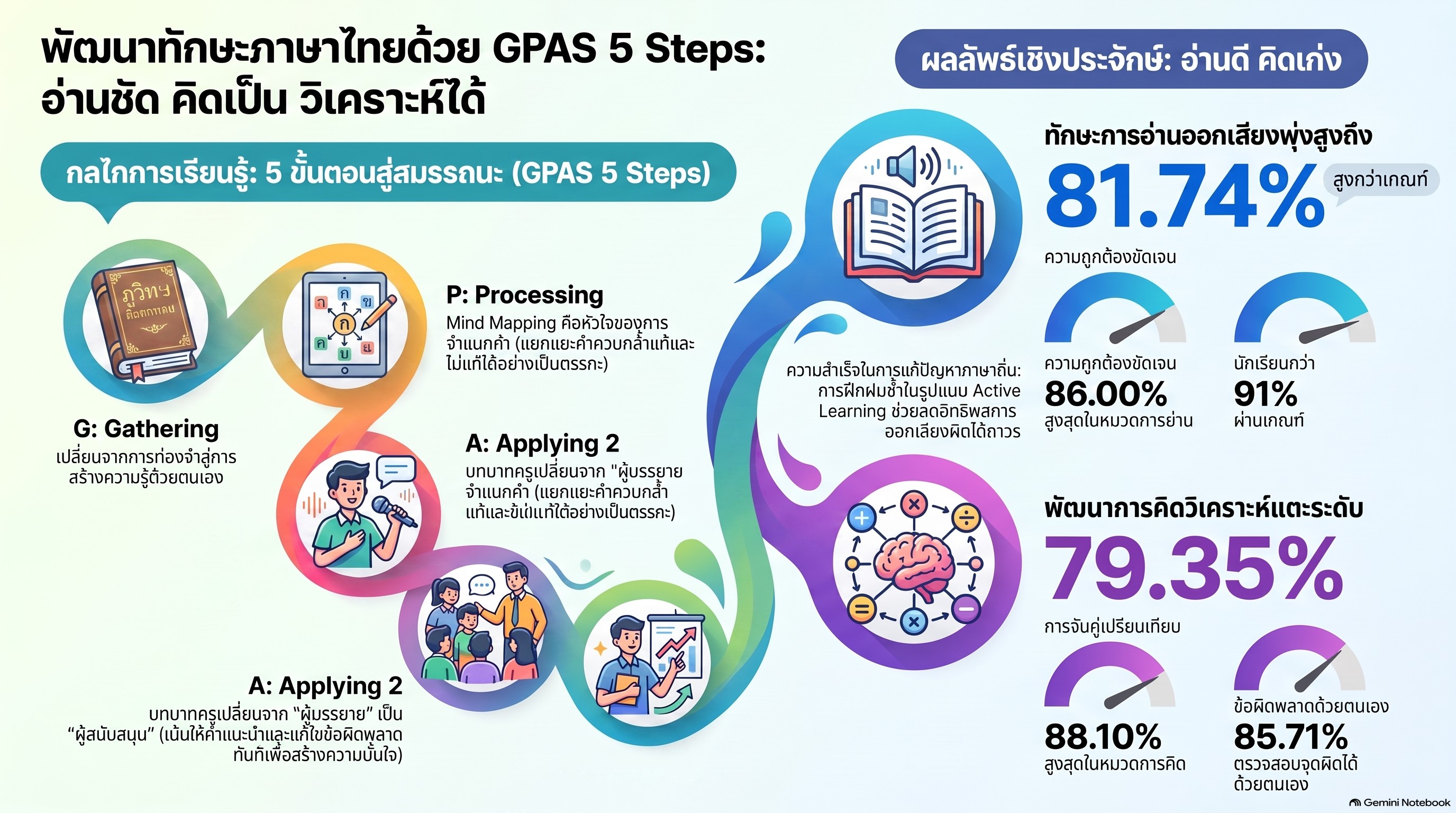
This research aimed to: 1) develop the ability to pronounce Thai consonant clusters through GPAS 5 Steps learning management for Grade 6 students, with a post-learning average score of not less than 75 percent and at least 75 percent of the students passing the established criterion; and 2) develop analytical thinking ability through GPAS 5 Steps learning management for Grade 6 students, with an average score of not less than 75 percent and at least 75 percent of the students passing the established criterion. The research employed purposive sampling. The target group consisted of 23 Grade 6 students studying in the second semester of the 2025 academic year at Ban Phai Saengthong Prachasan School. The research instruments included: 1) twelve lesson plans on the pronunciation of Thai consonant clusters using GPAS 5 Steps learning management, totaling 12 hours; 2) a test measuring the ability to pronounce Thai consonant clusters; and 3) a test measuring analytical thinking ability. The statistics used for data analysis were mean, standard deviation, and percentage. The findings revealed that: 1) the Grade 6 students achieved pronunciation ability in Thai consonant clusters with a mean score of 16.35 points, accounting for 81.74 percent, and 21 students, or 91.30 percent of the total number of students, passed the 75 percent criterion, which was higher than the predetermined criterion; and 2) the Grade 6 students demonstrated analytical thinking ability with a mean score of 15.87 points, accounting for 79.35 percent of the full score, and 18 students, or 78.26 percent of the total number of students, passed the established criterion.
References
กระทรวงศึกษาธิการ. (2551). หลักสูตรแกนกลางการศึกษาขั้นพื้นฐาน พุทธศักราช 2551. ชุมนุมสหกรณ์การเกษตรแห่งประเทศไทย.
กาญจนา ฐานะวุฒิกุล. (2567). การพัฒนาความสามารถการอ่านวิเคราะห์วรรณคดีไทยของนักเรียนชั้นประถมศึกษาปีที่ 6 โดยใช้กระบวนการ GPAS 5 Steps ร่วมกับอินโฟกราฟิก. วารสารสหวิทยาการเพื่อการพัฒนา มหาวิทยาลัยราชภัฏอุตรดิตถ์, 14(1), 50–63.
เกรียงศักดิ์ เจริญวงศ์ศักดิ์. (2556). การคิดเชิงสร้างสรรค์. ซัคเซส มีเดีย.
คมขำ แสนกล้า. (2557). การพัฒนาการเรียนรู้โดยใช้แบบฝึกทักษะการอ่านและการเขียนคำควบกล้ำ วิชาภาษาไทย ชั้นประถมศึกษาปีที่ 3 [วิทยานิพนธ์ปริญญามหาบัณฑิต, มหาวิทยาลัยมหาสารคาม].
ฐะปะนีย์ นาครทรรพ. (2552). การสอนภาษาไทยระดับประถมศึกษา. ศูนย์ส่งเสริมวิชาการ.
ปรารถนา บุญญะสุระ. (2555). การพัฒนาแบบทดสอบสมรรถภาพทางกายสำหรับเด็กปฐมวัย [วิทยานิพนธ์ปริญญามหาบัณฑิต, จุฬาลงกรณ์มหาวิทยาลัย].
ผะอบ โปษะกฤษณะ. (2557). ลักษณะเฉพาะของภาษาไทย (พิมพ์ครั้งที่ 7). รวมสาส์น.
พวงรัตน์ ทวีรัตน์. (2543). วิธีการวิจัยทางพฤติกรรมศาสตร์และสังคมศาสตร์ (พิมพ์ครั้งที่ 7). สำนักทดสอบทางการศึกษาและจิตวิทยา มหาวิทยาลัยศรีนครินทรวิโรฒ.
มาริษา จันโสดา. (2565). การพัฒนาผลสัมฤทธิ์ทางการเรียนวิชาภาษาไทย. วารสารศึกษาศาสตร์ มหาวิทยาลัยบูรพา, 33(2), 45–58.
วิภาวดี มาประจง. (2564). ผลของการจัดการเรียนรู้แบบผสมผสาน. วารสารวิชาการครุศาสตร์, 12(2), 85–98.
สถาบันพัฒนาคุณภาพวิชาการ (พว.). (2562). เอกสารประกอบการอบรมครูและบุคลากรทางการศึกษา เรื่อง การจัดกิจกรรมการเรียนรู้สู่สมรรถนะด้วยกระบวนการคิดขั้นสูงเชิงระบบ GPAS 5 Steps. บริษัท พัฒนาคุณภาพวิชาการ (พว.) จำกัด.
สมศักดิ์ สินธุระเวชญ์. (2547). การวัดและประเมินผลการเรียนรู้ หลักสูตรการศึกษาขั้นพื้นฐาน พุทธศักราช 2544. วัฒนาพานิช.
สำนักงานคณะกรรมการการศึกษาขั้นพื้นฐาน. (2560). แนวทางการจัดทำหลักสูตรสถานศึกษา. สำนักงานคณะกรรมการการศึกษาขั้นพื้นฐาน.
สำนักงานเลขาธิการสภาการศึกษา. (2560). แผนการศึกษาแห่งชาติ พ.ศ. 2560–2579. สำนักงานเลขาธิการสภาการศึกษา.
สำนักงานสภาพัฒนาการเศรษฐกิจและสังคมแห่งชาติ. (2561). ยุทธศาสตร์ชาติ 20 ปี (พ.ศ. 2561–2580). สำนักงานสภาพัฒนาการเศรษฐกิจและสังคมแห่งชาติ.
Downloads
Published
How to Cite
Issue
Section
Categories
License
Copyright (c) 2026 Journal of Buddhist Education and Research (JBER)

This work is licensed under a Creative Commons Attribution-NonCommercial-NoDerivatives 4.0 International License.