The Development of Ability in Reading Aloud and Writing Consonant Cluster Words Using Brain-Based Learning Integrated with Gamification for First-Year Students of the Thai Studies Program, Vietnam National University, Hanoi
Keywords:
Brain-Based Learning with Gamification, Pronouncing Thai cluster words, Writing Thai cluster wordsAbstract
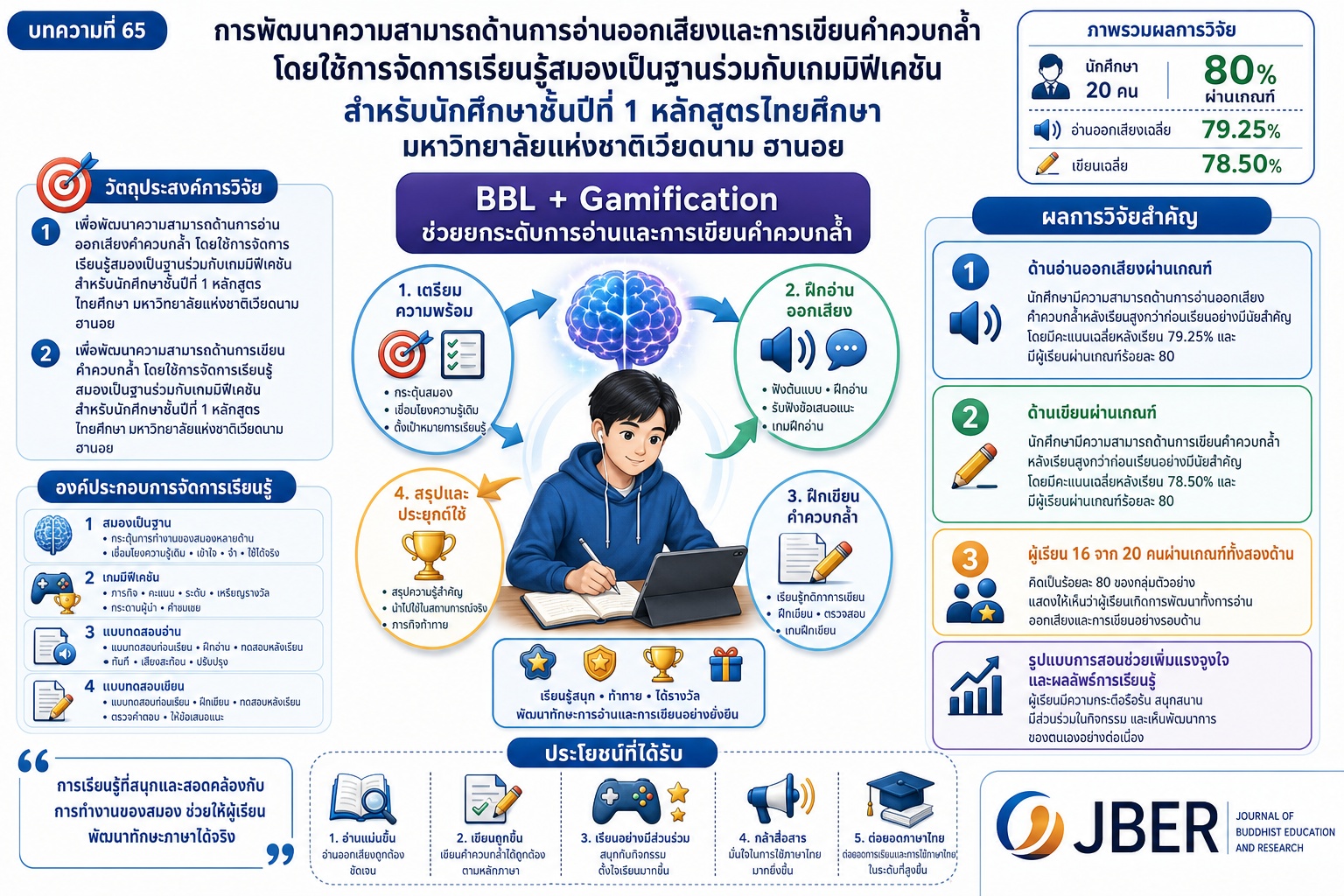
The objectives of this research were as follows: 1) to develop the pronunciation ability of Thai consonant cluster words using Brain-Based Learning with Gamification for first-year Thai Studies students at Vietnam National University, Hanoi, with a target of at least a 75 percent average score and at least 75 percent of students meeting the criterion; and 2) to develop the writing ability of Thai consonant cluster words for the same group using the same instructional approach and performance criteria. The research employed a one-group posttest-only design. The target group consisted of 20 first-year students in the Thai Studies program, Faculty of Oriental Studies, University of Social Sciences and Humanities, Vietnam National University, Hanoi, selected through purposive sampling. The research instruments included four Brain-Based Learning with Gamification lesson plans, each lasting 3 hours for a total of 12 instructional hours, a pronunciation test for Thai consonant cluster words, and a writing test for Thai consonant cluster words. The results revealed that: 1) for pronunciation, the students achieved a mean score of 15.85, representing 79.25 percent of the total score, and 16 students (80.00 percent) passed the criterion, which exceeded the predetermined benchmark; and 2) for writing, the students achieved a mean score of 15.70, representing 78.50 percent of the total score, and 16 students (80.00 percent) met the criterion. These results indicate that the students' performance exceeded the established benchmarks and fully satisfied the research objectives.
References
กมลทิพย์ ศรีนุ่ม. (2558). การพัฒนาความสามารถการเขียนสะกดคำของนักเรียนชั้นประถมศึกษาปีที่ 2 ด้วยการเรียนแบบร่วมมือเทคนิค CIRC ร่วมกับแบบฝึก. (วิทยานิพนธ์ปริญญามหาบัณฑิต). มหาวิทยาลัยศิลปากร.
จริยา สุขแก้ว. (2565). การพัฒนาความสามารถการอ่านคำโดยใช้การจัดกิจกรรมการเรียนรู้ตามแนวคิดสมองเป็นฐานร่วมกับการใช้แบบฝึกทักษะสำหรับนักเรียนชั้นประถมศึกษาปีที่ 1. (การค้นคว้าอิสระปริญญามหาบัณฑิต). มหาวิทยาลัยนเรศวร.
ณัชชาภรณ์ สาโรจน์. (2565). การจัดการเรียนรู้โดยใช้เทคนิคเกมมิฟิเคชันเพื่อส่งเสริมความสามารถในการอ่านภาษาอังกฤษเพื่อความเข้าใจ สำหรับนักเรียนชั้นมัธยมศึกษาปีที่ 2 โรงเรียนอุทัยวิทยาคม จังหวัดอุทัยธานี. (การค้นคว้าอิสระปริญญามหาบัณฑิต). มหาวิทยาลัยนเรศวร.
นงลักษณ์ ไชยวิชู. (2567). ผลการจัดการเรียนรู้โดยใช้สมองเป็นฐานร่วมกับเทคนิคเกมมิฟิเคชันเพื่อพัฒนาความรู้ด้านคำศัพท์และทักษะการอ่านภาษาอังกฤษของนักเรียนชั้นประถมศึกษาปีที่ 4. (วิทยานิพนธ์ปริญญามหาบัณฑิต). มหาวิทยาลัยพะเยา.
บุญชม ศรีสะอาด. (2545). การวิจัยเบื้องต้น (พิมพ์ครั้งที่ 7). สุวีริยาสาส์น.
มาเต็ม พิศศรี. (2567). การพัฒนาชุดกิจกรรมส่งเสริมทักษะการอ่านภาษาไทยโดยการจัดการเรียนรู้แบบใช้สมองเป็นฐาน สำหรับนักเรียนชั้นประถมศึกษาปีที่ 3. (วิทยานิพนธ์ปริญญามหาบัณฑิต). มหาวิทยาลัยราชภัฏรำไพพรรณี.
วรางคณา แสงธิป. (2564). การพัฒนาการจัดการเรียนรู้แบบเกมมิฟิเคชันร่วมกับวิธีการสอนแบบเน้นภาระงาน เพื่อส่งเสริมความสามารถในการอ่านภาษาอังกฤษเพื่อความเข้าใจและแรงจูงใจในการเรียน ของนักเรียนชั้นมัธยมศึกษาปีที่ 3. (วิทยานิพนธ์ปริญญามหาบัณฑิต). มหาวิทยาลัยศิลปากร.
สำนักงานปลัดกระทรวงการอุดมศึกษา วิทยาศาสตร์ วิจัยและนวัตกรรม. (2567). รายงานสถิติตัวชี้วัดด้านการอุดมศึกษา ประจำปีงบประมาณ พ.ศ. 2566: สถิตินักศึกษาต่างชาติในสถาบันอุดมศึกษาไทย. ศูนย์สารสนเทศอุดมศึกษา.
Ha Van. (2025). Vietnam and Thailand officially upgrade their relationship to a 'Comprehensive Strategic Partnership'. Government Electronic Newspaper. https://baochinhphu.vn/viet-nam-thai-lan-chinh-thuc-nang-cap-quan-he-len-doi-tac-chien-luoc-toan-dien-102250516141418697.htm
Jensen. (2000). Brain – based learning. San Diego, CA : The Brain Store Publishing
Lai, T. N. (2018). Thai phonetics in comparison with Vietnamese. Scientific Journal of Tan Trao University, 2(5), 15-20. https://doi.org/10.51453/2354-1431/2018/251
Martin, H. (2004). Pronunciation practice activities. Cambridge University Press.
Nation, I. S. P., & Newton, J. (2009). Teaching ESL/EFL reading and writing. Routledge. https://doi.org/10.4324/9781003613756
Perret, C., & Olive, T. (2019). Spelling words: From double to single-letter words. Frontiers Media SA. Volume: 39. DOI: 10.1163/9789004394988
The Central Committee of the Communist Party of Vietnam. (2013). Resolution No. 29-NQ/TW of November 04, 2013, on “Fundamental and comprehensive innovation in education, serving industrialization and modernization in a socialist-oriented market economy during international integration” ratified in the 8th session. https://thuvienphapluat.vn/van-ban/Thuong-mai/Nghi-quyet-29-NQ-TW-nam-2013-doi-moi-can-ban-toan-dien-giao-duc-dao-tao-hoi-nhap-quoc-te-212441.aspx
The Ministry of Education and Training. (2014). Circular on promulgating the six-level foreign language proficiency framework for Vietnam (Circular No. 01/2014/TT-BGDDT). https://apolatlegal.com/wp-content/uploads/2025/05/Circular-01-2014-TT-BGDDT.pdf
The Prime Minister. (2008). Decision No. 1400/QD-TTg approving the scheme on foreign language teaching and learning in the national education system in the 2008-2020 period. https://thuvienphapluat.vn/van-ban/Giao-duc/Quyet-dinh-1400-QD-TTg-phe-duyet-de-an-day-va-hoc-ngoai-ngu-trong-he-thong-giao-duc-quoc-dan-giai-doan-2008-2020-71152.aspx
The Prime Minister. (2011). Decision No. 208/QD-TTg approving the strategy on cultural diplomacy through 2020. https://thuvienphapluat.vn/van-ban/EN/Van-hoa-Xa-hoi/Decision-No-208-QD-TTg-approving-the-strategy-on-cultural-diplomacy/122676/tieng-anh.aspx
VNU-University of Social Sciences and Humanities, Hanoi. (2023). Oriental Studies Curriculum program - Thai studies Program. https://ussh.vnu.edu.vn/eng/dao-tao/nganh-dong-phuong-hoc/nganh-dong-phuong-hoc-23031.html
Downloads
Published
How to Cite
Issue
Section
Categories
License
Copyright (c) 2026 Journal of Buddhist Education and Research (JBER)

This work is licensed under a Creative Commons Attribution-NonCommercial-NoDerivatives 4.0 International License.