Personnel Administration in the Digital Era Based on Pāpaṇika Dhamma III of School Administrators under Loei Primary Educational Service Area Office 3
Keywords:
Personnel Administration, Pāpaṇika Dhamma III, School AdministratorsAbstract
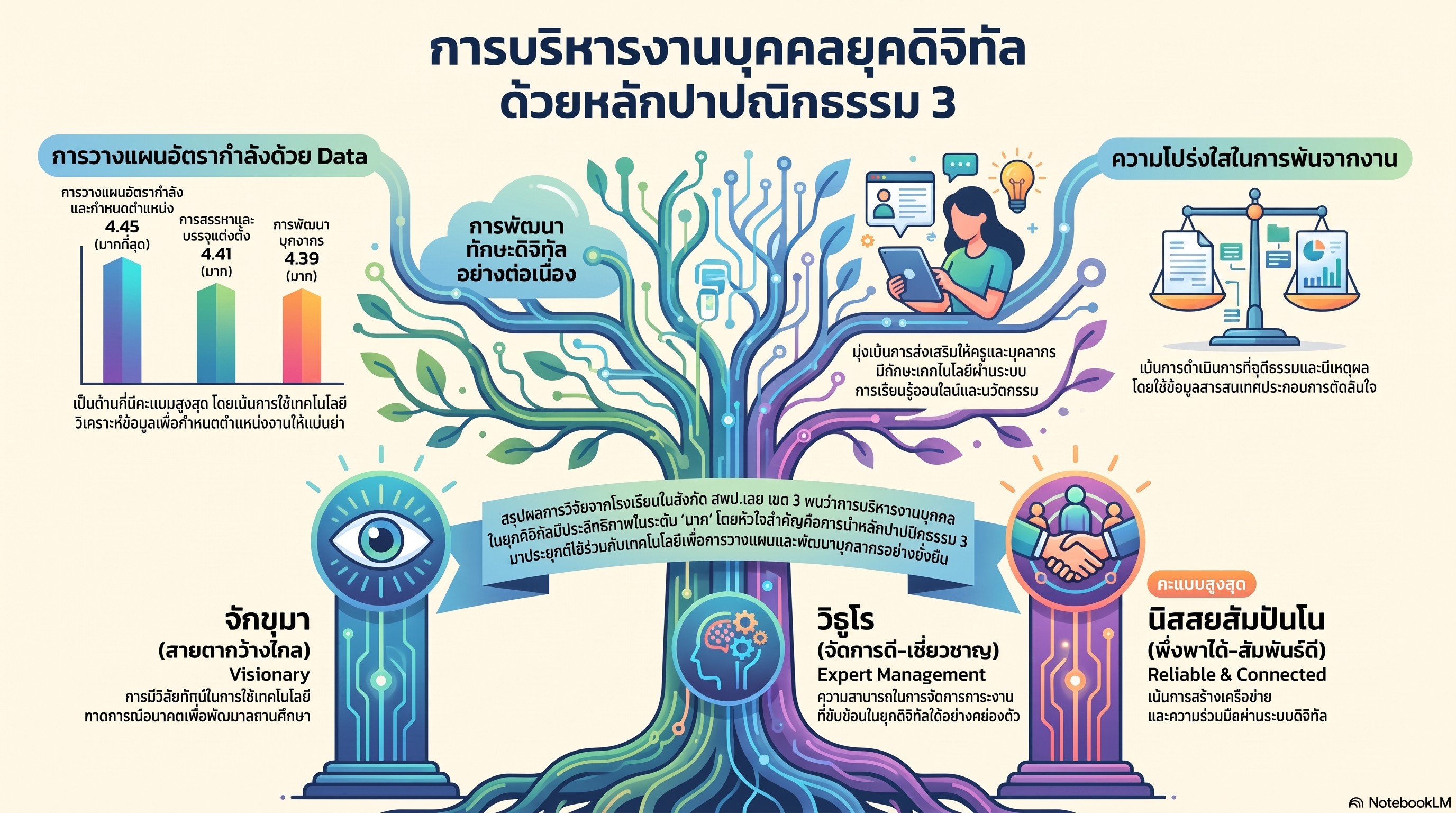
The objectives of this research were: 1) to study the conditions of personnel administration in the digital era of school administrators under Loei Primary Educational Service Area Office 3; 2) to study personnel administration methods in the digital era based on Pāpaṇika Dhamma III of school administrators under Loei Primary Educational Service Area Office 3; and 3) to propose guidelines for developing personnel administration in the digital era based on Pāpaṇika Dhamma III of school administrators under Loei Primary Educational Service Area Office 3. This study employed a mixed-methods research design. The sample group consisted of 31 school administrators and 205 teachers, totaling 236 participants. For the qualitative study, the researcher conducted interviews with 7 key informants. The research instruments included questionnaires and interview forms, and the data were analyzed using descriptive statistics. The research results were as follows: 1. The overall level of personnel administration in the digital era of school administrators was at a high level. The aspect with the highest mean score was workforce planning and position determination, followed by recruitment and appointment, and personnel development, while the aspect with the lowest mean score was personnel termination. 2. The overall level of personnel administration in the digital era based on Pāpaṇika Dhamma III of school administrators under Loei Primary Educational Service Area Office 3 was at a high level. The aspect with the highest mean score was personnel administration based on Nissayasampanno, followed by personnel administration based on Vidhuro, while the aspect with the lowest mean score was personnel administration based on Cakkhumā. 3. The guidelines for developing personnel administration in the digital era based on Pāpaṇika Dhamma III indicated that administrators should plan workforce management by using data and technology for analysis, promote recruitment and personnel development to enhance digital skills, support competency development, knowledge exchange, and educational innovation, and implement personnel termination processes fairly, transparently, and reasonably through the use of data-based decision-making.
References
ทองดี ปาโส. (2566). ภาวะผู้นำตามหลักปาปณิกธรรมของการบริหารองค์กรในยุคชีวิตวิถีใหม่. วารสารสหวิทยาการนวัตกรรมปริทรรศน์, 6(4), 145–157.
ปราณี คาดการณ์ไกล. (2556). การใช้อำนาจของผู้บริหารที่ส่งผลต่อแรงจูงใจในการปฏิบัติงานของครู สังกัดสำนักงานเขตพื้นที่การศึกษาประถมศึกษาสุพรรณบุรี เขต 2 [วิทยานิพนธ์ศึกษาศาสตรมหาบัณฑิต, มหาวิทยาลัยศิลปากร].
พระอธิการอุทัย อตฺตมปญฺโญ (ศรชา). (2565). การบริหารงานบุคคลตามหลักทุติยปาปณิกสูตรของผู้บริหารโรงเรียนพระปริยัติธรรม แผนกสามัญศึกษา จังหวัดขอนแก่น [วิทยานิพนธ์ศึกษาศาสตรมหาบัณฑิต สาขาพุทธบริหารการศึกษา, มหาวิทยาลัยมหาจุฬาลงกรณราชวิทยาลัย].
รัชนี ท้าวมาชนี, ธิดารัตน์ จันทะหิน, & ชวนคิด มะเสนะ. (2568). การบริหารงานบุคคลในยุคดิจิทัลของผู้บริหารสถานศึกษา สังกัดสำนักงานเขตพื้นที่การศึกษาประถมศึกษาอุบลราชธานี เขต 3. วารสารราชภัฏสุรินทร์วิชาการ, 3(6), 33–51.
ศุภเกียรติ วรสาร, & จิตตรา จันขอนแก่น. (2568). การบริหารงานบุคคลในยุคดิจิทัลของสถานศึกษา. วารสาร มจร, 10(1), 25–40.
สุกัญญา แช่มช้อย. (2561). การบริหารสถานศึกษาในยุคดิจิทัล. จุฬาลงกรณ์มหาวิทยาลัย.
สำนักงานเขตพื้นที่การศึกษาประถมศึกษาเลย เขต 3. (2568). แผนปฏิบัติการประจำปีงบประมาณ พ.ศ. 2568. กลุ่มนโยบายและแผน สำนักงานเขตพื้นที่การศึกษาประถมศึกษาเลย เขต 3.
สำนักงานคณะกรรมการดิจิทัลเพื่อเศรษฐกิจและสังคมแห่งชาติ. (2560). แผนพัฒนาดิจิทัลเพื่อเศรษฐกิจและสังคม ระยะ 20 ปี (พ.ศ. 2560–2579). กระทรวงดิจิทัลเพื่อเศรษฐกิจและสังคม.
Krejcie, R. V., & Morgan, D. W. (1970). Determining sample size for research activities. Educational and Psychological Measurement, 30(3), 607–610. https://doi.org/10.1177/001316447003000308
Downloads
Published
How to Cite
Issue
Section
Categories
License
Copyright (c) 2026 Journal of Buddhist Education and Research (JBER)

This work is licensed under a Creative Commons Attribution-NonCommercial-NoDerivatives 4.0 International License.