Developing Reading Comprehension Skills through Creative-Based Learning (CBL) Integrated with the Four Iddhipāda Principles for Grade 7 Students at Sawat Witthaya School, Udon Thani Province
Keywords:
Reading Comprehension, Creative-Based Learning (CBL), Four Iddhipāda Principles, Learning Achievement, Student SatisfactionAbstract
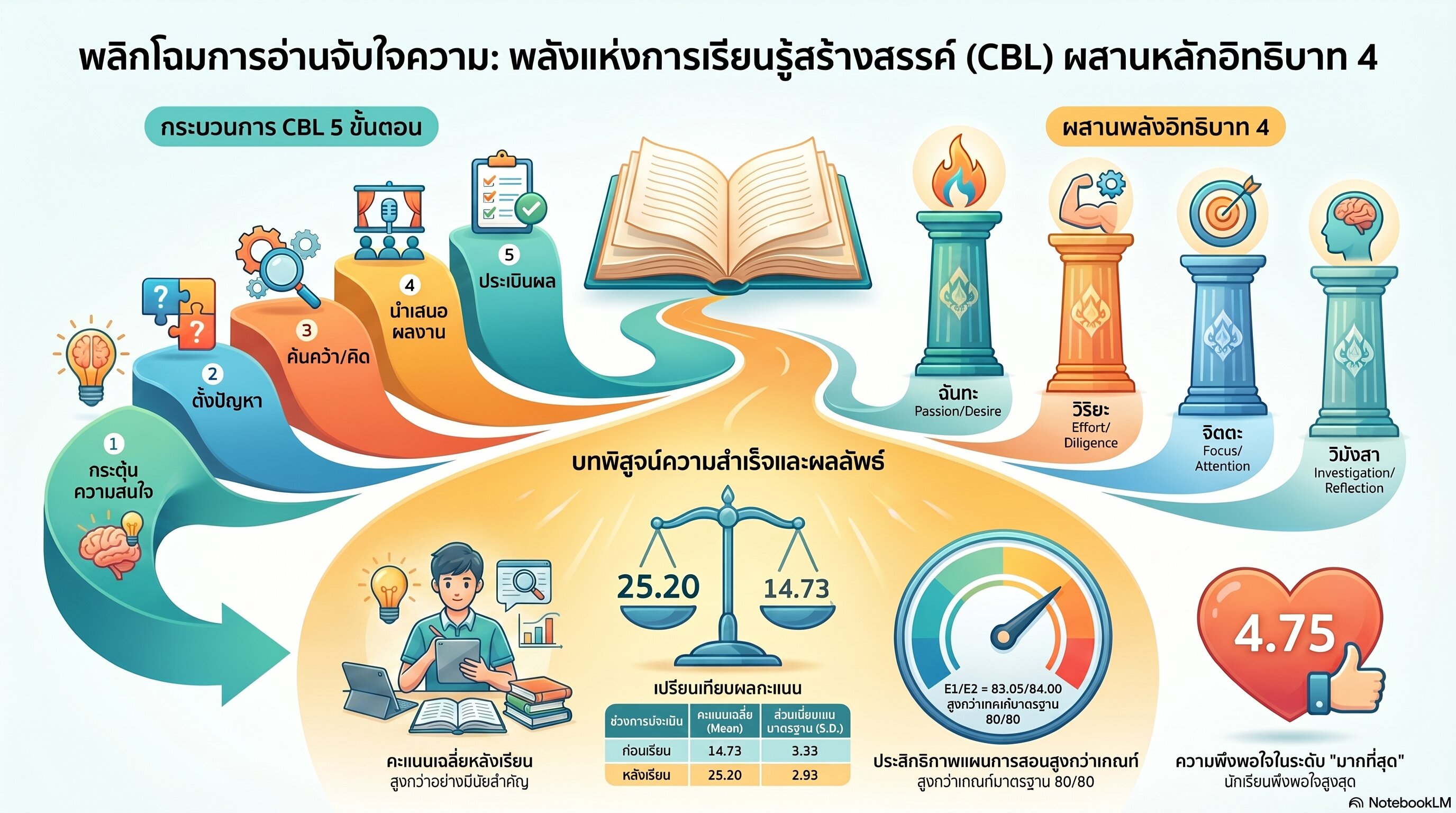
This research aimed to: (1) develop a reading comprehension learning plan using Creative-Based Learning (CBL) integrated with the Four Iddhipāda Principles to meet the 80/80 efficiency criterion, (2) compare learning achievement in reading comprehension through CBL combined with the Four Iddhipāda Principles, and (3) examine students’ satisfaction with the learning plan. The instruments used included: (1) the reading comprehension lesson plan using CBL and the Four Iddhipāda Principles, (2) an achievement test, and (3) a student satisfaction questionnaire. The sample consisted of 15 Grade 7 students from Sawat Witthaya School, Udon Thani Province. Data were analyzed using basic statistics: mean, standard deviation (S.D.), and dependent t-test. The research results were as follows: 1. The efficiency of the lesson plan process (E₁) was 83.05, and the efficiency of the result (E₂) was 84.00, both exceeding the criterion of 80/80. 2. Students' average pre-test score was 14.73 (S.D. = 3.33), while the post-test score was 25.20 (S.D. = 2.93). The post-test scores were significantly higher than pre-test scores at the .05 level. 3. Students' overall satisfaction with the learning plan was high, with a mean of 4.47. Satisfaction by aspect was as follows: instructional activities (mean = 4.75), assessment and evaluation (mean = 4.43), instructional media and tools (mean = 4.39), and content (mean = 4.33)—all at a high level.
References
กรมวิชาการ. (2544). การจัดการเรียนรู้แบบร่วมมือ. ใน เอกสารชุดเทคนิคการจัดกระบวนการเรียนรู้ที่ผู้เรียนสำคัญที่สุด. กรุงเทพฯ: โรงพิมพ์การศาสนา.
กรมวิชาการ. (2546). การจัดการเรียนรู้กลุ่มสาระภาษาไทย. กรุงเทพฯ: คุรุสภาลาดพร้าว.
กระทรวงศึกษาธิการ. (2551). ตัวชี้วัดและสาระการเรียนรู้แกนกลางกลุ่มสาระการเรียนรู้ภาษาไทย ตามหลักสูตรแกนกลางการศึกษาขั้นพื้นฐาน พุทธศักราช 2551. กรุงเทพฯ: โรงพิมพ์ชุมนุมสหกรณ์การเกษตรแห่งประเทศไทย.
กนกวรรณ ภู่ทิม. (2561). การศึกษาความสามารถในการอ่านจับใจความและการเขียนวิชาภาษาไทยของนักเรียนชั้นมัธยมศึกษาปีที่ 1 โดยการประยุกต์ใช้การจัดการเรียนรู้แบบร่วมมือเทคนิค CIRC ร่วมกับการสอนอ่านแบบปฏิบัติการ. Journal of Education and Innovation, 21(1), 1–12.
เมขลา ลือโสภา. (2555). การพัฒนาการอ่านจับใจความด้วยวิธีการสอนแบบ SQ4R กลุ่มสาระการเรียนรู้ภาษาไทยชั้นมัธยมศึกษาปีที่ 1 [วิทยานิพนธ์ครุศาสตรมหาบัณฑิต, มหาวิทยาลัยราชภัฏมหาสารคาม].
พนิตนันท์ บุญพามี. (2542). เทคนิคการอ่านเบื้องต้นสำหรับบรรณารักษ์. นครราชสีมา: สถาบันราชภัฏนครราชสีมา.
ยุวดี โททำ. (2565). การพัฒนาทักษะการอ่านจับใจความของนักเรียนชั้นประถมศึกษาปีที่ 4 โดยใช้แบบฝึกทักษะร่วมกับเทคนิค 5W1H [วิทยานิพนธ์ครุศาสตรมหาบัณฑิต, มหาวิทยาลัยราชภัฏชัยภูมิ].
ธีราภรณ์ พลายเล็ก. (2564). การศึกษาสมรรถนะการสร้างนวัตกรรมการเรียนรู้ทางด้านการออกเสียงภาษาอังกฤษของนักศึกษาครูสาขาวิชาภาษาอังกฤษตามแนวทางการจัดการเรียนรู้แบบสร้างสรรค์เป็นฐานและการจัดการเรียนรู้แบบโครงงานเป็นฐาน. Journal of Roi Kaensarn Academi, 6(11), 197–211.
วรรณี โสมประยูร. (2544). การสอนภาษาไทยระดับชั้นประถมศึกษา (พิมพ์ครั้งที่ 4). กรุงเทพฯ: ไทยวัฒนาพานิช.
วิริยะ ฤาชัยพาณิชย์. (2558). การสอนแบบสร้างสรรค์เป็นฐาน. วารสารนวัตกรรมการเรียนรู้ มหาวิทยาลัยวลัยลักษณ์, 1(2), 31–32.
ราชกิจจานุเบกษา. (2553). พระราชบัญญัติการศึกษาแห่งชาติ พ.ศ. 2542 และที่แก้ไขเพิ่มเติม (ฉบับที่ 3) พ.ศ. 2553. ราชกิจจานุเบกษา, 127(45 ก), 13–14.
Downloads
Published
How to Cite
Issue
Section
License
Copyright (c) 2026 Authors

This work is licensed under a Creative Commons Attribution-NonCommercial-NoDerivatives 4.0 International License.