Smart Learning: Developing English Communication Skills for Excellence in Spreading Buddhism
Keywords:
Thai reading skill, gamification-based learning, Citta BhāvanāAbstract
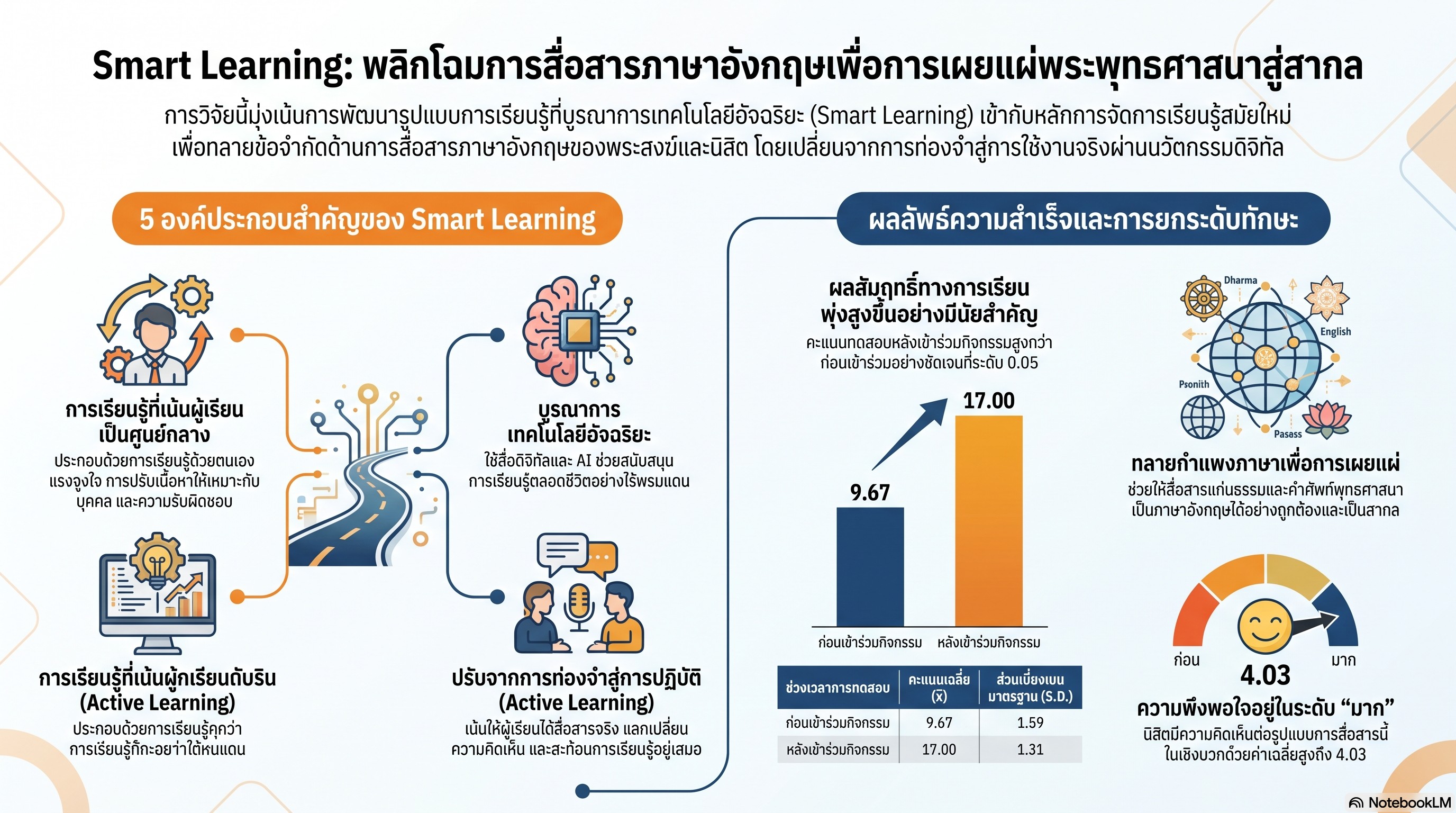
This research aimed to: 1) study the model of English communication for excellence in Buddhist propagation; 2) enhance Smart Learning for developing English communication skills for excellence in Buddhist propagation; and 3) propose and implement Smart Learning for developing English communication skills for excellence in Buddhist propagation. The study employed a mixed-methods research approach, consisting of quantitative research, qualitative research, and action research. The quantitative research used a survey method with a sample of 330 students and monks residing in Phra Nakhon Si Ayutthaya Province. The qualitative research was conducted with a specific target group through data collection by means of in-depth interviews and focus group discussions involving 30 participants. In addition, action research was carried out with 15 participants who took part in the activities. The research findings revealed that: 1) The study of the model of English communication for excellence in Buddhist propagation found that the overall opinions of the students had a mean score of 4.03, which, according to the established criteria, was at a high level. The findings also led to the development of a model of English communication for excellence in Buddhist propagation, 2) The planning and design of Smart Learning should systematically integrate intelligent technologies with modern learning management principles and Buddhist content. Furthermore, learning activities should emphasize Active Learning by providing opportunities for learners to engage in authentic communication, exchange ideas, and reflect on their learning experiences, 3) The results of the pre-test and post-test showed that the participants who took part in the activities achieved higher post-test scores in Smart Learning for English communication in Buddhist propagation (x̄ = 17.00, S.D. = 1.31) than their pre-test scores before participating in the Smart Learning activities (x̄ = 9.67, S.D. = 1.59), with statistical significance at the 0.05 level.
References
จุฑาภรณ์ ภารพบ และฐิตินาร์ถ คำยอด. (2558). “การศึกษารูปแบบการใช้ภาษาอังกฤษเพื่อการสื่อสารของผู้ให้บริการคุณภาพการท่องเที่ยวจังหวัดสตูล”. รายงานการวิจัย. สงขลา: คณะศิลปศาสตร์ มหาวิทยาลัยเทคโนโลยีราชมงคลศรีวิชัย.
ณัชปภา โพธิ์พุ่ม และคณะ. (2561). “การพัฒนาทักษะสื่อสารภาษาอังกฤษของนักเรียนในจังหวัดสุรินทร์โดยใช้กระบวนการทฤษฎี CLT”. รายงานการวิจัย. พระนครศรีอยุธยา: มหาวิทยาลัยมหาจุฬาลงกรณราชวิทยาลัย.
ธิราภรณ์ พลายเล็ก. (2555). “การพัฒนาทักษะการออกเสียงพยัญชนะท้ายคำภาษาอังกฤษของนักเรียนชั้นประถมศึกษาปีที่ 6 โรงเรียนสาธิตมหาวิทยาลัยราชภัฏสวนสุนันทา”. รายงานการวิจัย. กรุงเทพมหานคร: มหาวิทยาลัยราชภัฏสวนสุนันทา.
นฤมล จิตรเอื้อ และเขมมารี รักษ์ชูชีพ. (2012). กลยุทธ์การจูงใจการท่องเที่ยวระยะยาวแบบเปี่ยมสุขของนักท่องเที่ยวผู้สูงอายุชาวต่างประเทศ. RMUTT Global Business and Economics Review, 7(2).
ประเวศ วะสี. (2541). บนเส้นทางใหม่การส่งเสริมสุขภาพ อภิวัฒน์ชีวิตและสังคม. กรุงเทพมหานคร: หมอชาวบ้าน.
พระกิติพงษ์ นางเมาะ. (2568). “นวัตกรรมการเรียนรู้ภาษาอังกฤษเพื่อเผยแผ่หลักธรรมทางพระพุทธศาสนาในยุคดิจิทัล”. วารสารภาษาและวัฒนธรรมศึกษา, 4(2), 33–42.
พระธรรมปิฎก (ป.อ. ปยุตโต). (2546). จะพัฒนาคนกันได้อย่างไร. กรุงเทพมหานคร: มูลนิธิพุทธธรรม.
พระนพดล ปันมะ. (2568). “แนวทางการประยุกต์ใช้เทคโนโลยีดิจิทัลเพื่อการเรียนรู้ภาษาอังกฤษในการเผยแผ่พระพุทธศาสนา”. วารสารสังคมศึกษาปริทรรศน์, 1(3), 150–160.
พระมหาราชัน จิตฺตปาโล. (2561). “แนวทางการพัฒนาภาษาอังกฤษของพระสงฆ์ไทยเพื่อการเผยแผ่พระพุทธศาสนา”. วารสารบัณฑิตศึกษาปริทรรศน์, 14(3), 111–123.
พระมหาวราสะยะ วราสยานนท์. (2563). “ภาษาอังกฤษกับการเผยแผ่พระพุทธศาสนาในศตวรรษที่ 21”. วารสารมหาจุฬานาครทรรศน์, 7(10), 98–112.
เลิศ เกสรคำ. (2541). ไวยากรณ์และเทคนิคภาษาอังกฤษ. กรุงเทพมหานคร: บริษัท ซีเอ็ดยูเคชั่น จำกัด.
วิจิตร ศรีสอ้าน. (ม.ป.ป.). วิจิตรชี้ช่องการสอนภาษาอังกฤษพัฒนาใหม่เพื่อใช้สื่อสารในระดับภูมิภาคเอเชีย. กรุงเทพมหานคร: โรงพิมพ์บ้านเมือง.
วีรยุทธ พงษ์ศิริ. (2560). “รูปแบบการเผยแผ่พระพุทธศาสนากับชาวต่างชาติของพระสงฆ์ในเขตอำเภอเมือง จังหวัดเชียงใหม่”. วารสารพุทธศาสตร์ศึกษา จุฬาลงกรณ์มหาวิทยาลัย, 8(2), 34–43.
สายฝน บุษบรรณ์. (2568). “แนวทางการพัฒนาทักษะภาษาอังกฤษเพื่อการเผยแผ่พระพุทธศาสนาสำหรับพระวิปัสสนาจารย์”. วารสารวิจัยวิชาการ, 8(3), 81–96.
สุริน ร่วมคำ และคณะ. (ม.ป.ป.). การพัฒนาทักษะการพูดภาษาอังกฤษในชีวิตประจำวันโดยใช้บทบาทสมมติ. สืบค้นข้อมูล จาก http://www.lannapoly.ac.th/mis/download. php?ResearchID=91
อภิสิทธิ์ อินทปัน. (2569). “การพัฒนาทักษะการสื่อสารภาษาอังกฤษโดยใช้ปัญญาประดิษฐ์สำหรับนักเรียนโรงเรียนบ้านไสดง สังกัดสำนักงานเขตพื้นที่การศึกษาประถมศึกษาสุราษฎร์ธานี เขต 3”. วารสารปราชญ์ประชาคม, 4(1), 189–197.
Downloads
Published
How to Cite
Issue
Section
License
Copyright (c) 2026 Authors

This work is licensed under a Creative Commons Attribution-NonCommercial-NoDerivatives 4.0 International License.