The Development of Creative Writing Skills Through Open Approach Learning Management for Grade 8 Students at Wat Chaiyapradit Phrapariyattidhamma School
Keywords:
Creative Writing, Open Approach, Learning Achievement SatisfactionAbstract
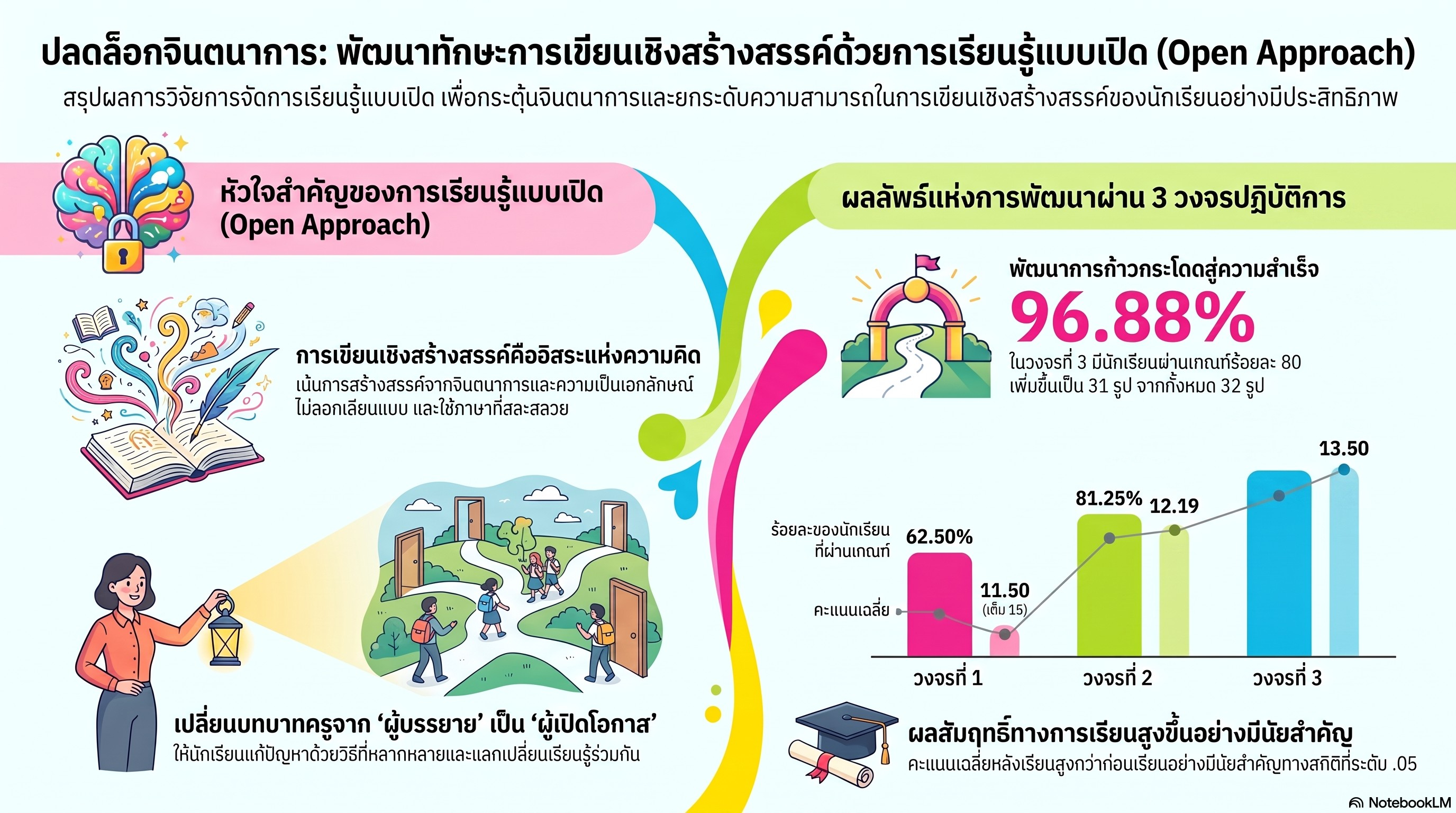
This research aimed to (1) develop Grade 8 students’ creative writing ability through the Open Approach learning management and (2) compare students’ creative writing ability before and after learning through the Open Approach. The sample consisted of 32 Grade 8 students from Wat Chaiyapradit Phrapariyattidham School, Nong Khai Province. The research instruments included: (1) lesson plans based on the Open Approach learning management; (2) reflective instruments comprising students’ learning behavior observation forms and end-of-cycle tests; and (3) a creative writing achievement test. The data were analyzed using percentage, arithmetic mean, and standard deviation. The results revealed that: (1) the development of students’ creative writing ability through the Open Approach met the predetermined criterion. In the third action cycle, 26 out of 32 students (81.25%) achieved the criterion of at least 80%, exceeding the established benchmark. Across the three action cycles, the students obtained a mean score of 12.32 out of 15 points (82.13%), with a standard deviation of 1.38. (2) The students’ post-test achievement in creative writing was significantly higher than their pre-test achievement at the .05 level of statistical significance.
References
กัลยวรรธน์ ประดุจชนม์. (2555). ผลการพัฒนาความสามารถในการเขียนเชิงสร้างสรรค์โดยการจัดกิจกรรมการเรียนรู้แบบซิปปา กลุ่มสาระการเรียนรู้ภาษาไทย ชั้นประถมศึกษาปีที่ 3 [วิทยานิพนธ์การศึกษามหาบัณฑิต, สาขาวิชาหลักสูตรและการสอน]. มหาวิทยาลัยมหาสารคาม.
จุไร วรศักดิ์โยธิน. (2520). การสร้างคู่มือการสอนเขียนภาษาไทยในระดับประกาศนียบัตรวิชาการศึกษาชั้นสูง [วิทยานิพนธ์ครุศาสตรมหาบัณฑิต, สาขาวิชามัธยมศึกษา]. จุฬาลงกรณ์มหาวิทยาลัย.
ณิศรา สุทธิสังข์. (2555). ขั้นตอนการดำเนินการกลั่นแนวคิดสู่ความคิดรวบยอดในกระบวนการนามธรรมของนักเรียนจากการบูรณาการรูปธรรมและนามธรรม. วารสารศึกษาศาสตร์ มหาวิทยาลัยบูรพา, 23(3), 122–136.
ฐะปะนีย์ นาครทรรพ. (2519). การประพันธ์ ท.041. อักษรเจริญทัศน์.
ประภาศรี สีหอำไพ. (2544). เขียนเจาะใจ. อักษรเจริญทัศน์.
ปราณี พิศุทธิสุวรรณ. (2554). การเปรียบเทียบความสามารถด้านการเขียนเชิงสร้างสรรค์ของนักเรียนชั้นมัธยมศึกษาปีที่ 5 ระหว่างการเรียนรู้แบบ 4MAT กับการเรียนรู้ตามปกติ [วิทยานิพนธ์การศึกษามหาบัณฑิต, สาขาวิชาหลักสูตรและการสอน]. มหาวิทยาลัยมหาสารคาม.
ปราณี สุรสิทธิ์. (2541). การเขียนสร้างสรรค์เชิงสารศาสตร์. แสงดาว.
ปวีณา พงษ์พันนา. (2555). การพัฒนาผลการจัดกิจกรรมการเรียนรู้ด้านการเขียนเชิงสร้างสรรค์ของนักเรียนชั้นประถมศึกษาปีที่ 5 โดยใช้แผนผังความคิดประกอบกลุ่มร่วมมือแบบ LT [วิทยานิพนธ์การศึกษามหาบัณฑิต, สาขาวิชาหลักสูตรและการสอน]. มหาวิทยาลัยมหาสารคาม.
ไมตรี อินทร์ประสิทธิ์. (2547). การจัดกิจกรรมการเรียนรู้แบบปลายเปิด. มหาวิทยาลัยขอนแก่น.
เยาวเรศ คำชมพู. (2555). การพัฒนาความสามารถด้านการเขียนเชิงสร้างสรรค์ของนักเรียนชั้นประถมศึกษาปีที่ 6 โดยใช้ Mind Mapping [วิทยานิพนธ์การศึกษามหาบัณฑิต, สาขาวิชาหลักสูตรและการสอน]. มหาวิทยาลัยมหาสารคาม.
ราตรี ขวัญคุ้ม. (2556). ผลการจัดการเรียนรู้ภาษาไทย เรื่องการเขียนเชิงสร้างสรรค์ ชั้นประถมศึกษาปีที่ 5 โดยใช้แผนผังความคิดประกอบกลุ่มร่วมมือแบบ LT [วิทยานิพนธ์การศึกษามหาบัณฑิต, สาขาวิชาหลักสูตรและการสอน]. มหาวิทยาลัยมหาสารคาม.
สำลี รักสุธี. (2554). การเปรียบเทียบผลการจัดกิจกรรมการเรียนรู้ภาษาไทยด้านการอ่านเชิงวิเคราะห์และการเขียนสื่อความระหว่างการใช้แผนผังความคิดกับนวัตกรรมแบบเปิดของนักเรียนชั้นประถมศึกษาปีที่ 6 [วิทยานิพนธ์การศึกษามหาบัณฑิต, สาขาวิชาหลักสูตรและการสอน]. มหาวิทยาลัยมหาสารคาม.
Vass, E., Littleton, K., Miell, D., & Jones, A. (2008). The discourse of collaborative creative writing: Peer collaboration as a context for mutual inspiration. Thinking Skills and Creativity, 3(3), 192–209. https://doi.org/10.1016/j.tsc.2008.09.001
Downloads
Published
How to Cite
Issue
Section
License
Copyright (c) 2026 Authors

This work is licensed under a Creative Commons Attribution-NonCommercial-NoDerivatives 4.0 International License.