Flexible Management Strategies Based on Buddhist Principles for School Administrators under Primary Educational Service Area Offices
Keywords:
Flexible Management, Management Strategy, Buddhist Principles, School AdministratorsAbstract
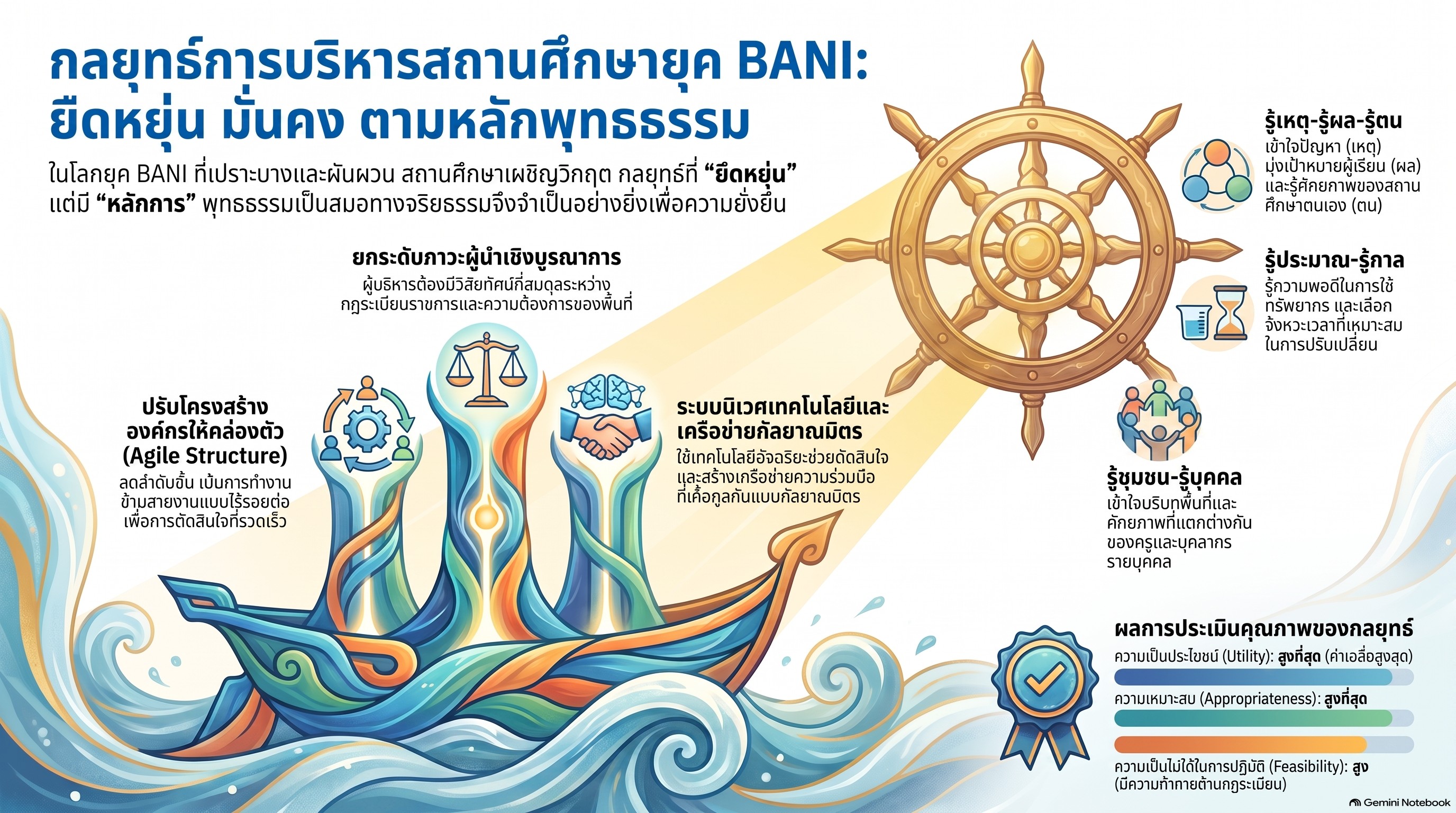
This research aimed to study the current state of flexible administration among school administrators, develop flexible administration strategies based on Buddhist principles, and propose strategies for school administrators under the Primary Educational Service Area Offices. A mixed-methods research design was employed, with data collected in multiple phases from various groups of informants using questionnaires, interviews, and focus group discussions. Data were analyzed using descriptive statistics, the Priority Needs Index, and content analysis. The findings revealed that flexible administration encompassed leadership, networks, readiness for change, organizational structure, and technology. The evaluation results showed that utility received the highest mean score, followed by appropriateness, accuracy, and feasibility, respectively. The proposed strategies consisted of vision, mission, goals, and strategic approaches focusing on leadership, adaptability, organizational structure, technology, and networks of kalyāṇamitta (spiritual friendship).
References
บุญชม ศรีสะอาด. (2535). การวิจัยเบื้องต้น. สุวีริยาสาส์น.
มหาจุฬาลงกรณราชวิทยาลัย. (2539). พระไตรปิฎกภาษาไทย ฉบับมหาจุฬาลงกรณราชวิทยาลัย. โรงพิมพ์มหาจุฬาลงกรณราชวิทยาลัย.
สำนักงานคณะกรรมการการศึกษาขั้นพื้นฐาน. (2565). ถอดบทเรียนการแก้ไขภาวะถดถอยทางการเรียนรู้ (Learning Loss). กระทรวงศึกษาธิการ.
สำนักงานเลขาธิการสภาการศึกษา. (2560). แผนการศึกษาแห่งชาติ พ.ศ. 2560–2579. พริกหวานกราฟฟิค.
Bennis, W., & Nanus, B.. (2007). Leaders: Strategies for taking charge. HarperBusiness.
https://doi.org/10.1007/BF02310555Cascio, J.. (2020). Facing the age of chaos. Medium. https://medium.com/@cascio/facing-the-age-of-chaos-b00687b1f51d.
Cronbach, L. J.. (1951). Coefficient alpha and the internal structure of tests. Psychometrika, 16(3), 297–334. https://doi.org/10.1007/BF02310555.
https://doi.org/10.1177/001316447003000308Fullan, M.. (2001). Leading in a culture of change. Jossey-Bass.
Krejcie, R. V., & Morgan, D. W.. (1970). Determining sample size for research activities. Educational and Psychological Measurement, 30(3), 607–610. https://doi.org/10.1177/001316447003000308.
Organisation for Economic Co-operation and Development. (2018). The future of education and skills: Education 2030. OECD Publishing.
Downloads
Published
How to Cite
Issue
Section
License

This work is licensed under a Creative Commons Attribution-NonCommercial-NoDerivatives 4.0 International License.