A Development Model of Learning Management in the Subject of Modern Literary Criticism Using the Principles of Buddhist Teaching Methods for Undergraduate Students in Thai Language Teaching Program at Mahachulalongkornrajavidyalaya University
Keywords:
Modern Literary Criticism; Buddhist Teaching Methods; Learning Management Model; Learning Achievement; Thai Language TeachingAbstract
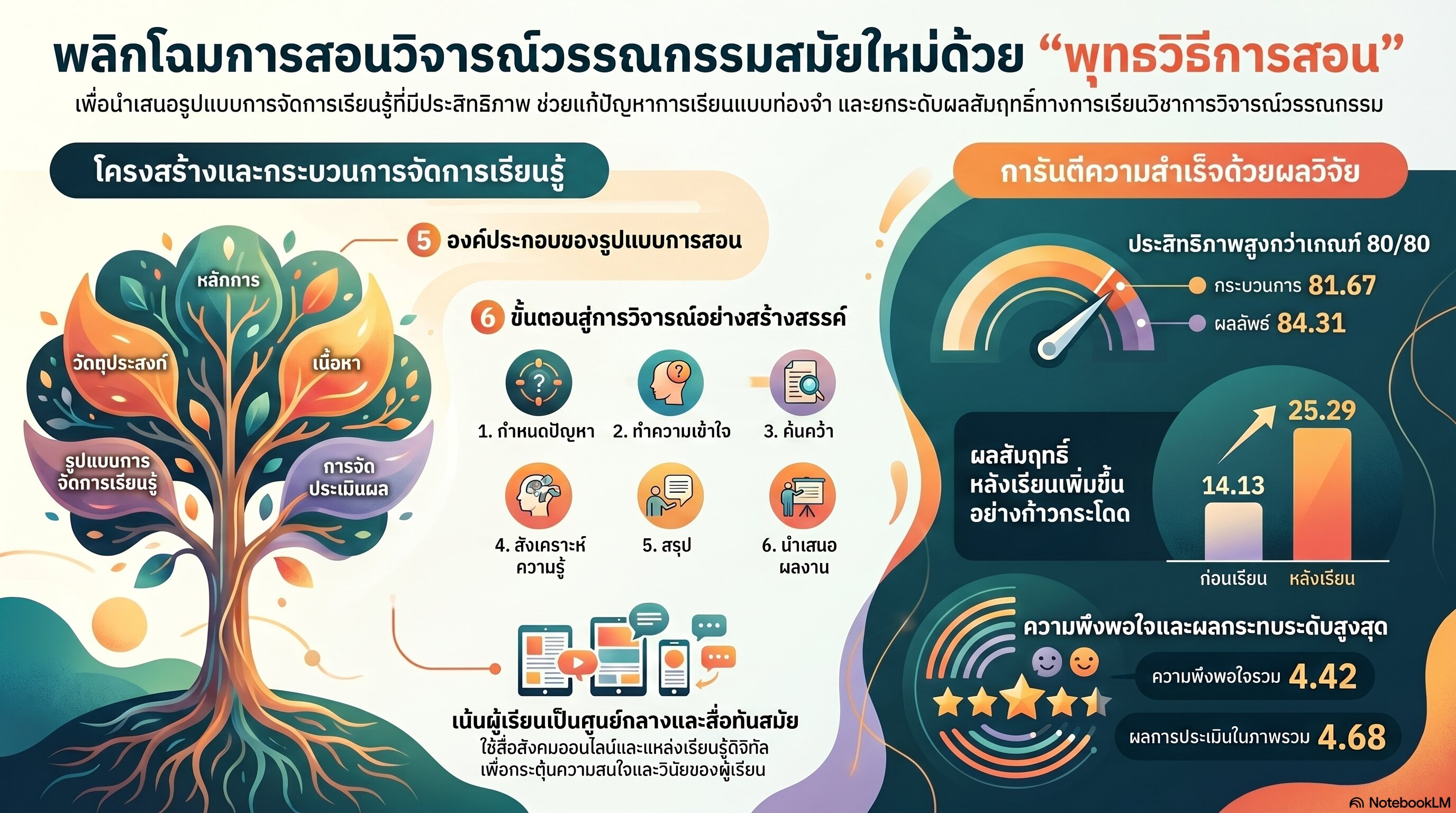
This research and development study aimed to: 1) investigate the current state of learning management in Modern Literary Criticism using Buddhist instructional principles; 2) develop a learning management model based on Buddhist teaching methods; 3) implement the developed model; and 4) evaluate its effectiveness. The study was conducted in four phases, namely situation analysis, model development, implementation, and evaluation. The target groups consisted of administrators, instructors, undergraduate students majoring in Thai Language Teaching at Mahachulalongkornrajavidyalaya University, experts, and administrators of Khon Kaen Buddhist College, totaling 119 participants. The research instruments included questionnaires, focus group discussion records, model evaluation forms, a model handbook, an achievement test, and a satisfaction questionnaire. Data were analyzed using mean and standard deviation. The findings revealed that the overall state of learning management in Modern Literary Criticism based on Buddhist instructional principles was at a high level (x̄ = 3.82). The developed model comprised five components: principles, objectives, content, learning management process, and assessment and evaluation, with overall appropriateness, feasibility, and usefulness rated at a high level (x̄ = 4.10). The model achieved an efficiency score of 81.67/84.31, exceeding the established criterion of 80/80. Students’ post-test achievement scores were significantly higher than their pre-test scores at the .05 level, and their satisfaction with the model was at a high level (x̄ = 4.42). Furthermore, the overall evaluation of the model implementation was at the highest level (x̄ = 4.68). The results indicate that the developed learning management model based on Buddhist teaching methods effectively enhances students’ learning achievement and promotes learning in Modern Literary Criticism, making it suitable for application in higher education contexts.
References
ดวงมน จิตร์จำนงค์. (2556). วรรณคดีวิจารณ์เบื้องต้น. กรุงเทพมหานคร: ประพันธ์สาส์น.
นุชนาถ พรหมการี. (2563). การพัฒนารูปแบบการเรียนรู้แบบผสมผสานเพื่อส่งเสริมทักษะการคิดวิเคราะห์ของนักเรียนระดับชั้นมัธยมศึกษา. วารสารวิจัยทางการศึกษา, 15(2), 45–60.
พรทิพย์ ศิริสมบูรณ์เวช. (2547). การพัฒนารูปแบบการสอนวรรณคดีไทยตามทฤษฎีการตอบสนองของผู้อ่าน เพื่อเสริมสร้างความสามารถด้านการตอบสนองต่อวรรณคดี การอ่านเพื่อความเข้าใจ และการคิดไตร่ตรองของนิสิตระดับปริญญาบัณฑิต [วิทยานิพนธ์ครุศาสตรดุษฎีบัณฑิต สาขาหลักสูตรและการสอน]. จุฬาลงกรณ์มหาวิทยาลัย.
ภูมิภัทร พันธ์ทองหลาง. (2562). การพัฒนารูปแบบหลักสูตรฝึกอบรมเพื่อเสริมสร้างความสามารถในการใช้ภาษาไทยสำหรับนักศึกษาวิชาชีพครู สถาบันการพลศึกษา [วิทยานิพนธ์ปรัชญาดุษฎีบัณฑิต สาขาวิชาหลักสูตรและการสอน]. มหาวิทยาลัยราชภัฏวไลยอลงกรณ์ ในพระบรมราชูปถัมภ์.
วิทย์ ศิวะศริยานนท์. (2544). วรรณคดีและวรรณคดีวิจารณ์ (พิมพ์ครั้งที่ 6). กรุงเทพมหานคร: ธรรมชาติ.
สุพจน์ ศรีนฤมล. (2561). การพัฒนารูปแบบการเรียนรู้แบบสร้างสรรค์เพื่อส่งเสริมความคิดสร้างสรรค์ของนักเรียนมัธยมศึกษา. วารสารศึกษาศาสตร์ มหาวิทยาลัยขอนแก่น, 41(1), 123–138.
ไพศาล หวังพานิช. (2567). องค์ประกอบการจัดการเรียนรู้. สืบค้นเมื่อ 20 มกราคม 2567, จาก http://www.ipecp.ac.th/ipecp/cgi-binn/webpili/unit1/lev
Anderson, T. P. (1997). Using models of instruction. In C. R. Dills & A. J. Romiszowski (Eds.), Instructional development paradigms. Educational Technology Publications.
Arends, R. I. (1999). Classroom instruction and management. McGraw-Hill.
Joyce, B., Weil, M., & Calhoun, E. (2004). Models of teaching (7th ed.). Allyn & Bacon.
Slavin, R. E. (1990). Cooperative learning: Theory, research and practice. Prentice-Hall.
Downloads
Published
How to Cite
Issue
Section
License
Copyright (c) 2026 Authors

This work is licensed under a Creative Commons Attribution-NonCommercial-NoDerivatives 4.0 International License.