Guidelines for Developing Participatory Leadership Based on Brahmavihāra IV of School Administrators under Loei Primary Educational Service Area Office 2
Keywords:
Participatory leadership, the Four Sublime States of Mind (Brahma Vihara 4), school administratorsAbstract
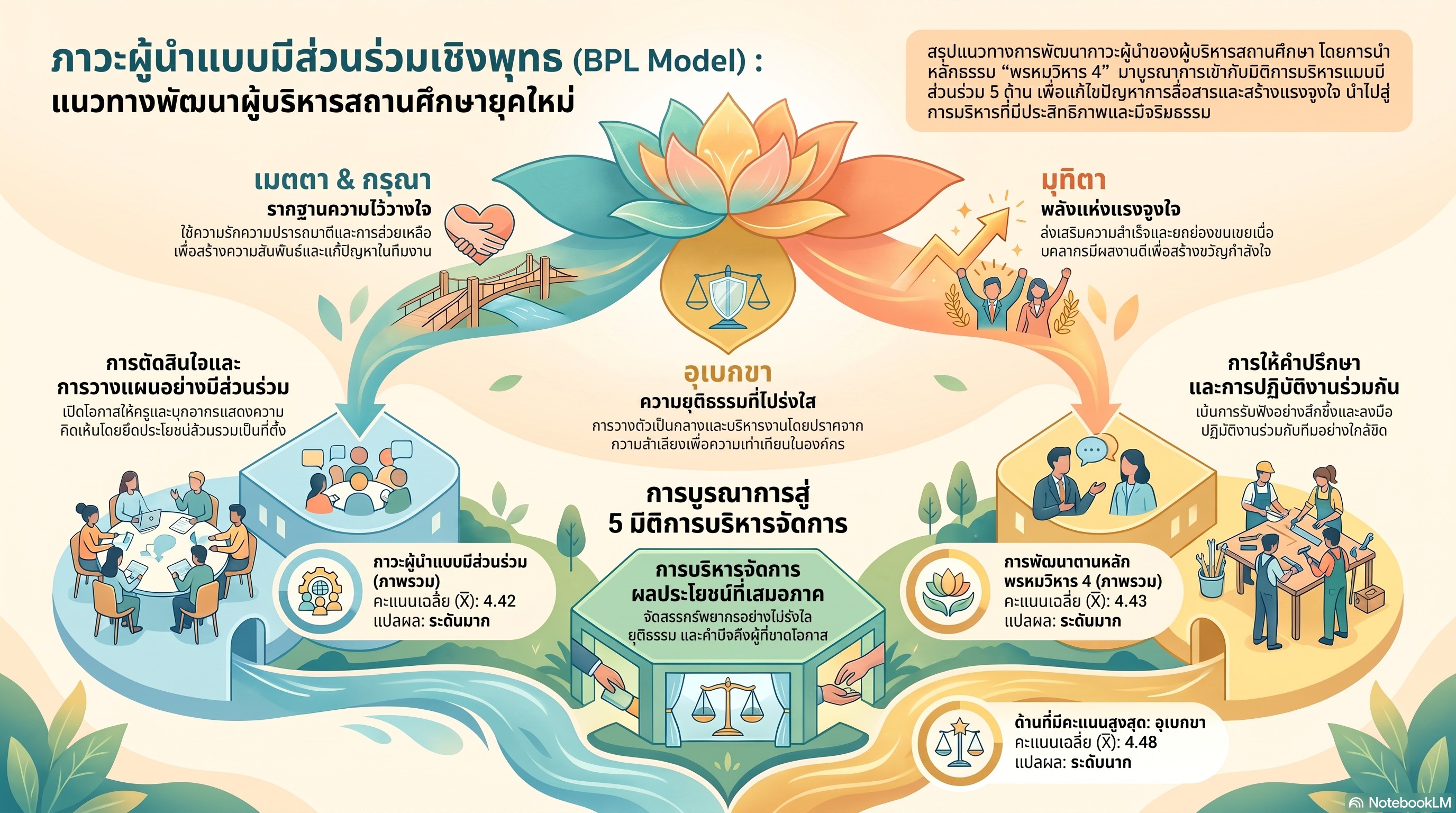
The objectives of this research were: 1) to study the conditions of participatory leadership of school administrators under Loei Primary Educational Service Area Office 2; 2) to study the development of participatory leadership based on Brahmavihāra IV of school administrators under Loei Primary Educational Service Area Office 2; and 3) to propose guidelines for developing participatory leadership based on Brahmavihāra IV of school administrators under Loei Primary Educational Service Area Office 2. This study employed a mixed-methods research design. The target group consisted of 269 educational personnel under Loei Primary Educational Service Area Office 2. The research instrument for quantitative data collection was a five-level rating scale questionnaire. For the qualitative study, the researcher conducted interviews with seven key informants, including educational scholars, school administrators with at least five years of administrative experience, and Buddhist administrative experts. The qualitative research instrument was an interview form. The research results were as follows: 1. The overall level of participatory leadership of school administrators under Loei Primary Educational Service Area Office 2 was at a high level. When considered by aspects, the aspect with the highest mean score was benefits, followed by consultation, decision-making, planning, and operational practice, respectively. 2. The overall level of participatory leadership development based on Brahmavihāra IV of school administrators under Loei Primary Educational Service Area Office 2 was at a high level. When considered by aspects, the aspect with the highest mean score was equanimity (Upekkhā), followed by compassion (Karuṇā), loving-kindness (Mettā), and sympathetic joy (Muditā), respectively. 3. The guidelines for developing participatory leadership based on Brahmavihāra IV of school administrators under Loei Primary Educational Service Area Office 2 indicated that the principles of loving-kindness, compassion, sympathetic joy, and equanimity should be integrated into all dimensions of administration, including decision-making, planning, consultation, operational practice, and benefit management. Emphasis should be placed on personnel participation, fairness, transparency, and positive motivation. The application of Brahmavihāra IV would enable administrators to develop ethical leadership alongside effective management, leading to cooperation, harmony, and organizational strength within educational institutions, as well as contributing to the sustainable improvement of educational quality.
References
กิตติศักดิ์ ละออ. (2566). ภาวะผู้นำแบบมีส่วนร่วมและบรรยากาศการทำงานเชิงบวกในสถาบันการศึกษา. วารสารภาวะผู้นำโรงเรียน, 5(2), 77–92.
จักรกฤษณ์ โพดาพล และคณะ. (2563). สถิติเพื่อการวิจัยและการใช้โปรแกรม SPSS ในการวิจัย. สำรวย ก๊อปปี้บ้านใหม่.
จีระ พุฒหอมโพธิ์. (2566). แนวทางการพัฒนาภาวะผู้นำแบบมีส่วนร่วมในยุคฐานวิถีชีวิตใหม่ตามหลักพรหมวิหาร 4 ของผู้บริหารสถานศึกษา กลุ่มสหวิทยาศึกษาลำพญา สังกัดสำนักงานเขตพื้นที่การศึกษาประถมศึกษาสระบุรี เขต 2 [วิทยานิพนธ์ครุศาสตรมหาบัณฑิต, มหาวิทยาลัยมหาจุฬาลงกรณราชวิทยาลัย].
ธีระวัฒน์ จันทวงษ์. (2566). พรหมวิหาร 4 และการจัดการความขัดแย้งในการบริหารโรงเรียน. วารสารพุทธศาสตร์และสังคมศาสตร์, 12(4), 88–102.
พงศ์ศักดิ์ ชัยเสนา. (2567). การประยุกต์ใช้หลักธรรมทางพระพุทธศาสนาในการพัฒนาภาวะผู้นำเชิงจริยธรรมสำหรับผู้บริหารการศึกษาไทย. วารสารการบริหารและการเป็นผู้นำทางการศึกษาแห่งเอเชีย, 10(1), 112–128.
พชรพล ผลเพียร. (2566). แนวทางการพัฒนาภาวะผู้นำเชิงพุทธในยุคดิจิทัลของสถานศึกษา [วิทยานิพนธ์ครุศาสตรมหาบัณฑิต, มหาวิทยาลัยมหาจุฬาลงกรณราชวิทยาลัย].
พระสรศักดิ์ สมนฺตปาสาทิโก (ทองยวง). (2566). แนวทางการพัฒนาภาวะผู้นำการเปลี่ยนแปลงตามหลักพรหมวิหาร 4 โรงเรียนสังกัดสำนักงานเขตพื้นที่การศึกษาประถมศึกษาสุพรรณบุรี เขต 2 [วิทยานิพนธ์ครุศาสตรมหาบัณฑิต, มหาวิทยาลัยมหาจุฬาลงกรณราชวิทยาลัย].
ภัสรพรรณ แสนหล้า. (2564). การบริหารแบบมีส่วนร่วมในการพัฒนาหมู่บ้านเศรษฐกิจพอเพียง อำเภอเขาสวนกวาง จังหวัดขอนแก่น [วิทยานิพนธ์ครุศาสตรมหาบัณฑิต, มหาวิทยาลัยมหาจุฬาลงกรณราชวิทยาลัย].
วนิดา วาดีเจริญ และคณะ. (2560). ระเบียบวิธีวิจัย: จากแนวคิดทฤษฎีสู่ภาคปฏิบัติ. บริษัท ซีเอ็ดยูเคชั่น จำกัด (มหาชน).
ศิริพร จันทบุรี. (2568). การบูรณาการพรหมวิหาร 4 ในภาวะผู้นำทางการศึกษาเพื่อการกำกับดูแลองค์กรที่เพิ่มขึ้น. วารสารวิจัยทางการศึกษานานาชาติและบทวิจารณ์, 14(1), 1–15.
สำนักงานเขตพื้นที่การศึกษาประถมศึกษาเลย เขต 2. (2567). รายงานการติดตามและประเมินผลการบริหารจัดการศึกษา ปี 2566–2568 [เอกสารอัดสำเนา]. สำนักงานเขตพื้นที่การศึกษาประถมศึกษาเลย เขต 2.
อโนมา หอวิเชียร. (2564). รูปแบบการพัฒนาภาวะผู้นำการเปลี่ยนแปลงเชิงพุทธบูรณาการของผู้บริหารธนาคารออมสิน [ดุษฎีนิพนธ์พุทธศาสตรดุษฎีบัณฑิต, มหาวิทยาลัยมหาจุฬาลงกรณราชวิทยาลัย].
อนันต์ บุญยงค์. (2565). ความเหลื่อมล้ำทางการศึกษาและข้อจำกัดด้านทรัพยากรในภาคตะวันออกเฉียงเหนือของประเทศไทย. วารสารนโยบายและการจัดการการศึกษา, 8(2), 45–60.
Choi, S. (2023). Distributed leadership promotes teacher self-efficacy in multicultural classrooms through school capacity building: A multilevel SEM approach using U.S. Teaching and Learning International Survey. Educational and Psychological Measurement, 83(4), 1–25.
de Jong, A., de Kleijn, R. A. M., Lockhorst, D., Brouwer, J., Noordegraaf, M., & van Tartwijk, J. (2023). Collaborative spirit: Understanding distributed leadership practices in and around teacher teams. Teaching and Teacher Education, 123, Article 103977. https://doi.org/10.1016/j.tate.2022.103977
Galdames-Calderón, M. (2023). Distributed leadership: School principals' practices to promote teachers' professional development for school improvement. Education Sciences, 13(7), 715. https://doi.org/10.3390/educsci13070715
Kim, H. M., & Lee, J. Y. (2022). School principals' compassionate leadership and teacher well-being: A moderated mediation model of trust and organizational climate. Educational Administration Quarterly, 58(1), 76–98.
Krejcie, R. V., & Morgan, D. W. (1970). Determining sample size for research activities. Educational and Psychological Measurement, 30(3), 607–610. https://doi.org/10.1177/001316447003000308
Leithwood, K., Harris, A., & Hopkins, D. (2020). Seven strong claims about successful school leadership revisited. School Leadership & Management, 40(1), 5–22. https://doi.org/10.1080/13632434.2019.1596077
Özdemir, N., Kılınç, A. Ç., Polatcan, M., Turan, S., & Bellibaş, M. Ş. (2023). Exploring teachers' instructional practice profiles: Do distributed leadership and teacher collaboration make a difference? Educational and Psychological Measurement, 83(2), 1–27.
Özdoğru, M., & Sarıer, Y. (2024). The relationship of ethical leadership with teachers' organizational behavior, attitudes, and perceptions: A meta-analysis study. Humanities and Social Sciences Communications, 11, 1538. https://doi.org/10.1057/s41599-024-04082-9
Sharma, R., & Jha, S. (2021). The impact of ethical leadership on employee engagement and organizational commitment: A study in the educational sector. International Journal of Educational Management, 35(1), 101–118.
Downloads
Published
How to Cite
Issue
Section
Categories
License
Copyright (c) 2026 Journal of Buddhist Education and Research (JBER)

This work is licensed under a Creative Commons Attribution-NonCommercial-NoDerivatives 4.0 International License.