The Promotion of Balanced Living Based on the Five Principles of Āyussadhamma: A Case Study of the Elderly in Wat Saensuk Community, Saensuk Subdistrict, Warin Chamrap District, Ubon Ratchathani Province
Keywords:
Āyussadhamma 5, Promotion, Balanced Living, ElderlyAbstract
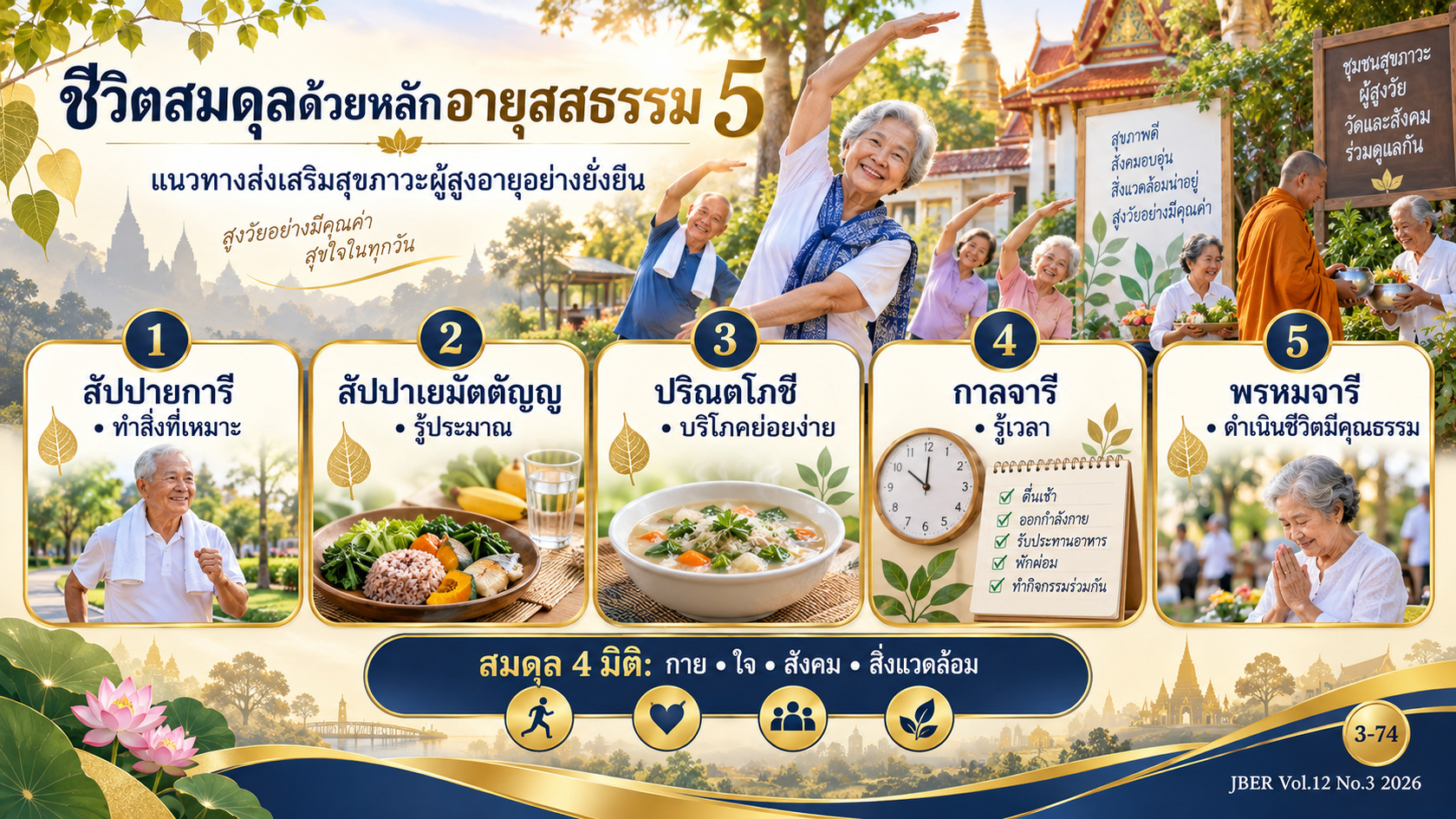
This research, titled “Enhancing Balanced Living through the Five Principles of Āyussadhamma: A Case Study of Elderly People in the Wat Saensuk Community, Saensuk Subdistrict, Warin Chamrap District, Ubon Ratchathani Province,” aimed to: 1) examine concepts and theories related to promoting balanced living among the elderly; 2) study the Five Principles of Āyussadhamma; and 3) analyze guidelines for enhancing balanced living through the application of these principles within the Wat Saensuk community context.
The findings revealed that 1) balanced living is a crucial factor in improving the overall quality of life of older adults, encompassing physical, mental, social, economic, and environmental dimensions. This aligns with the holistic health concept of the World Health Organization, which emphasizes well-being in physical, mental, and social aspects. Achieving balanced living requires life planning, holistic health care, positive social relationships, and adherence to moral principles. 2) The Five Principles of Āyussadhamma—Sappāyakārī (appropriate conduct), Sappāye-mattaññū (moderation in suitable conditions), Pariṇatabhojī (wise consumption), Kālacārī (timely conduct), and Brahmacārī (virtuous living)—serve as guidelines for promoting longevity with quality. These principles foster healthy habits, reduce risky behaviors, and cultivate mindfulness, concentration, and wisdom, leading to physical and mental balance. They can also be effectively integrated with the health promotion policies of the Ministry of Public Health. 3) Analysis of the case study found that the temple serves as a central hub for religious and social activities, supporting healthcare, community participation, and living in accordance with Buddhist philosophy. As a result, older adults are able to develop well-being in four dimensions—physical, mental, social, and environmental—in a balanced, meaningful, and sustainable manner. This approach aligns with the context of Thailand’s aging society, both at present and in the future.
References
กุลยา ตันติผลาชีวะ. (2551). คู่มือการดูแลสุขภาพใจสำหรับผู้สูงอายุ สูงวัยด้วยใจสุข. กรุงเทพมหานคร: เรือนปัญญา (บทความ) ประยุกติ์ใช้หลักอายุสสธรรมในการดำเนินชีวิตของผู้สูงอายุ%20 (13).pdf
ดวงกมล โพธิ์แก้ว. (2561). “การพัฒนาวิถีการดำรงชีวิตของผู้สูงอายุตามหลักพุทธบริหารการศึกษา”, วิทยานิพนธ์ปริญญาพุทธศาสตรมหาบัณฑิต, (บัณฑิตวิทยาลัย : มหาวิทยาลัยมหาจุฬาลงกรณราชวิทยาลัย).
ปิยพัชญ์ กุลเจริญพงศ์. (2567). การเสริมสร้างชีวิตที่ดีตามแนวจูฬกัมมวิภังคสูตร, ดุษฎีนิพนธ์ หลักสูตรปรัชญาดุษฎีบัณฑิต สาขาวิชาวิจัยพุทธศาสตร์และปรัชญา บัณฑิตวิทยาลัยมหาวิทยาลัยมหามกุฏราชวิทยาลัย.
พระครูจันโทภาส (ชาคโร) บุญส่ง สินธุ์นอก, และ สมเดช นามเกตุ. (2564). การประยุกต์ใช้หลักอายุสสธรรมในการดำเนินชีวิตของผู้สูงอายุในเขตอำเภอกุดจับ จังหวัดอุดรธานี. วารสารมหาจุฬานาครทรรศน์, ปีที่ 8(ฉบับที่ 4), 59–74.และคณะ (2564).
พระมหาทวี มหาปญฺโญ (ละลง, 2556) “วิเคราะห์อายุสสธรรม 5 หลักธรรมที่ช่วยให้อายุยืน 5 ประการในคัมภีร์พุทธศาสนาเถรวาท”, บทสังเคราะห์งานวิจัย, (สถาบันวิจัยพุทธศาสตร์:มหาวิทยาลัยมหาจุฬาลงกรณราชวิทยาลัย), หน้า บทคัดย่อ.
พระศุภชาติ สำลีวงษ์ และคณะ (2568) การเสริมสร้างวิถีชีวิตสมดุลของผู้สูงอายุด้วยหลักอายุสสธรรม, บทความวิจัย (Research Article) Received 19 May 2025; Revised 26 June 2025; Accepted 29 June 2025
เพียงพิศ ศรีมูล (2566) ศึกษาหลักพุทธธรรมที่ส่งเสริมการดำเนินชีวิตของผู้สูงอายุ ของศูนย์กิจกรรมและบริการผู้สูงอายุเทศบาลตำบลหนองป่าครั่ง อ.เมือง จ.เชียงใหม่ วิทยานิพนธ์ หลักสูตรปริญญาพุทธศาสตรมหาบัณฑิต สาขาวิชาพระพุทธศาสนา บัณฑิตวิทยาลัย มหาวิทยาลัยมหาจุฬาลงกรณราชวิทยาลัย.
รมย์ธนิกา ฝ่ายหมื่นไวย์ และคณะ (2564) รูปแบบการดูแลผู้สูงอายุ : คำตอบอยู่ที่ระบบสุขภาพชุมชน วารสารการส่งเสริมสุขภาพและอนามัยสิ่งแวดล้อม, 44(3), 11-22.
สุพาพร เทพยสุวรรณ. ดร. (2561). 7 วิธีอยู่ร่วมกับผู้สูงอายุอย่างมีความสุข. ผู้จัดการออนไลน์. จาก https://mgronline.com/qol/detail/9630000071266
สุวิญ รักสัตย์ (2561) พุทธิปัญญากับการปรับสมดุลชีวิต. ธรรมธาราวารสารวิชาการทางพระพุทธศาสนา, 5(1), 39-71.
สำนักงานสถิติแห่งชาติ กระทรวงดิจิทัลเพื่อเศรษฐกิจและสังคม. (2567). การสำรวจประชากรสูงอายุในประเทศไทย พ.ศ. 2567 จาก https://www.nso.go.th/nsoweb/storage/survey_detail/2025/20241209145003_27188.pdf
อาวรณ์ ฟั่นเฝือ (2564) การสร้างเสริมสุขภาวะตามหลักเบญจศีลของผู้สูงอายุ ตำบลขี้เหล็ก อำเภอแม่แตง จังหวัดเชียงใหม่ วิทยานิพนธ์, หลักสูตรศาสนศาสตรมหาบัณฑิต สาขาวิชาพุทธศาสนาและปรัชญา บัณฑิตวิทยาลัย มหาวิทยาลัยมหามกุฏราชวิทยาลัย
Downloads
Published
How to Cite
Issue
Section
License

This work is licensed under a Creative Commons Attribution-NonCommercial-NoDerivatives 4.0 International License.