Guidelines for the Development of Academic Administration in the Digital Era of Educational Institutions Under the Office of Nakhon Ratchasima Primary Educational Service Area 6
Keywords:
Guidelines ; Academic Administration in the Digital Age; Current condition; Desired conditionAbstract
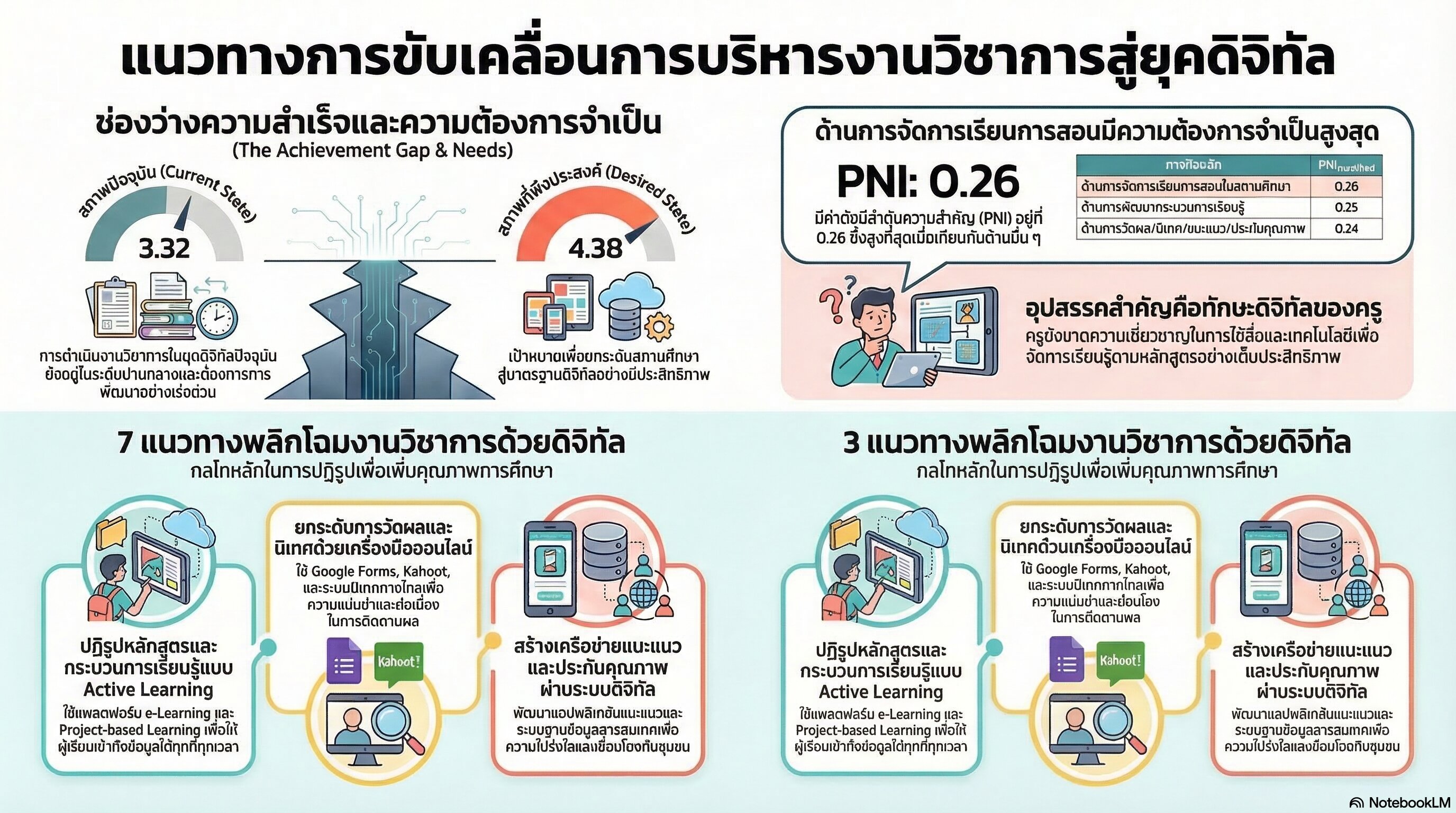
The research aims to study 1) the current situation, the desired situation and the necessary requirements for academic administration in the digital age of educational institutions under the Office of Nakhon Ratchasima Primary Educational Service Area 6. And 2) to study the development guidelines for academic administration in the digital age of educational institutions under the Office of the Primary Educational Service Area, Nakhon Ratchasima Area 6. This research was a mixed-method research. The sample group was 306 educational institution administrators and teachers. The research instruments were a five-point rating scale questionnaire, a dual-response questionnaire, a semi-structured interview questionnaire, and an appropriateness and feasibility assessment. The content validity using IOC value was 0.80-1.00, the item discrimination power was between 0.48-0.89 and the reliability of the whole questionnaire was 0.89. The statistics used in data analysis were percentage, mean, standard deviation, Priority Needs Index (PNImodified), and content analysis. The results of the research were as follows: 1. Current conditions, desired conditions and necessary needs of academic administration in the digital age of educational institutions under the Office of Nakhon Ratchasima Primary Educational Service Area 6 found that: The current condition of academic administration in the digital age of educational institutions under the Nakhon Ratchasima Primary Educational Service Area 6 was at a moderate level, with an average value of (x̄ = 3.32). The desired condition of academic administration in the digital age of educational institutions under the Nakhon Ratchasima Primary Educational Service Area 6 was at a high level, with an average value of (x̄ = 4.32). And the assessment of the overall needs had a need index value (PNImodified = 0.24). When considering each aspect, by ranking the index of necessity from highest to lowest, they were: In terms of teaching management in educational institutions, there was a need index (PNImodified = 0.26). In terms of learning process development, there was a need index (PNImodified = 0.25). In terms of measurement, evaluation and transfer of learning results, in terms of educational supervision, in terms of educational guidance and development of internal quality assurance systems in educational institutions, the need index values were the same (PNImodified = 0.24), and in terms of educational institution curriculum development, the need index values were the same (PNImodified = 0.23), respectively. 2. Guidelines for the development of academic administration in the digital age of educational institutions under the Office of the Nakhon Ratchasima Primary Educational Service Area 6, consisting of 7 areas and 21 guidelines as follows 1) In terms of curriculum development, there were 3 approaches. 2) In terms of learning process development, there were 3 approaches. 3) In terms of assessment and transfer of learning results, there were 3 approaches. 4) In terms of educational supervision, there were 3 approaches. 5) In terms of educational guidance, there were 3 approaches. 6) In terms of developing the quality assurance system within the educational institution, there were 3 approaches. 7) In terms of organizing teaching and learning in the educational institution, there were 3 approaches. And overall, the results of the evaluation of suitability were at a high level, with an average value of (x̄ = 3.49) and the results of the evaluation of feasibility were at a high level, with an average value of (x̄ = 4.42).
References
กลุ่มนิเทศติดตามประเมินผลการจัดการศึกษา, สำนักงานเขตพื้นที่การศึกษานครราชสีมา เขต 6. (2566). รายงานการสังเคราะห์ผลการประเมินตนเองของสถานศึกษา (SAR) ปีการศึกษา 2566. สำนักงานเขตพื้นที่การศึกษานครราชสีมา เขต 6.
ดำริ บุญชู. (2546). การจัดทำแผนพัฒนาคุณภาพการศึกษา. ชวนพิมพ์.
ประภาส จันทร์โคตร. (2567). รูปแบบการวัดการบริหารงานวิชาการตามหลักธรรมาภิบาลของสถานศึกษาในยุคดิจิทัล. วิทยาลัยนวัตกรรมการจัดการ มหาวิทยาลัยเทคโนโลยีราชมงคลรัตนโกสินทร์.
พระอนันต์ ธมฺมวิริโย (นามทอง), และคณะ. (2564). การบริหารงานวิชาการในยุคดิจิทัลของผู้บริหารสถานศึกษา สังกัดสำนักงานเขตพื้นที่การศึกษาประถมศึกษาขอนแก่น เขต 1 [วิทยานิพนธ์ครุศาสตรมหาบัณฑิต, มหาวิทยาลัยมหาจุฬาลงกรณราชวิทยาลัย].
วารุณี ภาวงค์, และคณะ. (2565). การพัฒนาแนวทางการบริหารงานวิชาการของผู้บริหารสถานศึกษาในยุคดิจิทัล สังกัดสำนักงานเขตพื้นที่การศึกษาประถมศึกษาสกลนคร เขต 2 [วิทยานิพนธ์การศึกษามหาบัณฑิต, มหาวิทยาลัยมหาสารคาม].
วีระพล สันโดษ. (2566). ภาวะผู้นำเชิงดิจิทัลของผู้บริหารสถานศึกษา สังกัดสำนักงานเขตพื้นที่การศึกษาประถมศึกษานครราชสีมา เขต 6 [วิทยานิพนธ์ศึกษาศาสตรมหาบัณฑิต, มหาวิทยาลัยมหามกุฏราชวิทยาลัย วิทยาเขตอีสาน].
สนั่น มีสัตย์ธรรม. (2540). ทางสายใหม่ของการปฏิบัติราชการ (พิมพ์ครั้งที่ 2). ประสานการพิมพ์.
สำนักงานคณะกรรมการการศึกษาแห่งชาติ. (2545). การดำเนินงานตามยุทธศาสตร์ปฏิรูปการศึกษา. โรงพิมพ์องค์การรับส่งสินค้าและพัสดุภัณฑ์.
ศิริพงษ์ กลั่นไพฑูรย์. (2564). รูปแบบการพัฒนาภาวะผู้นำทางวิชาการในยุคดิจิทัลของผู้บริหารสถานศึกษาขั้นพื้นฐาน [วิทยานิพนธ์การศึกษาดุษฎีบัณฑิต, มหาวิทยาลัยนเรศวร].
Bennis, W. G. (2013). Leadership in a digital world: Embracing transparency and adaptive capacity. MIS Quarterly, 31(2), 635–636.
Brophy, G. M. (2016). A study of the process used by academic affairs administrators at participating institutions of higher education to select instructional technology tools for faculty use in instruction in undergraduate classes [Doctoral dissertation]. Dissertation Abstracts International, 67(8), 183–A.
Downloads
Published
How to Cite
Issue
Section
Categories
License
Copyright (c) 2026 Journal of Buddhist Education and Research (JBER)

This work is licensed under a Creative Commons Attribution-NonCommercial-NoDerivatives 4.0 International License.