Academic Administration According to the Four Iddhipāda Principles of Educational Institution Administrators in Ban Fang District, Khon Kaen Province
Keywords:
Academic Administration, Four Iddhipāda Principles, Educational Institution AdministratorsAbstract
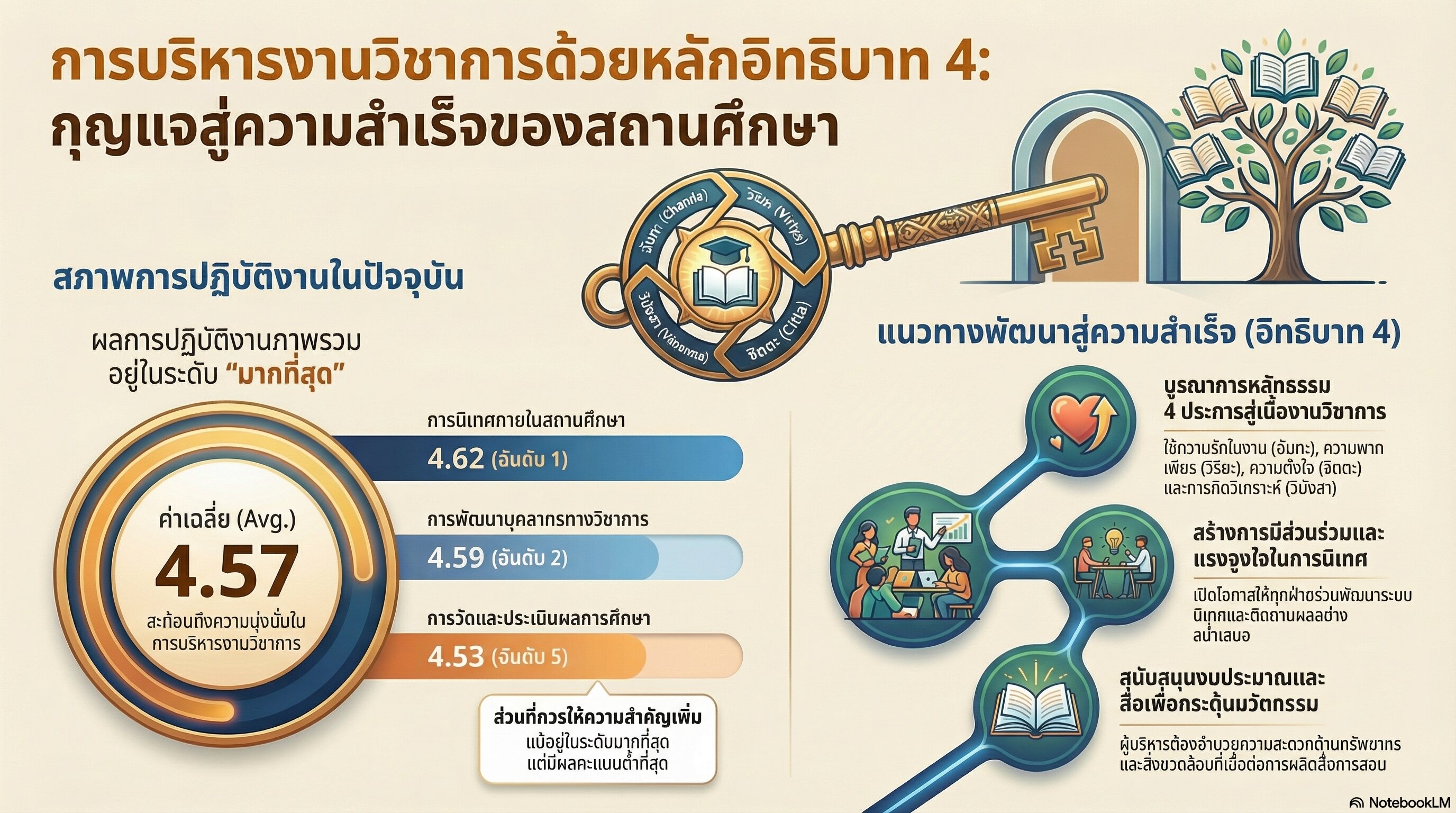
This research aimed (1) to study the conditions of academic administration based on the Four Iddhipāda Principles of educational institution administrators in Ban Fang District, Khon Kaen Province, and (2) to explore guidelines for academic administration according to the Four Iddhipāda Principles of educational institution administrators in Ban Fang District, Khon Kaen Province. This study employed a mixed-methods research design, combining quantitative and qualitative approaches. For the quantitative phase, a questionnaire was used as the main research instrument with a reliability coefficient of 0.99. The sample group consisted of 68 participants, including school administrators and teachers. Statistical tools used in data analysis included frequency, percentage, mean, and standard deviation. For the qualitative phase, interviews were conducted with six key informants, who were experts in educational administration, selected through purposive sampling. The findings of the research were as follows: 1. The overall level of academic administration based on the Four Iddhipāda Principles of educational institution administrators in Ban Fang District, Khon Kaen Province, was found to be at the highest level. By aspect, the highest level of implementation was found in internal supervision, followed by academic personnel development and curriculum administration. The lowest level of implementation was in educational measurement and evaluation. 2.The guidelines for developing academic administration based on the Four Iddhipāda Principles of educational institution administrators in Ban Fang District, Khon Kaen Province, indicate that school administrators should cultivate satisfaction and genuine determination in providing opportunities for all stakeholders to participate in developing systems of supervision, monitoring, and evaluation of teaching and learning regularly and effectively. They should motivate and collaborate with teachers to maintain internal supervision records diligently and attentively, ensure the continuity of operations, and facilitate resources such as budgets, materials, and suitable learning environments for producing educational media and innovations. Furthermore, administrators should possess a deep understanding of the curriculum and the ability to analyze, identify strengths and weaknesses, and improve it thoughtfully and effectively.
References
กระทรวงศึกษาธิการ. (2553). แนวทางการจัดการเรียนรู้ตามหลักสูตรแกนกลางการศึกษาขั้นพื้นฐาน พุทธศักราช 2551. โรงพิมพ์สหกรณ์การเกษตรแห่งประเทศไทย.
บุญชม ศรีสะอาด. (2544). การวิจัยเบื้องต้น (พิมพ์ครั้งที่ 6). สุวีริยาสาส์น.
ประยูร อาษานาม. (2551). คู่มือวิจัยทางการศึกษา (พิมพ์ครั้งที่ 2). มหาวิทยาลัยขอนแก่น.
พระมหาสุเนตร อภิปุญฺโญ. (2555). การบริหารงานวิชาการตามหลักอิทธิบาท 4 โรงเรียนประถมศึกษา อำเภอพระสมุทรเจดีย์ จังหวัดสมุทรปราการ (วิทยานิพนธ์พุทธศาสตรมหาบัณฑิต, มหาวิทยาลัยมหาจุฬาลงกรณราชวิทยาลัย).
วิจารณ์ พาณิช. (2556). ครูเพื่อศิษย์สร้างห้องเรียนกลับทาง. เอส.อาร์.พริ้นติ้ง แมสโปรดักส์.
สมนึก ภัททิยธนี. (2551). การวัดผลการศึกษา (พิมพ์ครั้งที่ 4). ประสานการพิมพ์.
สำนักงานเขตพื้นที่การศึกษาประถมศึกษาขอนแก่น เขต 1. (2565). รายงานผลการดำเนินงานตามแผนปฏิบัติการประจำปีงบประมาณ พ.ศ. 2565.
สำนักงานเขตพื้นที่การศึกษาประถมศึกษาขอนแก่น เขต 1. (2566). แผนปฏิบัติการประจำปีงบประมาณ 2566.
สำนักงานคณะกรรมการการศึกษาแห่งชาติ. (2553). พระราชบัญญัติการศึกษาแห่งชาติ พ.ศ. 2542 และที่แก้ไขเพิ่มเติม (ฉบับที่ 4) พ.ศ. 2562.
สำนักงานเลขาธิการสภาการศึกษา. (2560). แผนการศึกษาแห่งชาติ พ.ศ. 2560–2579. พริกหวานกราฟฟิค.
Downloads
Published
How to Cite
Issue
Section
License
Copyright (c) 2026 Authors

This work is licensed under a Creative Commons Attribution-NonCommercial-NoDerivatives 4.0 International License.