The Guideline for Ethical Leadership of School Administrators under Khon Kaen Primary Educational Service Area Office 3
Keywords:
guidelines for development; ethical leadershipAbstract
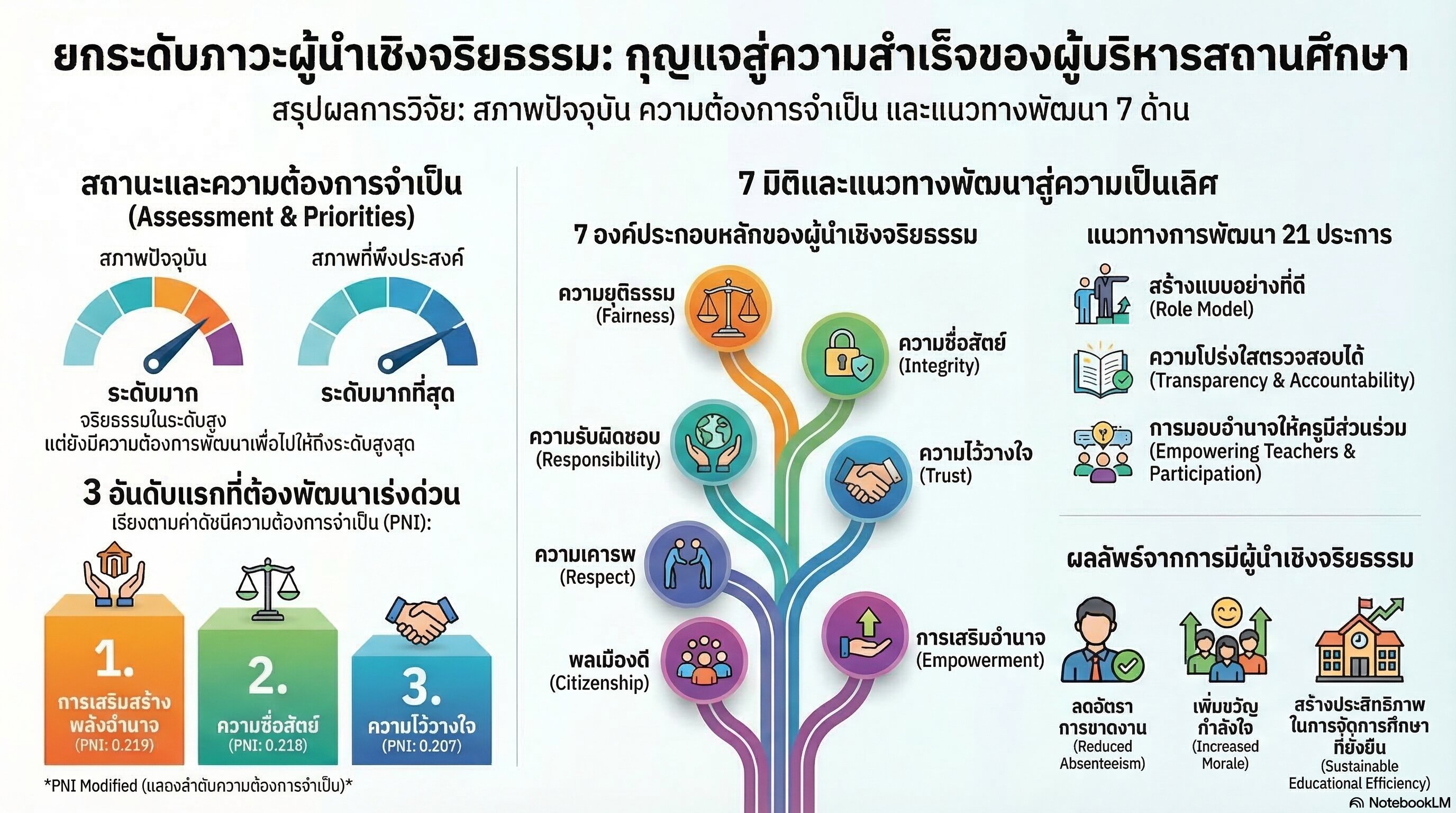
The purposes of this research were: 1) the current and desirable conditions and needs of the ethical leadership of School Administrators under Khon Kaen Primary Educational Service Area Office 3 2) the guideline for ethical leadership of School Administrators under Khon Kaen Primary Educational Service Area Office 3.The sample size was determined using the Krejcie and Morgan table consisted of 298 administrators and teachers and stratified random sampling he key research informants 9 experts purposively selected persons comprised educational supervisors, school administrators, and teachers. The employed research instruments were a questionnaire concerning the current and desirable conditions of being ethical leadership, were 5-level estimation scale and reliability coefficients of .87 and .89 respectively and an interview form on guidelines for development of being professional learning community. The statistics for data analysis included percentage, mean, standard deviation, PNI modified and content analysis. The research findings were as following: 1) The current of ethical leadership of School Administrators under Khon Kaen Primary Educational Service Area Office 3 at a high level when considering each aspect, it was found that justice was second, followed by responsibility and citizenship, and the aspect with the lowest average score was trust. The desirable conditions of ethical leadership of School Administrators under Khon Kaen Primary Educational Service Area Office 3 at a highest level when considering each aspect, it was found that the aspect with the highest average value was justice, followed by honest and empowerment, and the aspect with the lowest average value was trust. The needs of the ethical leadership of School Administrators under Khon Kaen Primary Educational Service Area Office 3 the need index was obtained. (PNImodified= 0.184) when considering each aspect, rank from most to least important, the top three areas were empowerment, honest and trust. 2) The guideline for ethical leadership of School Administrators under Khon Kaen Primary Educational Service Area Office 3. The researcher has presented guidelines for developing ethical leadership of School Administrators, in 7 areas, totaling 21 guidelines. The appropriate and the possibility are at the highest level.
References
กระทรวงยุติธรรม. (2566). คู่มือค่านิยมและวัฒนธรรมองค์กร กระทรวงยุติธรรม.
คำพร กองเตย. (2560). การพัฒนาตัวบ่งชี้ภาวะผู้นำเชิงจริยธรรมของผู้บริหารสถานศึกษาโรงเรียนสังกัดกรุงเทพมหานคร [ดุษฎีนิพนธ์ปริญญาปรัชญาดุษฎีบัณฑิต, มหาวิทยาลัยบูรพา].
ชุติมา รักษ์บางแหลม. (2559). การวิเคราะห์องค์ประกอบภาวะผู้นำเชิงจริยธรรมและประเด็นปัญหาจริยธรรมในการบริหารสถานศึกษาของผู้บริหารวิทยาลัยพยาบาล สังกัดสถาบันพระบรมราชชนก กระทรวงสาธารณสุข [วิทยานิพนธ์ปรัชญาดุษฎีบัณฑิต, มหาวิทยาลัยสงขลานครินทร์].
ดวงพร อัตโน, & โกวัฒน์ เทศบุตร. (2565). การพัฒนาแนวทางเสริมสร้างภาวะผู้นำเชิงจริยธรรมของผู้บริหารสถานศึกษา สังกัดสำนักงานเขตพื้นที่การศึกษาประถมศึกษาร้อยเอ็ด เขต 1. วารสารการบริหารและนิเทศการศึกษา, 13(1), 32–41.
ดาวรุวรรณ ถวิลการ. (2561). ภาวะผู้นำเชิงจริยธรรมของผู้บริหารกับการเสริมสร้างภาพลักษณ์ของสถานศึกษา. วารสารศึกษาศาสตร์ มหาวิทยาลัยขอนแก่น, 11, 56.
ณัฐริดา นิพนธ์. (2562). ความสัมพันธ์ระหว่างภาวะผู้นำเชิงจริยธรรมกับบทบาทของผู้บริหารสถานศึกษาในการพัฒนาคุณลักษณะอันพึงประสงค์ของผู้เรียนในสถานศึกษา สังกัดสำนักงานเขตพื้นที่การศึกษาประถมศึกษานครสวรรค์ เขต 1 [วิทยานิพนธ์ปริญญาศึกษาศาสตรมหาบัณฑิต, มหาวิทยาลัยสุโขทัยธรรมาธิราช].
บุญชม ศรีสะอาด. (2560). การวิจัยเบื้องต้น (พิมพ์ครั้งที่ 9). สุวีริยาสาส์น.
บรรจพร แย้มละมูล. (2563). ปัจจัยเชิงสาเหตุที่ส่งผลต่อการบริหารเชิงจริยธรรมของผู้บริหารสถานศึกษามัธยมศึกษาภาคตะวันออก สังกัดสำนักงานคณะกรรมการการศึกษาขั้นพื้นฐาน [วิทยานิพนธ์ปริญญาปรัชญาดุษฎีบัณฑิต, มหาวิทยาลัยบูรพา].
พิชญาภา ยืนยาว. (2562). การวิเคราะห์องค์ประกอบคุณลักษณะของภาวะผู้นำเชิงจริยธรรม. Veridian E-Journal, Silpakorn University, 12(4), 12–23.
ภิรมณ์ญา มูลเมือง. (2567). ภาวะผู้นำเชิงจริยธรรมของผู้บริหารสถานศึกษา สังกัดสำนักงานเขตพื้นที่การศึกษาประถมศึกษานครพนม เขต 1. วารสารครุศาสตร์ มหาวิทยาลัยนครพนม, 5(1), 12–23.
รัชนีวรรณ สุวรรณชัยรบ. (2566). ความต้องการจำเป็นและแนวทางการพัฒนาภาวะผู้นำเชิงจริยธรรมของผู้บริหารสถานศึกษา สังกัดสำนักงานส่งเสริมการศึกษานอกระบบและการศึกษาตามอัธยาศัยจังหวัดสกลนคร [วิทยานิพนธ์ครุศาสตรมหาบัณฑิต, มหาวิทยาลัยราชภัฏสกลนคร].
รัตติกรณ์ จงวิศาล. (2567). ภาวะผู้นำ: ทฤษฎี การวิจัย และแนวทางสู่การพัฒนา (พิมพ์ครั้งที่ 3). สำนักพิมพ์แห่งจุฬาลงกรณ์มหาวิทยาลัย.
วาโร เพ็งสวัสดิ์. (2551). วิธีวิทยาการวิจัย. สุวีริยาสาส์น.
วิภาวดี อินทร์ด้วง. (2561). ภาวะผู้นำเชิงจริยธรรมของผู้บริหารสถานศึกษาตามการรับรู้ของครู สังกัดสำนักงานเขตพื้นที่การศึกษาประถมศึกษาสุราษฎร์ธานี เขต 2 [วิทยานิพนธ์ครุศาสตรมหาบัณฑิต, มหาวิทยาลัยราชภัฏสุราษฎร์ธานี].
สำนักงานเขตพื้นที่การศึกษาประถมศึกษาขอนแก่น เขต 3. (2568). ข้อมูลสารสนเทศทางการศึกษา.
สำนักงานสภาพัฒนาการเศรษฐกิจและสังคมแห่งชาติ. (2562). สรุปสาระสำคัญของพระราชบัญญัติมาตรฐานทางจริยธรรม พ.ศ. 2562.
สุรัตน์ ไชยชมภู. (2557). ภาวะผู้นำเชิงจริยธรรมในการบริหารสถานศึกษา. วารสารการบริหารการศึกษา มหาวิทยาลัยบูรพา, 2(4).
อาอีชะห์ สงเดช. (2565). ภาวะผู้นำเชิงจริยธรรมของผู้บริหารสถานศึกษาโรงเรียนเอกชนสอนศาสนาอิสลาม จังหวัดพัทลุง.
เอกชัย ลวดคำ, & วีรภัทร ภัทรกุล. (2566). แนวทางการพัฒนาภาวะผู้นำเชิงจริยธรรมของผู้บริหารสถานศึกษา เขตพื้นที่การศึกษามัธยมศึกษาสุพรรณบุรี. วารสารปรัชญาปริทรรศน์, 28(1), 13–24.
เอกภักดิ์ ฉ่ำมณี. (2564). องค์ประกอบของภาวะผู้นำเชิงจริยธรรมของผู้บริหารสถานศึกษา สังกัดสำนักงานเขตพื้นที่การศึกษามัธยมศึกษา เขต 21.
Brown, M. E., & Treviño, L. K. (2005). Role modeling and ethical leadership. Paper presented at the Academy of Management Annual Meeting, Atlanta, GA, United States.
Hoskins, B. L., & Mascherini, M. (2009). Measuring active citizenship through the development of a composite indicator. Social Indicators Research, 90(3), 459–488.
Josephson, M. (2009). Ethical leadership outcomes student leader learning outcomes (SLLO) project.
Krejcie, R. V., & Morgan, D. W. (1970). Determining sample size for research activities. Educational and Psychological Measurement, 30(3), 607–610.
Yukl, G. (2010). Leadership in organizations. Pearson.
Downloads
Published
How to Cite
Issue
Section
Categories
License
Copyright (c) 2026 Journal of Buddhist Education and Research (JBER)

This work is licensed under a Creative Commons Attribution-NonCommercial-NoDerivatives 4.0 International License.