Academic Administration Based on the Seven Sappurisa Dhamma Principles of School Administrators under the Office of Secondary Educational Service Area, Khon Kaen
Keywords:
Academic Administration, Sappurisa Dhamma 7, School AdministratorsAbstract
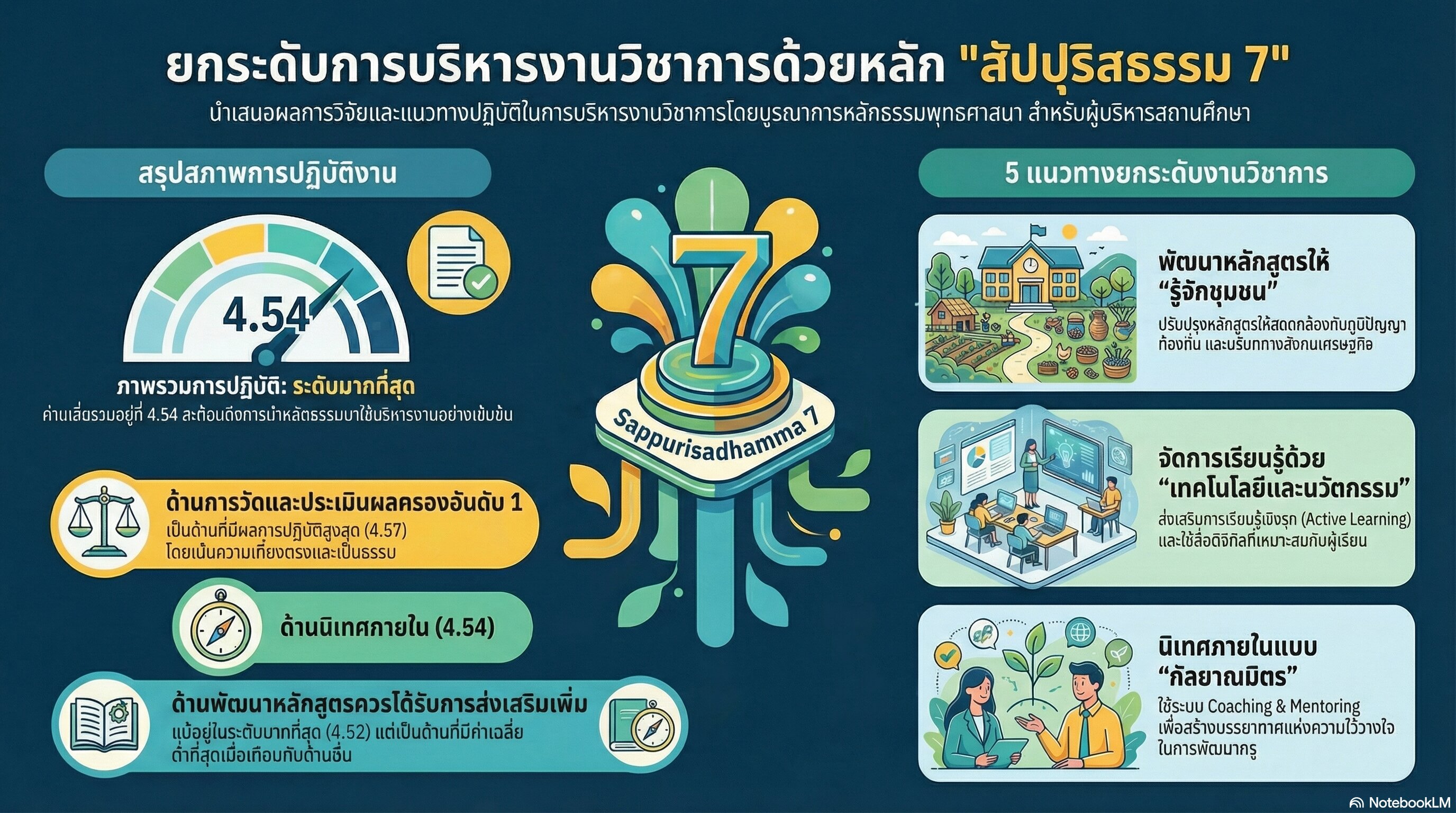
This mixed-methods research aimed primarily to investigate the current conditions of academic administration and to propose guidelines for academic administration based on the Seven Sappurisa-Dhamma principles of school administrators under the Secondary Educational Service Area Office, Khon Kaen. The quantitative sample consisted of 346 participants, including school administrators, deputy administrators, and teachers. The statistical methods used for data analysis included frequency, percentage, mean (x̄), and standard deviation (S.D.). For the qualitative component, in-depth interviews were conducted with nine experts selected through purposive sampling. The results of the study revealed that the overall and individual aspects of academic administration based on the Seven Sappurisa-Dhamma principles among school administrators under the Secondary Educational Service Area Office, Khon Kaen, were practiced at the highest level. When considering each aspect, the highest level of practice was found in measurement and evaluation based on the Seven Sappurisa-Dhamma principles, followed by internal supervision within the school, instructional media and innovation, and learning processes, respectively. The aspect with the lowest level of practice was curriculum development based on the Seven Sappurisa-Dhamma principles. The guidelines for promoting academic administration based on the Seven Sappurisa-Dhamma principles are as follows: (1) in curriculum development, school administrators should revise the curriculum to align with local society and culture; (2) in learning processes, administrators should promote technology- and innovation-based learning suitable to learners’ contexts; (3) in measurement and evaluation, administrators should encourage the use of assessment criteria aligned with learning objectives; (4) in instructional media and innovation, administrators should require teachers to analyze the strengths and weaknesses of instructional innovations; and (5) in internal supervision, administrators should support supervision practices that correspond to the potential of each individual.
References
กระทรวงศึกษาธิการ. (2546). พระราชบัญญัติการศึกษาแห่งชาติ พ.ศ. 2542 และที่แก้ไขเพิ่มเติม (ฉบับที่ 2) พ.ศ. 2545.
จุฑารัตน์ ทศไกร, วรกฤต เถื่อนช้าง, และ ปฏิธรรม สำเนียง. (2565). แนวทางการบริหารงานวิชาการตามหลักสัปปุริสธรรม 7 ของผู้บริหารโรงเรียนขนาดเล็ก สังกัดสำนักงานเขตพื้นที่การศึกษาประถมศึกษาพิจิตร เขต 1. วารสารวิจัยวิชาการ, 5(3), 163–178.
พระครูวินิตธรรมาทร (สมพร นิ่มนวล), วรกฤต เถื่อนช้าง, และ พระเทพวชิรเมธี (วีระวร ปญฺโญ). (2568). รูปแบบการบริหารงานวิชาการของโรงเรียนพระปริยัติธรรมแผนกสามัญศึกษาเขต 4 ตามหลักอิทธิบาท 4. วารสารวิจัยวิชาการ, 8(2), 29–44.
รัชนีกร ศรีประสาร. (2565). การพัฒนาแนวทางการบริหารงานวิชาการในยุคการศึกษา 4.0 ของสถานศึกษาสังกัดสำนักงานเขตพื้นที่การศึกษาประถมศึกษาร้อยเอ็ด เขต 2 (วิทยานิพนธ์การศึกษามหาบัณฑิต, มหาวิทยาลัยมหาสารคาม).
วรภาส ประสมสุข, และ นิพนธ์ กินาวงศ์. (2549–2550). หลักการบริหารการศึกษาตามแนวพุทธธรรม. วารสารศึกษาศาสตร์, 18(2), 76–81.
สุนทร สายคำ, และคณะ. (2560). ภาวะผู้นำของผู้บริหารในมุมมองของผู้ใต้บังคับบัญชา. วารสารสถาบันวิจัยพิมลธรรม, 4(2), 24–30.
อัจศรา ประเสริฐสิน. (2560). การศึกษาแนวทางการจัดการนวัตกรรมทางการศึกษาไปใช้ในการพัฒนาการเรียนการสอนและการทำวิจัยของครู. วารสารบรรณศาสตร์ มศว, 10(2), 84–86.
Downloads
Published
How to Cite
Issue
Section
License
Copyright (c) 2026 Authors

This work is licensed under a Creative Commons Attribution-NonCommercial-NoDerivatives 4.0 International License.